Get Full Government Meeting Transcripts, Videos, & Alerts Forever!
Get email alerts on the School Safety topic
No spam. Unsubscribe anytime.
Consultant outlines Texas options for armed security in schools; marshals, guardians and SROs compared
Summary
A school-safety consultant told the Victoria ISD board that Texas law effectively limits districts to SROs or school-based law enforcement, while school marshals (statutorily defined) and locally designed 'guardian' programs present different training, arrest-authority and liability tradeoffs. The presentation was informational; trustees asked questions but took no formal vote.
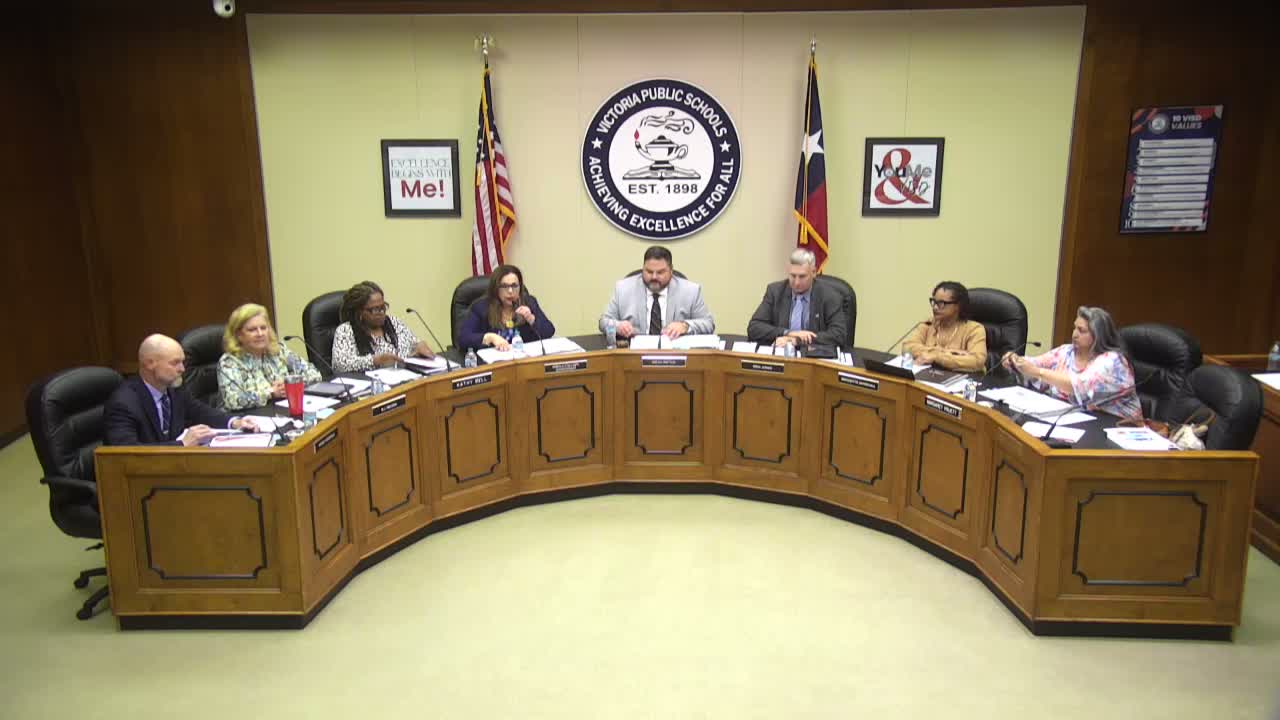
A school-safety consultant briefed the Victoria Independent School District board on the ways a Texas district can meet the statutory requirement for armed security on campuses, emphasizing legal differences, training expectations and operational tradeoffs.
"It is required ... that we have, armed at least 1 armed security officer on every campus of public schools in the state of Texas," said Jeb Lacey, the district's school safety consultant, summarizing the statutory baseline for campus security. He told trustees the two straightforward compliance paths are school resource officer (SRO) contracts with law enforcement and creation of a district police force (SBLE). He also described statutory school-marshals programs, which require 80 hours of TCOLE training, and locally administered "guardian" programs, which are not codified in state statute.
Lacey told the board that school marshals are defined in statute, subject to state training and equipment rules and — because they are commissioned — may carry arrest authority on campus. By contrast, he said, guardian programs are fashioned by districts, are not specifically regulated by statute and generally do not confer arrest powers. "Guardian programs exist in the intersection of state and federal law, where there's a gap in law," Lacey said, describing guardians as "individuals who the district has authorized to possess firearms on school campuses."
He outlined other practical distinctions: marshals require rigorous state training and can have arrest authority; guardians often include psychological evaluations in practice but are not subject to the same statutory standards; and both approaches carry distinct liability and campus-coverage challenges. Lacey also noted that if a district uses a guardian to satisfy a good-cause exception to statutory requirements, the guardian must meet specified training and renewal rules and the exception must be renewed annually.
Trustees asked questions about parental notification, portability of coverage across campuses and how districts document compliance. Lacey emphasized that districts may combine models — for example, SROs on some campuses and guardians or marshals on others — and that cost, coverage flexibility and legal risk vary by approach.
The presentation was informational; trustees did not take formal action on school-security policy at the meeting. The discussion will inform any future board decisions about whether to pursue SRO contracts, an SBLE, school marshals or a locally designed guardian program.
The presentation drew on state rules and agency trainings referenced in Lacey's talk; administration said it would collect trustees' questions for a future briefing or decision.