
Maine Senate enacts several emergency measures, records multiple committee votes
Get AI-powered insights, summaries, and transcripts
Sign Up Free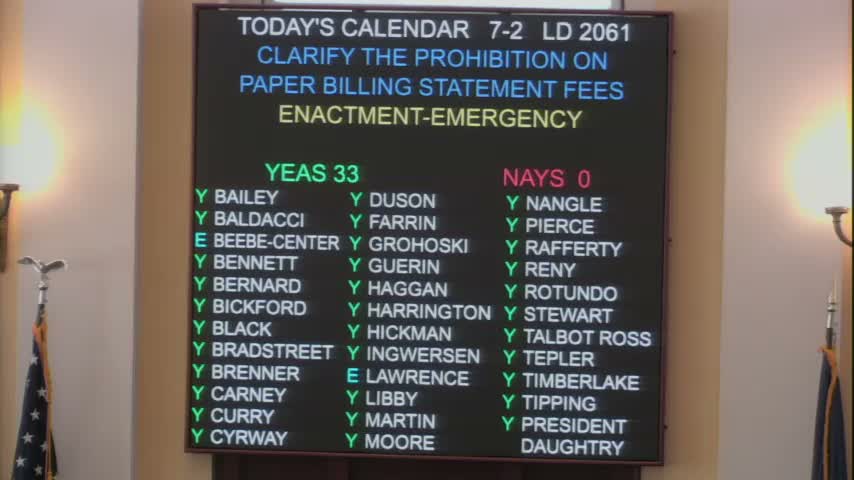
Summary
The Maine Senate passed several emergency measures reported by the Committee on Engrossed Bills, recorded multiple roll‑call votes on committee reports, and sent enacted emergency measures to the governor for approval.
The Maine Senate on the floor moved and approved a series of committee reports and emergency measures, recording a string of roll‑call votes and forwarding enacted emergency bills to the governor.
The chamber accepted multiple committee reports and adopted committee amendments on numerous bills; several senators requested roll‑call votes on 'majority ought to pass' reports. Recorded tallies in the session included 22–11, 25–8, 27–6 and 20–13 on separate committee questions before the body.
The Committee on Engrossed Bills presented several emergency measures described in the record as 'truly and strictly engrossed.' An emergency measure to provide required funding for reimbursement of assigned counsel passed on an enactment vote with 33 senators voting in favor and no opposition; the chair announced that 33 is more than two‑thirds of the Senate and that the bill would be signed by the president and presented to the governor for approval.
The Senate likewise passed other emergency enactments recorded in the transcript—motions referenced as exempting residential electricity from sales taxes and creating a narrow tobacco‑sales exception for certain small grocery stores—each reported with affirmative recorded tallies of 33–0 and ordered sent to the governor.
The session included motions to place several bills and resolves on the special appropriations table and actions to set aside particular items for later consideration. Where no senator objected to matters being sent forthwith, the chair ordered them transmitted for concurrence.
The Senate concluded its calendar activity by directing several measures to committee referral and reporting results of the day's roll‑call votes in accordance with chamber practice.