Get Full Government Meeting Transcripts, Videos, & Alerts Forever!
Get email alerts on the Staffing Specialists topic
No spam. Unsubscribe anytime.
Alief ISD proposes cutting two elementary specialists per campus, creating higher‑paid 'model classroom' roles
Summary
District leaders proposed reducing elementary specialists by two per campus, reimagining those roles as 'model classroom teachers' with added stipends and tiered pay to retain instructional leaders; trustees asked for campus‑level impact analyses and a transition plan.
Alief ISD administrators proposed a staffing redesign on Dec. 16 that would reduce the number of elementary specialists by two per campus while converting the role into a new "model classroom" teacher position at certain schools.
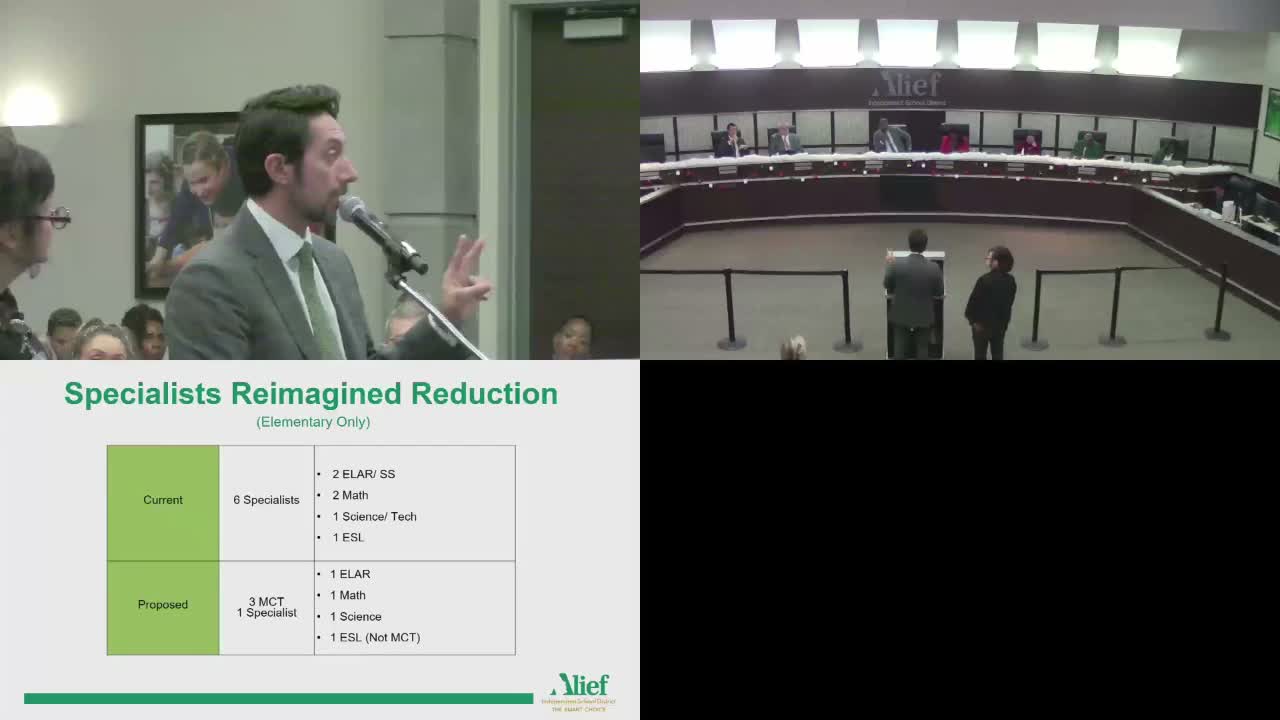
Deputy Superintendent Charlie Garcia told the board the district currently staffs six specialists per elementary campus and is proposing to curtail one ELAR and one math specialist while keeping science and ESL positions. "We are proposing to reduce the specialist only at the elementary level by 2 per campus," Garcia said, and described a reimagined role that combines high‑level classroom instruction with coaching responsibilities.
The reimagined positions would receive local stipends during implementation. Elizabeth Bellows Powell, deputy superintendent for human resources and professional learning, outlined a draft compensation path: in year one, all reimagined specialists would receive a $5,000 stipend during a data‑capture year; in year two those on designated tiered campuses could receive additional local stipends of $8,000–$10,000, producing total compensation that could approach or exceed $90,000 for some positions depending on Teacher Incentive Allotment (TIA) recognition.
Administrators said the changes are intended to retain instructional experts and create an internal career pathway from teacher to assistant principal and principal, while also generating estimated cost savings for the district. The team estimated a net recurring cost savings of about $3.5 million after accounting for the local stipends and other implementation costs.
Trustees pressed for safeguards. Trustee Moreno and others asked for campus‑by‑campus analysis to avoid blanket reductions that could disproportionately affect struggling schools. Board members also sought a clear transition plan so campuses are not left without essential day‑to‑day supports. Garcia and Powell said the proposal was developed with stakeholder input and that the district has piloted the model in some places; they promised a more detailed presentation in January that will include selection criteria, transition plans and appraisal methods.
Administrators also said many current specialist positions are funded by federal Title funds and that shifting or reclassifying those positions will require compliance checks: some specialists currently funded by Title I would move back to the general fund if their roles change. Powell said the district will provide the board a detailed implementation schedule and the staffing implications for each campus before any final decisions are made.