Get Full Government Meeting Transcripts, Videos, & Alerts Forever!
Get email alerts on the Board Governance topic
No spam. Unsubscribe anytime.
Round Rock ISD trustees review grievance rules, communications limits and Open Meetings Act in team-of-8 training
Summary
At a team-of-8 training session, trustees heard a walkthrough of grievance procedures (board policies F/G), limits on individual trustee actions, Chapter 21 contract rules, social-media/email guidance, and Texas Open Meetings Act requirements including walking quorums and closed-session limits.
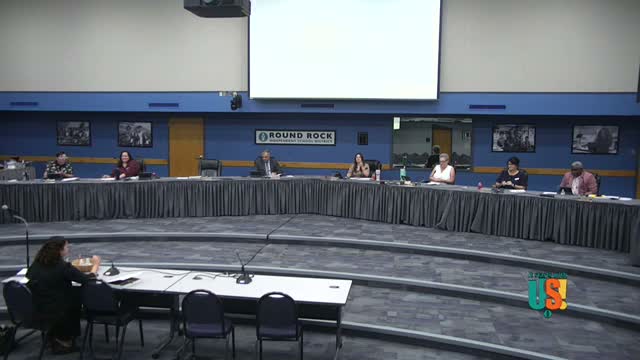
Michelle Alcala, the session’s trainer, opened the Round Rock Independent School District team-of-8 training by asking trustees to consider a scenario in which a parent filed an F and G grievance alleging race-based bullying while also speaking with a trustee. "My name is Michelle Alcala and I'm delighted to be with you tonight to conduct the team of 8 training," she told the board before reviewing the district’s operating procedures and the Texas Education Code.
Alcala used the bullying scenario to illustrate several governance rules trustees should follow: route constituent complaints through the superintendent rather than contact campus staff directly; avoid statements to the media that could be construed as speaking for the district; and recognize that hearing facts outside the official grievance process can require recusal if a matter later reaches the board. She noted that F and G refers to parent/student grievance policy and that the district’s employee grievance policy is DGBA.
Trustees pressed on practical distinctions. One trustee said contacting a campus principal could compromise neutrality, and others asked whether a trustee must reply to a parent who approaches them. Trustees agreed that a neutral acknowledgment — for example, confirming a complaint was forwarded to the superintendent — is appropriate, while substantive responses should come from administration. Alcala emphasized that trustees may request information that already exists but cannot unilaterally require the administration to create new reports; generating new information for the board generally must be authorized at a posted meeting or via board consensus or motion.
The trainer reviewed employment authority and Chapter 21 protections: the superintendent makes hiring and renewal recommendations, and the board may accept or reject those recommendations. Chapter 21 employees (a set of staff defined by statute) have contract protections and renewals unless nonrenewed according to statutory procedure; other employees may be at-will or have district contracts.
On communications and public engagement, Alcala and trustees discussed email, social media, and the district’s "Let's Talk" intake system. The operating procedures advise that trustees avoid responding to anonymous communications, forward concerns to the superintendent, and be mindful that using a personal account for district business may trigger public-records obligations. The trainer also warned about the "power of suggestion" when trustees visit campuses or respond to constituents in social settings: interactions can be interpreted as official direction unless clearly framed as a personal capacity.
The session included a focused overview of the Texas Open Meetings Act (TOMA). Alcala explained that a quorum exchanging information about district business outside a posted meeting can constitute a meeting under TOMA — a so-called walking quorum — and advised trustees to avoid reply-all or sequential communications that create deliberations among a majority. She also reviewed permitted closed-session topics (attorney consultation, personnel, real estate, safety/security) and the requirement that any final action occur in open session; certified agendas or recordings of closed meetings must be preserved according to law.
Trustees and the trainer discussed board decorum and parliamentary procedures. Alcala recommended using points of order and time limits to keep discussion focused and pointed to the board operating procedures and Robert’s Rules guidance included in trustees’ training packets.
The training closed with practical exchanges about constituent email response practice and who on staff should be copied on inquiries. Trustees were urged to forward incoming constituent messages to the superintendent and to rely on administration to investigate and respond promptly; several trustees described administrative workflows they use to ensure questions are routed and answered. The session ended with appreciation for the presentation and questions from newer trustees. The meeting adjourned at 9:33 p.m.