Get Full Government Meeting Transcripts, Videos, & Alerts Forever!
Get email alerts on the City Budget topic
No spam. Unsubscribe anytime.
Austin proposes $6.3 billion operating budget, outlines cuts and housing investments
Summary
The City of Austin presented a proposed $6.3 billion operating budget with a $33 million general-fund deficit, prioritizing homelessness services, emergency rental assistance, energy rebates, youth athletic fields and storm drainage while planning overtime reductions for police and fire that may require changing a 2018 ordinance.
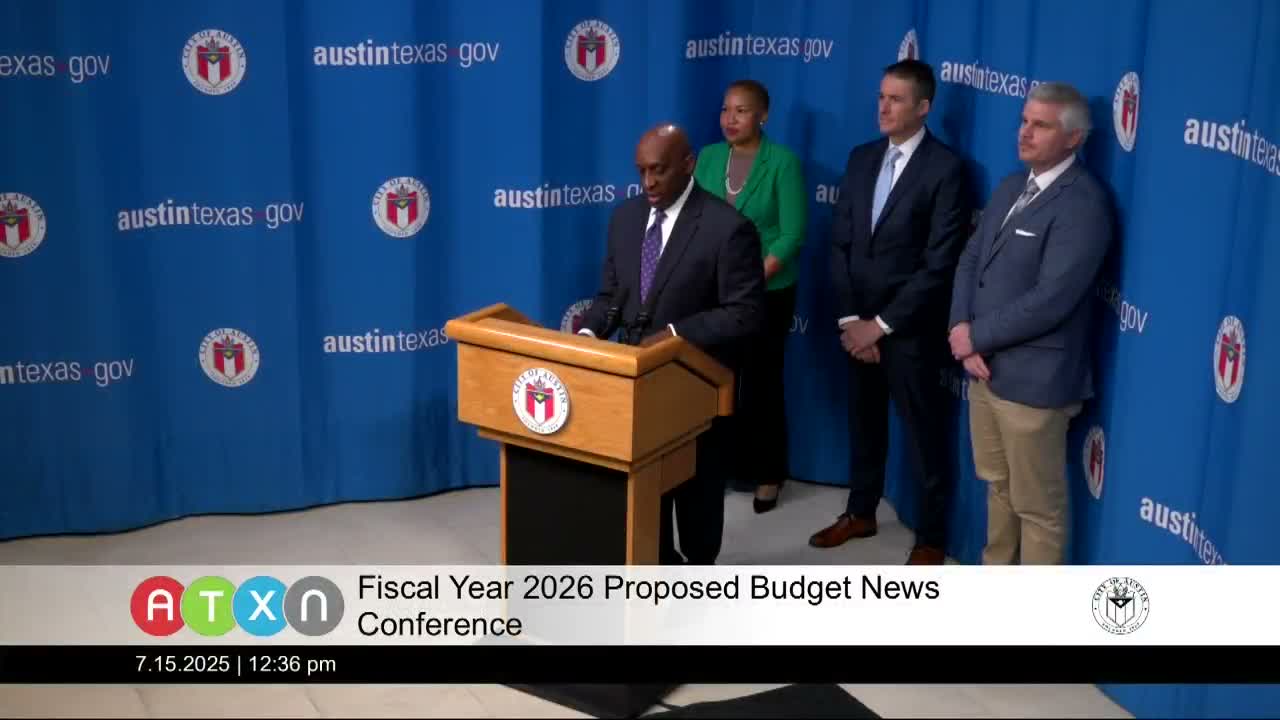
The presenter outlined a proposed $6,300,000,000 operating budget and said the plan was shaped by input from Austin residents. "This year's $6,300,000,000 operating budget was shaped and influenced by Austin residents who provided input through surveys and both in person and virtual meetings I hosted around the city," the presenter said.
The transcript records a $33,000,000 shortfall in the general fund. "The $33,000,000 deficit in the general fund was primarily driven by the state's 3.5% cap on property tax revenue growth, lowering the projected sales tax revenues as well and cuts in federal funding," the presenter said, explaining the primary causes cited for the gap.
The proposal keeps funding for social-service priorities, the presenter said, while seeking reductions or one-time savings elsewhere. Key investment areas listed in the presentation include shelter for people experiencing homelessness, emergency rental assistance, energy rebates and incentives, youth athletic fields and storm drainage rehabilitation. The presenter said staff focused reductions to avoid disrupting important services and used budget-stabilization reserves to ease the impact on providers.
City Manager Rod Nicks pressed staff for detail on the largest line-item reduction identified in the presentation: overtime in police and fire. "The single biggest reduction in spending that I saw was an overtime for police and fire," Nicks said, asking how restructuring would generate savings. In response, the presenter described a two-part strategy: redeploy existing personnel (shifting employees from other units back to patrol to reduce the need to call officers in on overtime) and give the fire chief greater flexibility to manage staffing to lower premium overtime costs. The presenter said the change could include staffing some fire units with three people, rather than a mandatory four, when operationally feasible to preserve response capacity while reducing overtime.
On the staffing-flexibility approach, the presenter said council action would be required. "You would have to ask them to rescind the ordinance that they passed in 2018," the presenter said, adding that council would need to add language to provide the chief with flexibility. The presenter emphasized the intent to maintain safe response levels while reducing overtime costs.
Asked how the city is covering the shortfall, staff said $14,000,000 was moved from reserve funds and the budget-stabilization reserve was used to avoid cutting more than $14 million in social-service funding. The presenter said many one-time items were eliminated and that staff provided longer notice to providers to plan for potential future cuts; staff warned that balancing the FY2027 budget would be more difficult if revenue projections do not improve.
Budget Director Carrie Lang addressed questions about the Housing Trust Fund, saying staff worked with housing department personnel to identify available fund balances and savings that allowed the city to fund the marshalling yard for fiscal year 2026 while continuing emergency rental assistance and existing voucher programs. "Emergency rental assistance is still funded. There are a number of vouchers that are still funded," Lang said.
On the city’s revenue outlook, the presenter contrasted a figure cited for last year with a lower early-stage estimate for the coming period (the transcript gives the amounts as 5,300,000,000.0 and 2,300,000,000.0). The presenter said the city will need an economic-development roadmap and incentives to attract development and grow taxable value to sustain ongoing expenses.
No formal votes or motions were recorded in the transcript. The presentation concluded with questions from the press; staff said several of the budget choices reflect one-time reductions or reserves used to smooth impacts on critical services, while longer-term balancing will depend on revenue changes and potential council actions on staffing rules and other policies.