Get Full Government Meeting Transcripts, Videos, & Alerts Forever!
Get email alerts on the Land Use And Legislation topic
No spam. Unsubscribe anytime.
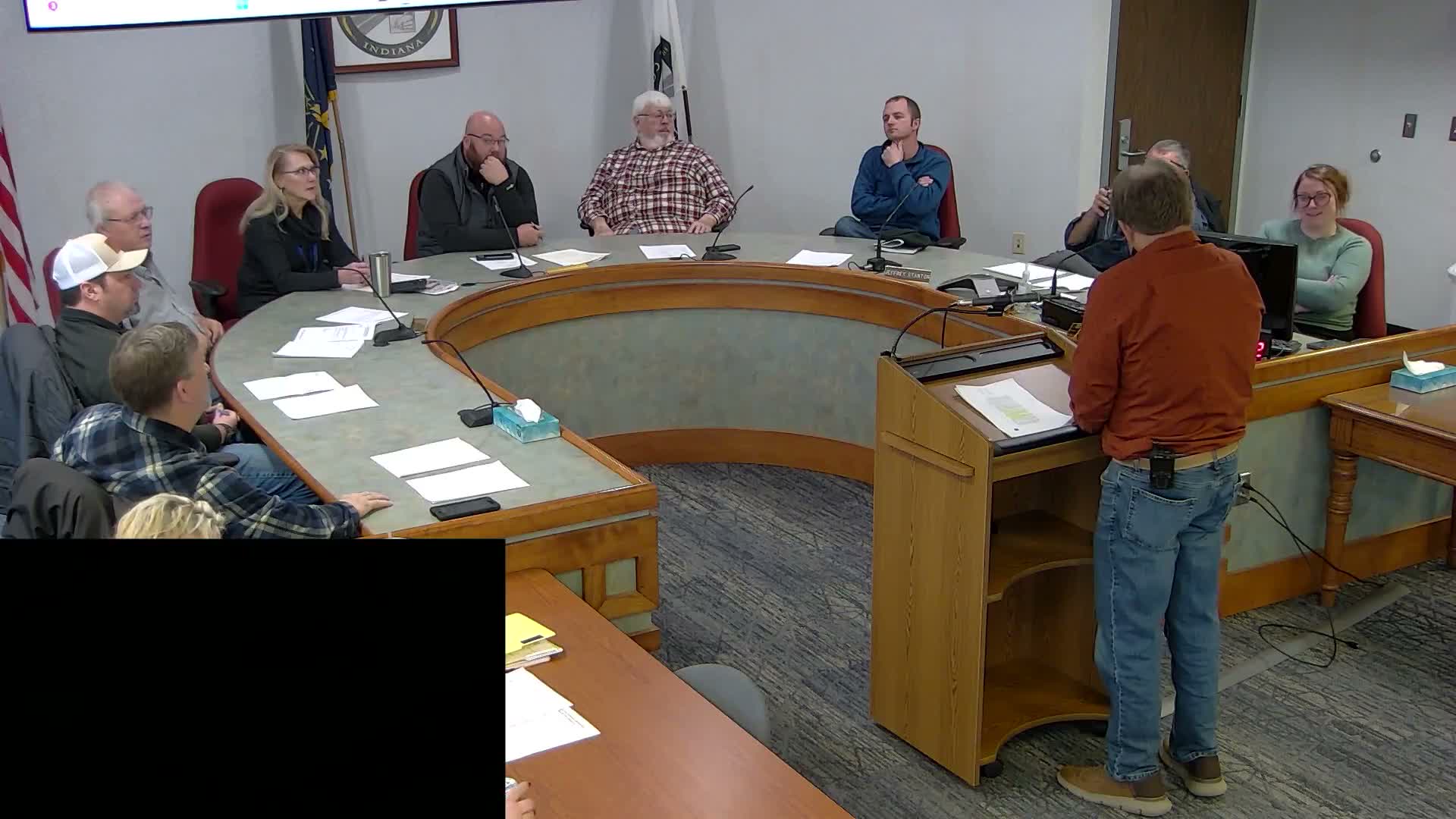
Plan Commission debates NRCS site‑evaluation tools and a possible moratorium amid concern about House Bill 1333
Summary
Commissioners discussed using the NRCS Web Soil Survey and the LISA land/site evaluation tool to map preferred development areas and debated whether House Bill 1333 could preempt local zoning; a resident urged a moratorium on data centers, carbon sequestration, SMRs and battery storage while the county studies impacts.
Commission members spent a substantial portion of the meeting discussing whether to use NRCS tools and a LISA (land/site evaluation assessment) to rank sites and whether state legislation could limit the county uthority to regulate certain land uses.
Commission discussion explained that the NRCS Web Soil Survey provides soil classifications that can indicate limitations for septic systems and pond siting, and that the LISA program rates sites by multiple criteria (soils, proximity to roads, distance to town) to allow comparison of candidate sites for a proposed land‑use change. Members debated how the tools are used in advance planning versus at the BZA stage and whether the end use needs to be specified for the tool to be meaningful.
One commissioner flagged House Bill 1333 and described its language on "permitted use," saying that if a site falls into certain NRCS soil capability classes then, as written in the bill, some projects could become a permitted use without local discretionary review. "If I have class 4 ground in Clinton Township, I can put absolutely anything I want on it, and you can't stop me," the member said, arguing the bill could remove local input for classed soils if enacted in its current form. The speaker said the bill had passed the state House and was awaiting action in the Senate committee.
Resident Laura Redwick (address provided during public comment) urged the commission to consider a moratorium on four project types — carbon capture and storage (CCS), data centers, small modular reactors (SMRs) and large battery storage — until the county completes research and ordinance updates. "Would it be beyond the scope of asking for a moratorium on all these 4 projects?" she asked, citing concerns over noise, generators and rapid developer approaches.
Commissioners said they have discussed moratoriums in committee and will continue committee work; they noted that a moratorium must include a time frame and would require follow‑up (public hearings and coordination with county commissioners) and that the final authority to enact a moratorium often rests with the county commissioners. Staff committed to collect examples of other county ordinances and research adopted elsewhere and to bring materials back to committee for consideration.