
Fulshear police report shows low formal complaints; chief says racial profiling analysis shows no discriminatory pattern
Get AI-powered insights, summaries, and transcripts
Sign Up Free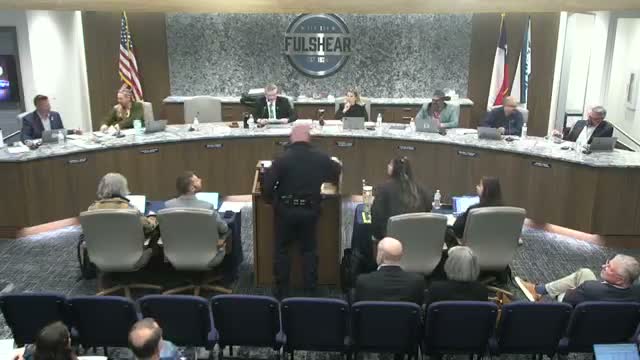
Summary
Chief Seymour presented the Fulshear Police Department—s 2025 annual and Senate Bill 1074 racial profiling report, reporting low crime rates, no formal racial-profiling complaints and recommendations by consultant Alex Del Carmen that the department—s search practices align with national trends. Council asked procedural questions about consent searches and the department—s new drone and Patrol Finder programs.
Chief Seymour presented the Fulshear Police Department—s 2025 annual report and the required racial profiling analysis to the City Council on March 17.
The report tallied roughly 13,580 traffic stops, 7,736 citations, 8,295 calls for service, 215 arrests and four use-of-force incidents in 2025. Seymour said the department recorded zero formal racial-profiling complaints and that consultant Alex Del Carmen—s analysis "does not reveal patterns of indicative or discriminatory practices." He described the filing as meeting the Senate Bill 1074 mandate for an annual racial profiling report and said Del Carmen—s review considered search rates, reasons for searches and hit rates.
Why it matters: The presentation combines operational statistics with a legally required analysis intended to show whether local policing practices produce disparate treatment. Seymour told council the department uses monthly supervisory reviews to evaluate stops for legality, training gaps and consistency.
In response to council questions, Seymour said officers do not log requests for consent searches that are refused (they log only searches that were performed) and explained the department—s categories of lawful searches: probable cause, arrest-incident searches, plain view, inventory searches and consent when given. He also described new and planned tools: a "Patrol Finder" GPS coverage program that increased recorded coverage from roughly 60% to 98% of city streets within 48 hours, and a drone-first-responder program the department expects will provide 88-second aerial arrival times across the city.
On the drone program Seymour said the system costs about $175,000 and the city—s share would be roughly $30,000; that funding came from a motor-vehicle-crimes grant and the department plans to seek the grant again. He said drone flights and use summaries will be published monthly, subject to open-records rules when not part of an active case.
Councilmember questions focused on search categories and documentation. When asked whether consent refusals are recorded, Seymour replied, "No, because you didn't do the search." He also clarified that searches incident to arrest and inventory searches are counted in the department's search totals.
The council did not take an action on the report itself; the presentation was received and discussed.