Get Full Government Meeting Transcripts, Videos, & Alerts Forever!
Get email alerts on the Land Acquisition topic
No spam. Unsubscribe anytime.
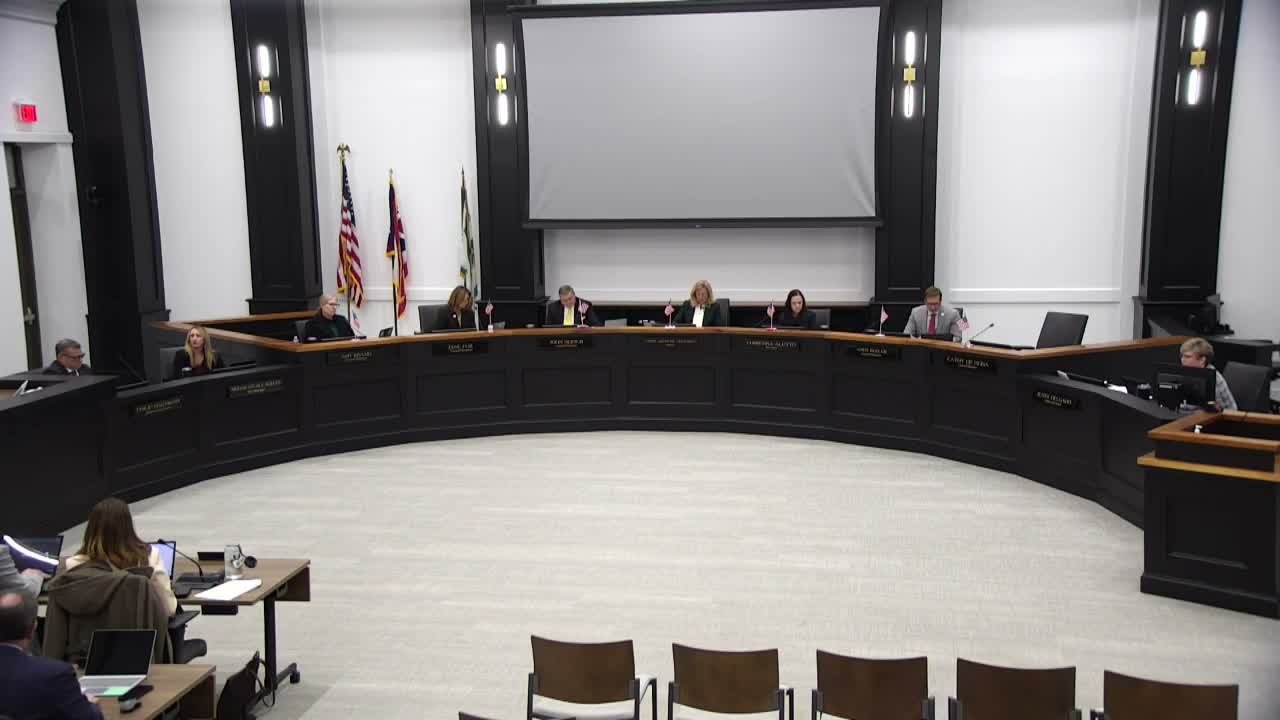
Dublin council approves purchase of two farm tracts and a short-term note after heated public hearing
Summary
After extended public comment urging more transparency and a second reading, Dublin City Council voted Dec. 8 to authorize purchases of roughly 84 and 265 acres west of the city and to approve a related note issuance to finance the acquisitions, with staff saying timing and market conditions required expedited action.
Dublin City Council on Monday approved ordinances authorizing the city to buy two large parcels of land on Dublin's western edge and authorized a short-term note to help fund the purchases, after residents urged the council not to waive the required second readings.
The council voted to adopt ordinances permitting the city manager to execute real estate purchase agreements for the Gingrich property (approximately 84 acres at $105,000 per acre) and the Miller property (approximately 265 acres at $50,000 per acre). Council also approved Ordinance 54-25 authorizing the sale of notes in a principal amount not to exceed $23,000,000; staff said the actual borrowing will likely be about $16.9 million with roughly $5.4 million contributed from the general fund.
The purchases, staff said, are intended to give the city control over strategic land adjacent to the West Innovation District (WID) and to provide flexibility for long-range transportation and utility planning. “Acquiring this land is in alignment with multiple adopted city plans,” City Manager Megan O'Callaghan said at the presentation. CFO Matt Rubino told council staff had structured a five-year, fixed-rate note with interest-only payments early in the term and a draft term sheet from Huntington Bank showing a locked-in rate below 4.2 percent.
Why it mattered: Residents of nearby neighborhoods told council they felt caught off guard by the timing and scope of the purchases and argued that the council should allow a second reading so the public could fully digest documents and ask follow-up questions. At the public hearing, Todd Hemmert of Hoochard Road asked the council not to waive the second reading and pressed staff for details about easements, wetlands, and how sewer and water would be provided. “Rushing does not build trust. Transparency does,” Hemmert said.
Legal and staff response: Dublin's law director, Yasser Shrawi, explained that Ohio law and the city charter give council discretion to waive readings and act legislatively when it chooses. Shrawi said the ordinances memorialize the purchase agreements and are consistent with the charter. Staff and counsel cited year-end timing and active market conditions as reasons for expedited action, noting this was the city's last meeting of the year and certain closing steps and financing logistics could be delayed by the council calendar.
Council action and votes: Council moved to dispense with the second reading for the Gingrich ordinance and then for the Miller ordinance, and then voted on each ordinance and on the note ordinance. Roll-call votes recorded a unanimous set of "yes" responses from the council members present. The ordinances include conditions noted in staff reports: the Miller purchase is subject to a Phase I environmental site assessment and securing a permanent access easement from Huichard/Hoosier Road.
Costs and financing: Rubino described a financing plan that relies on a direct placement with a bank and a five-year term to match acquisition and planning timelines. Staff said they expect flexibility to prepay principal after the second year with no penalty and that interest payments would be semiannual beginning June 1. The ordinance authorizing notes sets a legal cap of 6 percent but staff said the expected rate would be substantially lower.
What remains: Staff said future development of the parcels will be evaluated only when an opportunity arises and at a minimum the parcels will act as buffer land. Residents and some council members asked staff to return with explicit details on access easements, site constraints, and interim land use (how the city will maintain the parcels while they are owned). Council directed staff to follow up with neighbors and to return with additional information as part of implementation and future land-use discussions.
The council also approved related procedural resolutions to allow staff to pursue the financing and acquisition steps necessary to close on the properties in early 2026.