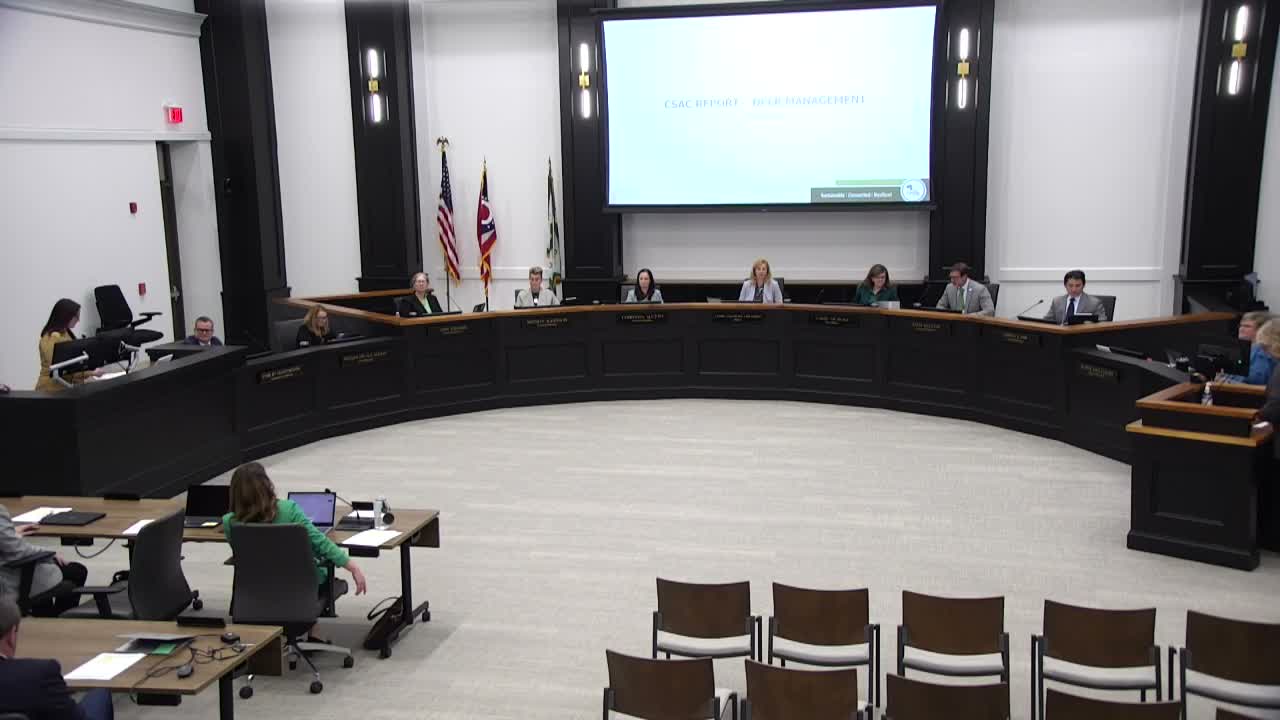
Dublin CSAC presents deer-management options as council moves topic to work session
Loading...
Summary
CSAC presented survey results, benchmarking and management options on deer, noting mixed resident sentiment and that roughly 59% of respondents favored population management; council voted to send the topic to a work session for additional expert briefings and to consider targeted removal and monitoring metrics.
The Community Services Advisory Committee (CSAC) briefed Dublin City Council on March 9 about ongoing deer-management work that began in February 2022. CSAC summarized regional approaches, benchmarking, and both the 2023 and the January 2026 surveys and recommended next steps should council wish to pursue active management.
Vicki Ginther, CSAC chair, and Emily Gulliver presented survey results showing mixed resident experience (about 40% positive, 38% negative and 22% neutral) but a majority — roughly 59% in the January 2026 survey — favor management to reduce perceived population growth. CSAC cited OSU capstone student estimates of approximately 50–85 deer per square mile in Dublin, noted increasing reports of aggressive deer encounters in 2025, and explained that relocation is not permitted under Ohio law and fertility control has limited effectiveness for open herds.
CSAC outlined options (targeted removal by trained professionals, archery programs, continued education and enforcement of feeding prohibitions), and compared local examples such as Worthington (which implemented targeted removal with a cap and venison donations to pantries) and Metroparks/Columbus programs. CSAC described likely costs, staffing needs and public‑outreach requirements for a lethal removal program and said processed venison can support local food pantries as part of program design.
Council members asked about monitoring metrics, the drone thermal‑imaging population index used in recent work, and whether priorities would be geographic (based on complaints, collisions or measured densities). Councilmembers and CSAC staff emphasized the importance of public education, tracking complaints and collisions, and establishing measurable annual goals if an active program is authorized.
Given the complexity and community division on the issue, a councilmember moved — and another seconded — to send the topic to a council work session with experts for deeper review; the motion passed by roll call. Council requested staff to arrange expert presentations and further public engagement before any policy decision.