
Panelists from Eradicate Hate, Boston Children's Hospital and OSPI outline school-based prevention and threat-assessment safeguards
Get AI-powered insights, summaries, and transcripts
Subscribe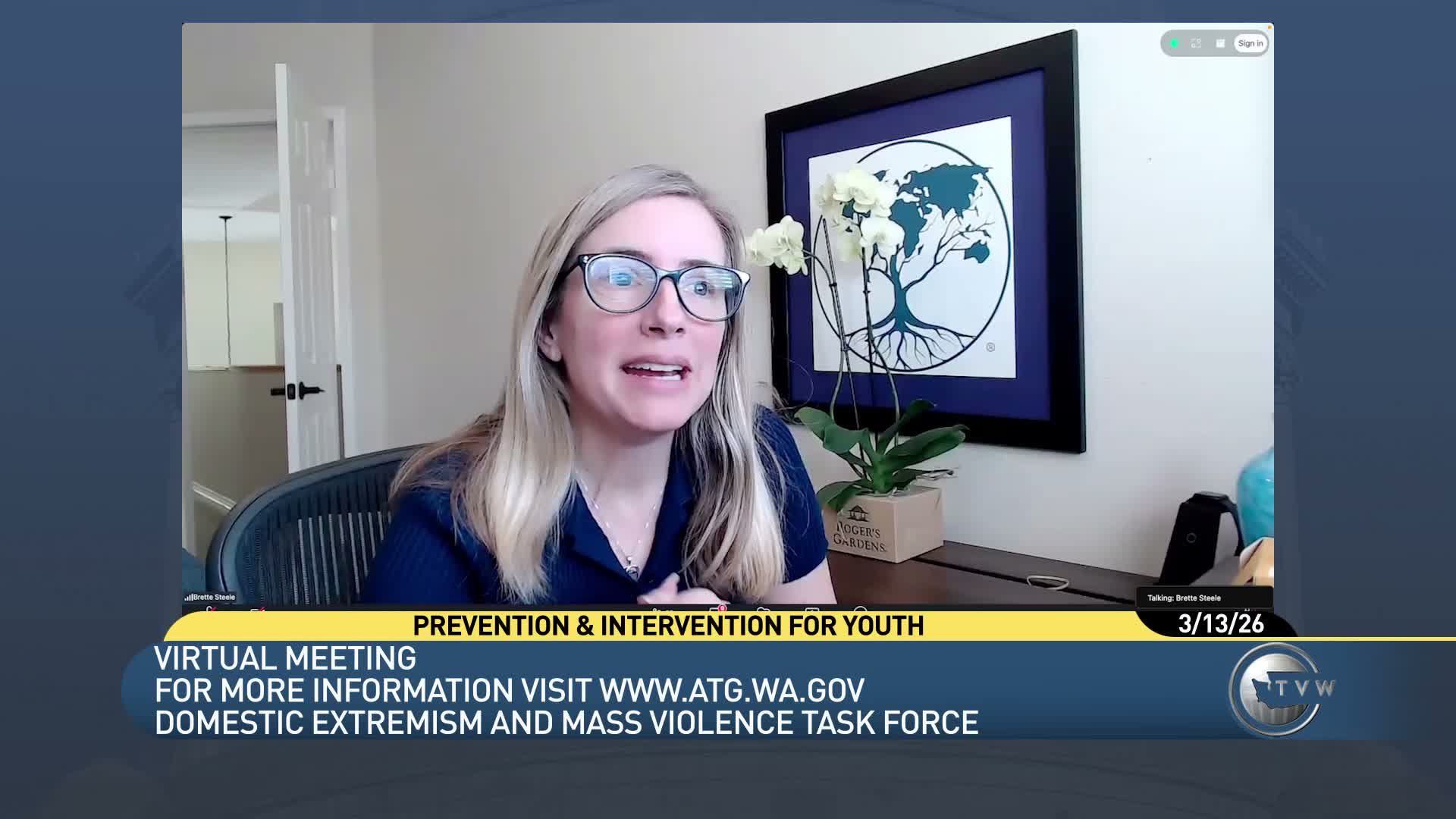
Summary
Panelists described primary and secondary prevention: Eradicate Hate's Upend Hate trained 300 students who documented 100+ interventions (including two averted school shootings), Boston Children's described five core tasks for community resilience, and OSPI outlined tiered behavioral threat assessment and regional safety centers.
Panelists Brett Steele (President, Eradicate Hate), Dr. Heidi Ellis (clinical child psychologist, Boston Children's Hospital/Harvard Medical School) and Amber Winn (Office of Superintendent of Public Instruction School Safety Center) told the task force that multidisciplinary, behavior-focused interventions reduce bias and increase the chance that at-risk youth get support rather than immediate criminalization.
"We know that when you take a proactive approach ... they will take those actions," Brett Steele said, describing Eradicate Hate's Upend Hate campaign. He said in-person training reached 300 students and those youth documented more than 100 concrete interventions; "including 2 of those 300 students reported weapons on campus and averted planned school shootings." Steele credited youth leadership supported by trusted adults and school teams.
Dr. Heidi Ellis said primary prevention should target community-level protective factors. She outlined five core tasks her research identified: reduce problematic internet use, promote emotional wellness, promote flexible thinking, promote fairness and justice, and promote belonging without othering. For youth who show risk, she said Boston Children's MAP program provides comprehensive assessment and multidisciplinary supports with the goal of diversion where appropriate.
Amber Winn described OSPI's model for school-based behavioral threat assessment: a two-tier approach where Level 1 is a building-level team focused on behaviors and supports, and Level 2 is a multidisciplinary team (which may include law enforcement, mental health providers and special ed representatives) that assesses higher-risk cases and coordinates interventions. Winn emphasized clear separation between support-focused threat assessment and criminal investigations or disciplinary processes.
Concerns and implementation: Task force members raised questions about liability that leads districts to default to law enforcement; panelists acknowledged the challenge and urged clearer referral pathways, training for trusted adults and community reintegration strategies for youth identified as at risk.
Administrative note: The task force adopted its agenda and approved prior meeting minutes at the start of the session.