Get Full Government Meeting Transcripts, Videos, & Alerts Forever!
Get email alerts on the Downtown Redevelopment topic
No spam. Unsubscribe anytime.
Boca Raton council adopts Master Partnership Agreement for downtown redevelopment; deal sent to March 10 referendum
Summary
After detailed staff briefings and more than three hours of public comment, the Boca Raton City Council voted 4–1 to adopt ordinance 57‑69 approving a Master Partnership Agreement, a 99‑year ground lease and related agreements with Boca Raton Center LLC/Terra Frisbee; the agreement proceeds to a March 10 voter referendum and requires multiple regulatory and financing approvals before any construction can begin.
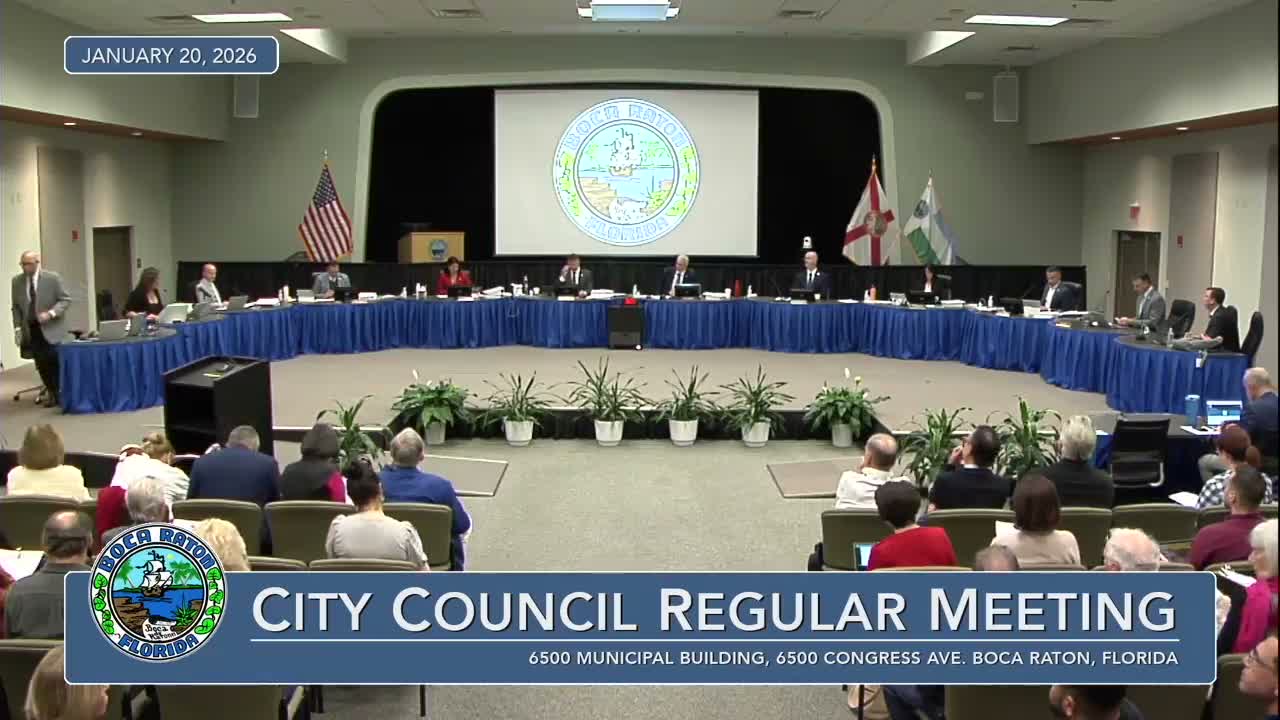
Boca Raton’s City Council voted 4–1 on Jan. 20 to adopt ordinance 57‑69, approving a Master Partnership Agreement (MPA), a 99‑year ground lease and related development and construction management agreements with Boca Raton Center LLC (the proposed private partner) for redevelopment of the downtown government campus. Mayor Singer cast the deciding vote after extended staff presentations and a lengthy public hearing; the adoption sends the finalized deal to a March 10 referendum for voter ratification.
The MPA, staff and consultants told the council, creates a framework that preserves city ownership of the land while setting performance milestones, financing and regulatory conditions that must be met before any lease commencement or vertical construction. “There cannot be any lease commencement, no construction, until all required approvals are secured,” City Attorney Mr. Koehler said, summarizing the legal protections embedded in the contracts.
City presentations focused on design, public space and fiscal analysis. Deputy City Manager Andy Lukasic walked the council through conceptual renderings and master‑plan goals—transit‑oriented design near the rail station, pedestrian‑first streets, and an expanded Memorial Park developed with veterans’ input. Kevin Plensler of PFM, the city’s fiscal consultant, said updated analyses show total operating revenues with a net present value of roughly $382 million and a net fiscal impact to the city in present value of about $227,850,633 under the assumptions used in the model. City CFO Jim Zervis noted the site’s most recent independent appraisal at about $99,000,000.
Supporters said the plan has been pared down and clarified in response to community input and will deliver modern civic facilities and new open space while generating revenues to offset public costs. “This project allows the downtown to become a walkable, vibrant neighborhood and creates revenue that can fund public improvements,” said resident Jerry Castillo during public comment.
Opponents raised concerns about the length of the ground lease (99 years), traffic, valuation and the distribution of risk. John Perlman, founder of the Save Boca movement, told the council the structure lets a developer capture a large upside without putting land purchase capital at risk, calling the arrangement “a private equity flip” that can leave the city exposed if revenues don’t materialize as projected. City staff responded that the agreements include multiple protections—payment‑in‑lieu of taxes provisions, limits on recalibrating key financial hurdles, mitigation fees (up to $4,000,000), and enforcement remedies up to termination—and that the referendum and later regulatory reviews are required before anything can proceed.
Council discussion reflected the balance between opportunity and risk. Supporters on the dais emphasized job creation, workforce housing and preserving green space; skeptics pointed to revenue uncertainty and traffic impacts. Council member Thompson voted against adoption, saying the deal placed too much risk on the city and that the financing projections were optimistic. Deputy Mayor Nattlis, Council members Drucker and Victor and Mayor Singer voted in favor.
The formal roll call on the ordinance adoption was: Nattlis — Yes; Drucker — Yes; Thompson — No; Victor — Yes; Singer — Yes. The measure passed 4–1.
What happens next: the ordinance’s adoption at the dais is a council action that finalizes the negotiated contractual framework and puts the proposal to the voters on March 10. Staff and the city attorney reiterated that even if voters approve the referendum, individual site plans, land‑development regulation approvals, building permits and full financing must be secured before lease commencement or construction. City staff also said they will continue public engagement on Memorial Park design and site‑specific details for the civic facilities.
Key numbers and clarifications noted in the meeting: the most recent independent appraisal of the land was cited at about $99,000,000; PFM presented an NPV of operating revenues around $382,000,000 and a net fiscal impact estimate of roughly $227.85 million; the developer’s off‑site contribution figure discussed during comments included approximately $7,900,000 for off‑site improvements; traffic mitigation fee exposure in the agreement was discussed as up to $4,000,000. City staff emphasized the MPA requires voter approval and that contractual obligations require full financing, regulatory approvals and permitted construction milestones before possession or construction begins.
The council also introduced related ordinances for comprehensive plan amendments and downtown zoning changes to be considered at future hearings; those steps are part of the regulatory path that the project must complete if ratified by voters. The council adjourned the downtown item and continued with routine consent business and public requests.
Sources: Council presentations by Deputy City Manager Andy Lukasic, City CFO Jim Zervis, city attorney Mr. Koehler and PFM consultant Kevin Plensler; roll‑call vote on ordinance 57‑69; public testimony from multiple residents and veterans’ groups during the Jan. 20 City Council meeting.