Get Full Government Meeting Transcripts, Videos, & Alerts Forever!
Get email alerts on the Government Campus P3 topic
No spam. Unsubscribe anytime.
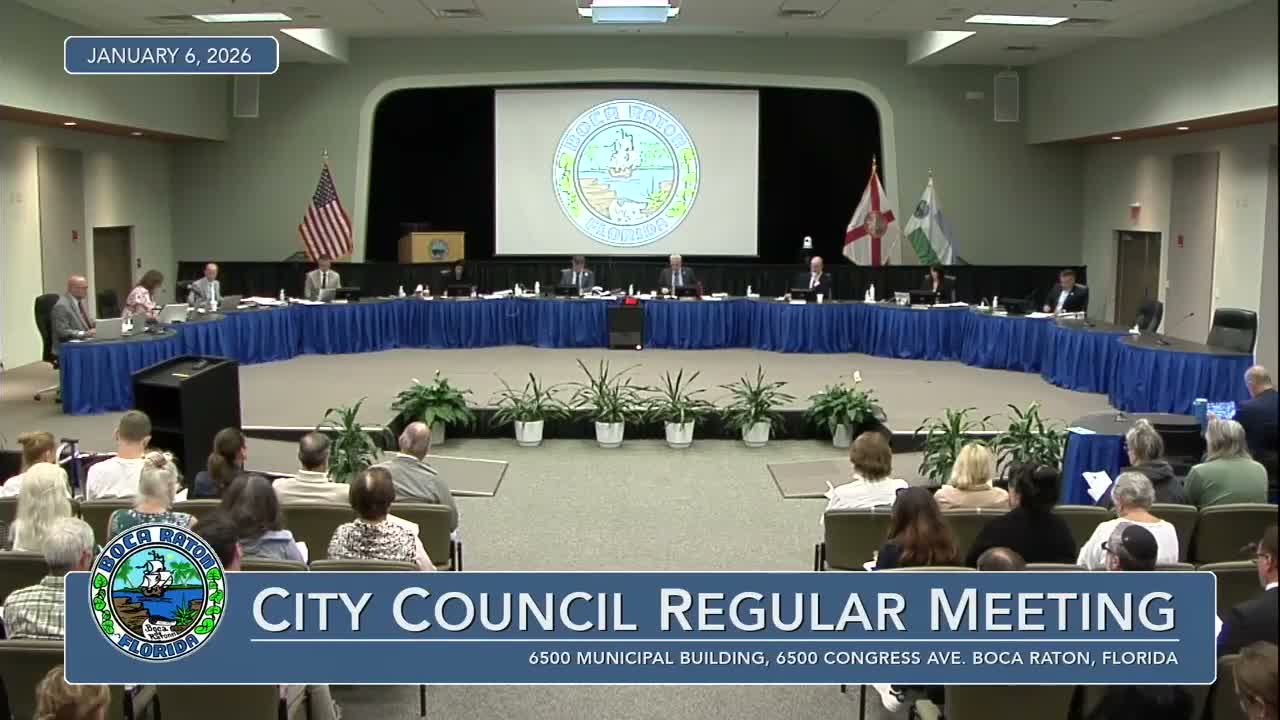
Boca Raton introduces ordinance to advance downtown ‘government campus’ P3 amid fierce public opposition
Summary
City staff introduced an ordinance to authorize a public‑private redevelopment of downtown Boca Raton on Jan. 6 and set a Jan. 20 council vote and a March 10 voter referendum. The meeting featured hours of public comment—mostly opposing the proposed 99‑year lease, questioning financial assumptions and warning about impacts to Memorial Park and trees.
Mayor Singer introduced Ordinance 57‑69 on Jan. 6, authorizing a series of agreements that would implement a public‑private partnership (P3) to redevelop a downtown tract east of Northwest 2nd Avenue and to plan civic uses west of that street.
City staff said the plan — developed with developer TerraFrisbie and analyzed by CBRE and PFM — is a mixed‑use, transit‑oriented project that was redesigned to reduce development intensity by about 27% from earlier submissions and to shift the city’s revenue model from a guaranteed rent to a percentage‑of‑rent structure. Deputy City Manager Andy Lukasick told the council the ordinance introduced tonight would return for final action Jan. 20, with comprehensive‑plan amendments expected in February and a voter referendum scheduled for March 10.
Why it matters: The proposal would commit long‑term rights over roughly the east side of the project area under a 99‑year ground lease while preserving fee‑simple ownership of the land for the city; staff and consultants say percentage rent and profit sharing plus residual land value make the P3 financially viable, while many residents argue the fiscal analysis understates risk.
City attorney Kaylor described the Master Partnership Agreement (MPA) as the umbrella document that governs sequencing, approvals and enforcement. He told the council that ‘‘if the referendum on March 10 is rejected by a majority of voters thereon, this agreement and any related documents, including without limitation, any executed lease, shall be null and void and of no further force and effect.’’ Council members asked staff to clarify survivability clauses and referendum language; Kaylor later proposed language intended to make clear a postponement due to events outside the city’s control would not be treated as approval.
Public reaction: The meeting’s public comment period ran for hours. Opposition coalesced around a group called Save Boca and residents who live near the site. Speakers pressed three recurring points: (1) protection of Memorial Park and mature trees, citing an arborist inventory they said the city and developer had not adequately addressed; (2) financial risk and valuation methodology — several commenters and local CPAs questioned the discount rate, the net present value calculations, and whether projected rent streams or appraisals properly reflected long‑term risk; and (3) transparency and timing, including objections to a first‑reading vote prior to Planning & Zoning action and concern that portions of the project’s civic side (the West Side) lack detailed, committed funding or design.
Save Boca founder John Perlman urged residents to vote to reject the project and accused the council of trying to ‘‘subvert the will of the people’’ by embedding confusing language in lengthy agreements. A number of presenters with financial backgrounds — including two CPAs — illustrated how different discount‑rate assumptions materially alter the project’s present‑value outcome, and CBRE and PFM representatives responded on the record about their chosen methodologies.
Staff response: CBRE’s technical advisor explained the team used a public‑sector discount rate in the mid‑4% range and emphasized that a lease versus sale comparison must include the residual (future) land value that the city retains. Staff and the city’s outside financial advisers also reiterated that no construction, lease commencement, or property rights transfer would occur until all required financing, permits, site plans and public hearings are in place.
What’s next: Council will consider final action on the implementing ordinance Jan. 20. If the council approves the ordinance then, staff said the process would proceed to comprehensive‑plan and LDR amendments in February and the citywide referendum on March 10. Staff and legal counsel told the council the MPA as currently drafted would be rendered void if voters reject the referendum; opponents have asked the council to tighten language further to ensure a rescheduled referendum would be required if March 10 cannot be held for reasons outside the city’s control.
No final vote on the MPA occurred on Jan. 6; Mayor Singer introduced Ordinance 57‑69 and announced it will return for consideration at the next meeting.