Get Full Government Meeting Transcripts, Videos, & Alerts Forever!
Get email alerts on the Healthcare Access topic
No spam. Unsubscribe anytime.
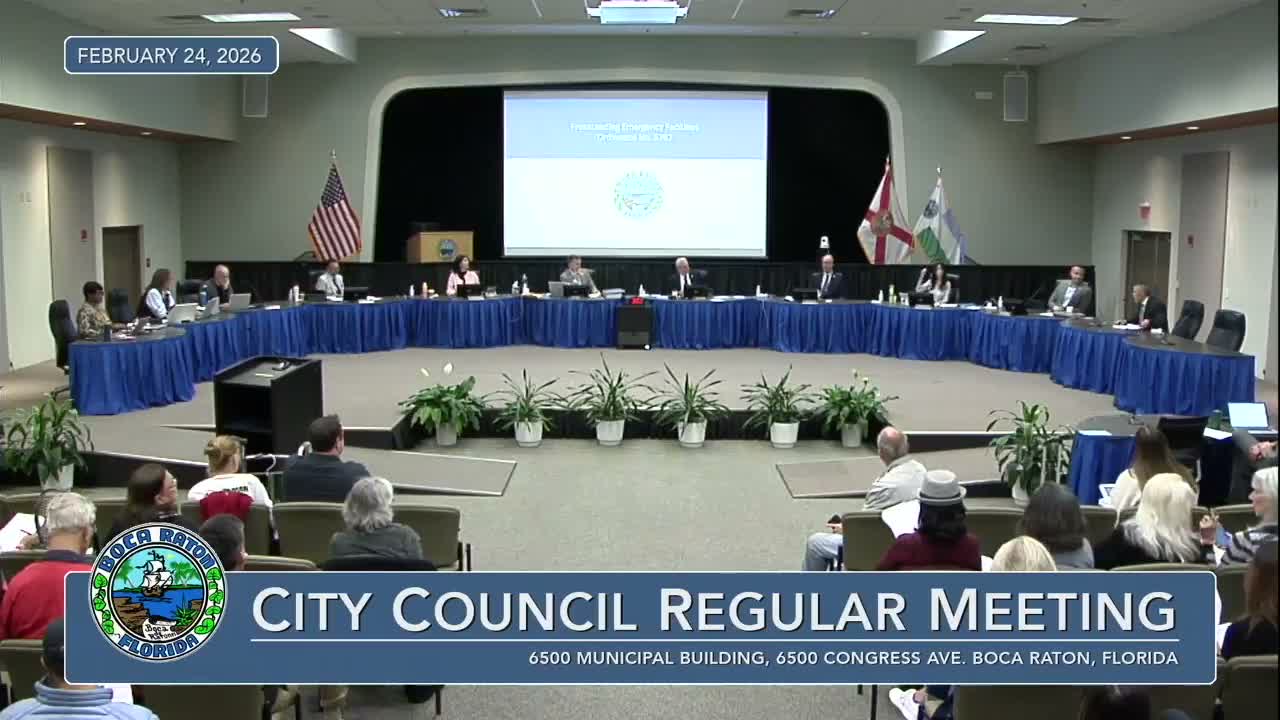
Boca Raton delays vote on freestanding emergency facility ordinance after lengthy public hearing
Summary
Councilors heard hours of testimony about parking, ambulance access, zoning boundaries and possible private drafting of ordinance text. Staff recommended conditional‑use rules and arterial‑frontage criteria; council directed staff to bring the draft to a workshop and the next regular meeting for further study.
The Boca Raton City Council on Tuesday postponed action on a city‑initiated ordinance that would create a new category for freestanding emergency facilities and make them conditional uses in select zoning districts.
Development Services Director Brandon Shad told the council the draft would add a definition of freestanding emergency facilities, allow them as conditional uses in multiple districts (including the medical center, general commercial and LIRP) and set standards such as arterial frontage, exclusion adjacent to single‑family residential, and a required ambulance loading area that does not interfere with circulation. Staff recommended approval of the text amendment as a measured approach to a relatively new use.
The issue prompted a sustained public response and vigorous council debate. Local physicians and facility operators urged careful treatment of parking and ambulance access. Dr. Evan Goldstein, an emergency medicine physician who runs a freestanding emergency department in West Boca, said such sites can draw substantial daily patient loads, reporting "during our busy season there are days that we're seeing more than 90 patients" and noting frequent ambulance visits and staffing needs.
Residents, neighboring property owners and representatives raised two recurring concerns: first, that the city’s draft used parking ratios and site selection criteria (zoning vs. direct arterial access) that differed sharply from standards other jurisdictions use; and second, that public records appeared to show private land‑use attorneys helped draft earlier versions of the ordinance, creating the appearance the language had been tailored to serve particular property interests. One speaker summarized: "These emails show conversations that deserve public explanation," and urged transparency about who prepared ordinance language.
Council members split on the proper path forward. Some said the city should adopt clear rules now to provide certainty; others said the draft needs more time for data collection and comparison with other cities, deeper review of ITE parking guidance versus local empirical data, and more precise mapping of eligible parcels and access points. Staff told the council that the eligible parcels map was generated by zoning district and whether parcels front on an arterial; it did not verify current driveway locations on every parcel.
Following debate, the council voted to postpone further action, directing staff to bring the item to the next workshop and to place the ordinance on the next regular meeting agenda so members could review additional data and outside examples. The motion to postpone passed by voice vote.
Council asked staff to gather comparative ordinances and operational data from other jurisdictions, clarify the parcels shown as eligible on the illustrative map, and explore empirical parking and ambulance‑stacking data to inform any final standards.