Get Full Government Meeting Transcripts, Videos, & Alerts Forever!
Get email alerts on the Property Foreign Ownership topic
No spam. Unsubscribe anytime.
Oklahoma committee splits over bill that criminalizes hostile foreign ownership of land
Summary
A lengthy committee debate split lawmakers over HB 14 53, which would add criminal penalties and mandatory divestment for hostile foreign parties owning Oklahoma land. Critics said the bill weakens existing indirect-ownership language and raises legal and procedural risks; sponsor said it adds "teeth" to protect Oklahoma land. Reported out to the floor 10-9.
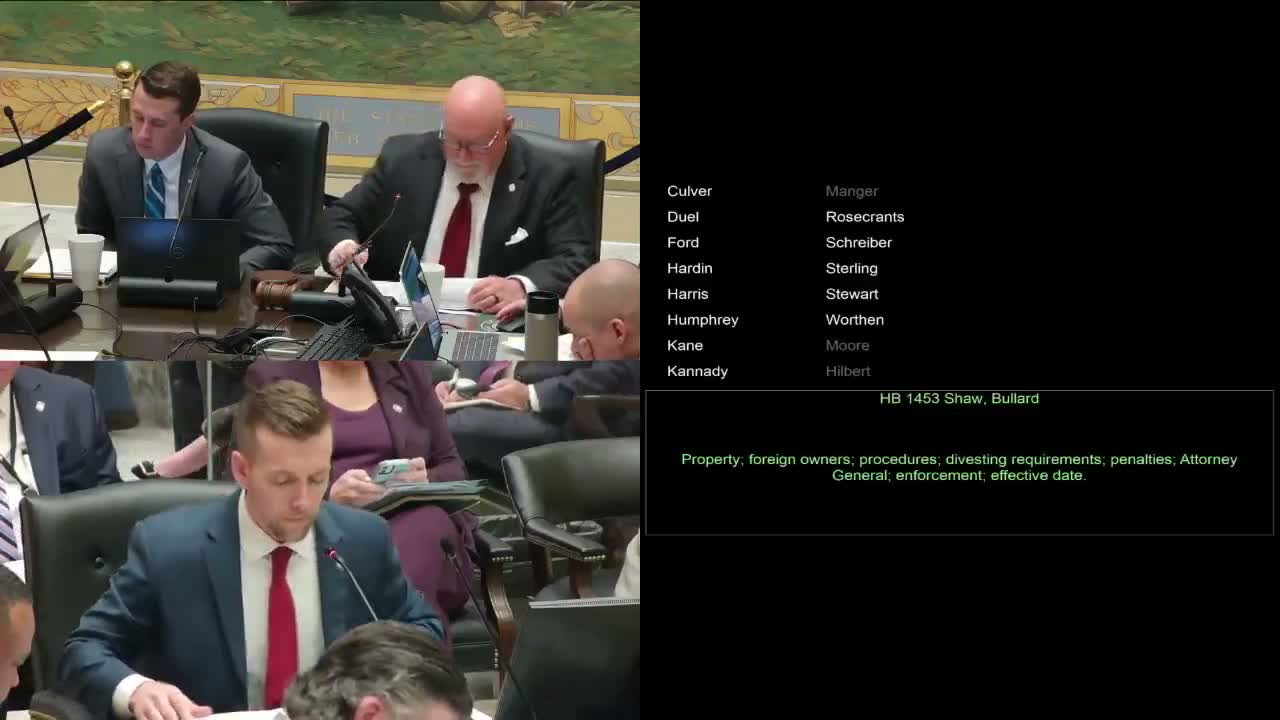
Representative Shaw presented House Bill 14 53 to the committee, saying the measure would criminalize ownership of Oklahoma real property by hostile foreign nationals or entities, force divestment of existing holdings within 12 months and create penalties including fines or imprisonment.
The bill narrows the definition of a "prohibited foreign party" to entities designated under certain federal codes and adds felony enforcement, mandatory divestment and judicial remedies tied to judicial foreclosure. Shaw said the changes "add teeth" to existing law and would protect Oklahoma farmland, markets and public safety.
Representative Kennedy sharply challenged the sponsor during extended questioning and debate. Kennedy argued the current statute already bars indirect ownership and said HB 14 53 "waters down the current statute" by removing indirect-ownership language while simultaneously adding criminal enforcement in a different title of Oklahoma law. "Words matter in the law," Kennedy said, warning that the bill could create loopholes that allow proxy purchases and hamper prosecution.
Kennedy also pressed the sponsor on a provision that would require a judicial foreclosure process that he said extends the timeline from 35 to 90 days, and on an affirmative-defense text that he said could shield resident aliens from criminal liability. Kennedy raised concerns about single-subject (what he called "law grueling") and ex post facto challenges if criminal penalties are applied to preexisting ownership.
Shaw responded that the bill builds on existing law by creating criminal penalties and a mandatory divestment process where none exists today. "This is not about nationality or appearance," Shaw said, adding that the bill relies on "objective federal security designations" and is intended to protect "law-abiding farmers." He said he was open to technical changes to strengthen the statute but would not remove the bill's title in committee.
Representative Humphreys and others asked whether outside agencies had reviewed legal risks; Shaw said he had received a letter from a state agency (OBN) supporting the bill and that House legal staff helped draft the language. Shaw also said he would work with colleagues and federal staff where needed.
After more than 20 minutes of debate, the committee reported HB 14 53 out of committee. The chair announced the report as 10 yes, 9 no.
What remains uncertain from the committee hearing: whether the bill's removal of "indirect" ownership language can be reconciled with the sponsor's stated criminal-enforcement goals, how courts will treat the mixture of civil divestment and criminal penalties, and whether the sponsor will accept targeted amendments on foreclosure timelines and definitions. The sponsor said he would work with colleagues but declined to strike title in committee.
The committee’s report moves HB 14 53 to the next stage of the legislative process; opponents asked for technical fixes and warned of constitutional and practical risks, while the sponsor emphasized the measure’s security rationale.