Get Full Government Meeting Transcripts, Videos, & Alerts Forever!
Get email alerts on the Zoning topic
No spam. Unsubscribe anytime.
Boca Raton board narrows what counts as 'retail' in new CIMD rules, sets 45-hour minimum
Summary
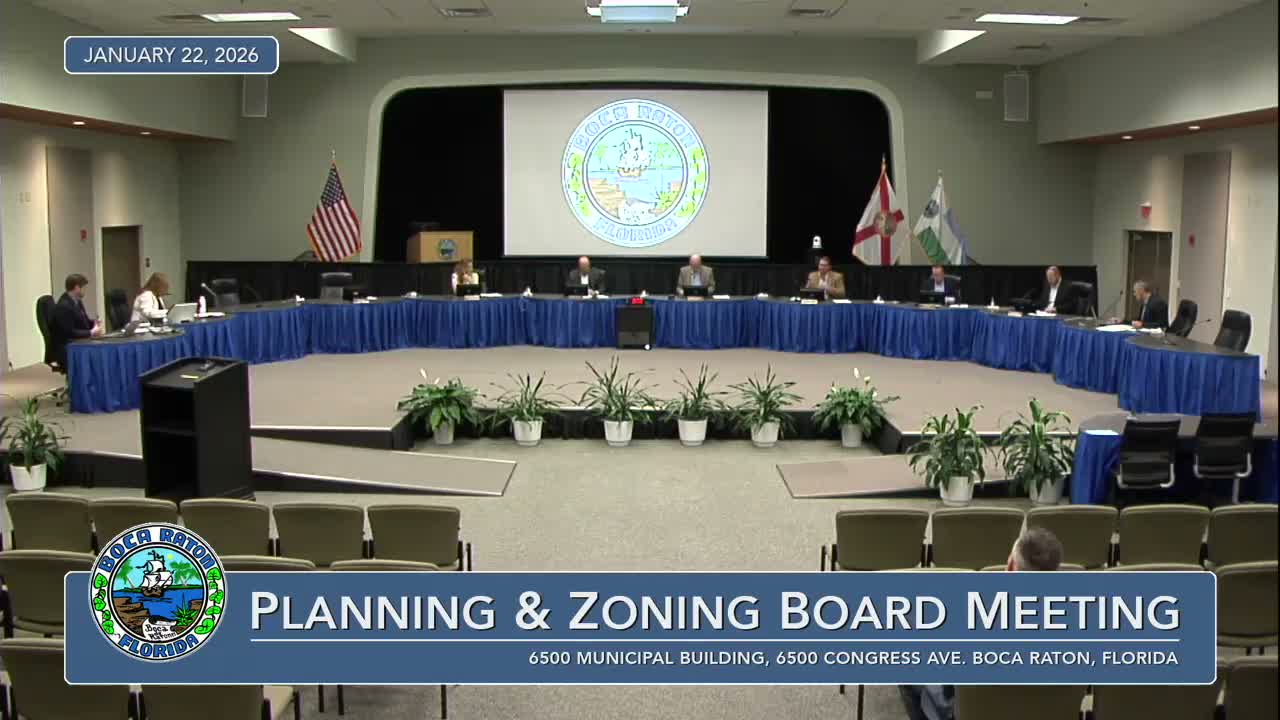
The Boca Raton Planning & Zoning Board on Jan. 22 approved an ordinance clarifying that on-site "retail sales or services" in commercial-industrial multifamily developments (CIMDs) exclude gyms and tutoring, and must be independently operated with ground-floor public access, signage and public marketing; the board amended weekly hours to 45 and passed the measure 6–0.
The Boca Raton Planning & Zoning Board on Jan. 22 approved an amendment clarifying what kinds of businesses can count as "retail sales or services" in commercial-industrial multifamily developments (CIMDs), excluding fitness centers and tutoring and adding conditions for public access, signage and marketing. The board amended the proposed weekly-hours requirement and approved the measure 6–0.
Development Services Director Brandon Shadd told the board the ordinance adds a definition of "retail sales or services" to Chapter 28 of the city zoning code and establishes minimum criteria for on-site retail in CIMDs. Under the city's CIMD program, adopted in 2024, projects providing affordable units may qualify for increased density; the program requires 10% of allowed units to be affordable (staff described affordability tiers up to roughly 120% area median income and a workforce tier up to about 140% AMI) and allows density incentives when workforce units are provided.
Shadd said the amendment was intended to ensure on-site businesses genuinely serve residents and visitors and promote walkability. "Retail sales or services means the sale of goods or merchandise directly to the ultimate consumer or a use that meets the definition of personal service shop," Shadd said, citing examples such as nail and hair salons, and adding that "the term expressly excludes ... fitness centers or gyms ... and tutoring or similar educational or instructional services." He said qualifying on-site businesses must be independent operations, publicly accessible with a ground-floor exterior entrance, have exterior business identification, publicly advertise or market, and must be reviewed by the city if they change use.
Board members asked a series of implementation questions. Miss McDonough asked whether a Pilates studio would be precluded; Shadd said such studios could locate in a CIMD but generally would not count toward the minimal 2,000-square-foot on-site retail requirement. Mr. Mitchell asked whether a gym could obtain a variance to count as the required retail; Shadd said a gym would not be allowed to meet that minimum and that the approval framework would not permit overriding that limitation. Mr. Matthews, drawing on developer experience, questioned whether 2,000 square feet was too large for some cafes; Shadd said the 2,000 figure was a council compromise when the program was first adopted and noted the space can be split into smaller units.
A public commenter representing developments said the group supported CIMD in principle but raised multiple concerns about the draft ordinance: whether the rules would apply to off-site retail, the exclusion of uses that can serve as legitimate small businesses (he cited karate, kickboxing and Pilates), the weekly-hours requirement (the draft required 60 hours), and possible conflicts between the ordinance's signage requirement and the city's sign code. "I think this is preventing our small local businesses from being able to operate within these developments," the commenter said, urging clearer language and implementation flexibility.
Shadd responded to the comments, acknowledging a scrivener's error in the draft and clarifying the provision applies only to on-site retail (not off-site mall tenants). He said staff expects flexibility on proof of public marketing ("it doesn't have to be your own website — it could be a Facebook listing") and that the properties allowed substantial signage, and suggested staff would work with stakeholders to refine language before City Council consideration.
After discussion about the weekly-hours minimum (the draft's 60 hours was criticized as onerous), the board moved to approve the ordinance with the correction Shadd identified and to lower the weekly-hours requirement. Vice Chair Dornblazer moved approval; Mr. Mitchell seconded the motion and proposed 45 hours as a compromise. The board amended the motion to set the minimum qualifying hours at 45 per week. The clerk called the roll and the measure passed 6–0.
The ordinance as approved clarifies that the minimum on-site qualifying retail is the greater of 5,000 sq ft or 10% of the CIMD nonresidential floor area (capped at 25,000 sq ft), with at least 2,000 sq ft required to be restaurant or retail when met on-site; it also requires ground-floor exterior access, exterior business identification, public accessibility and demonstration of marketing. Shadd said staff recommends approval and will work on clarifying language before the item is addressed to City Council. The board adjourned at 6:29 p.m.