Get Full Government Meeting Transcripts, Videos, & Alerts Forever!
Get email alerts on the Government Campus topic
No spam. Unsubscribe anytime.
Residents urge caution on Boca Raton government campus, flag BrightLine financing risks
Summary
Public commenters at the Dec. 1 CRA meeting urged the board to reconsider using a P3 for a proposed government campus, saying the plan’s reliance on BrightLine is risky after reports of steep declines in the company’s bond prices. Speakers urged staff and commissioners to avoid locking the city into a deal that shifts public value to private partners.
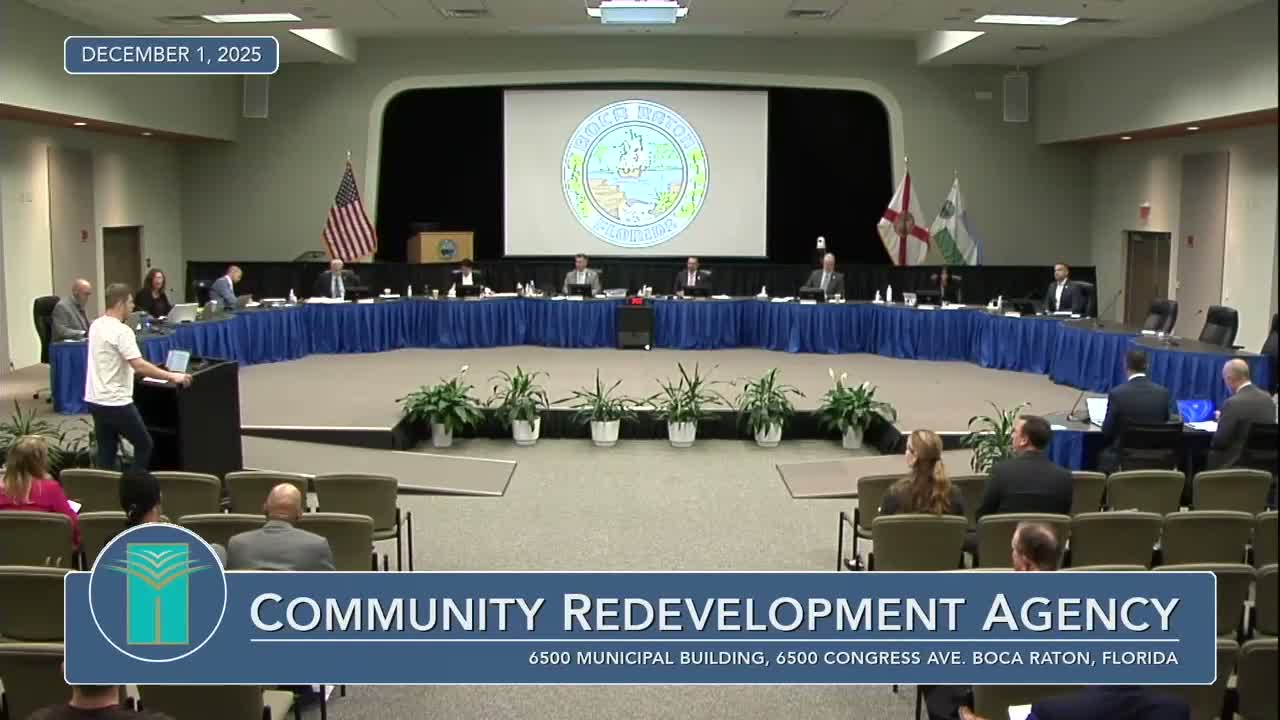
John Perlman, a Boca Raton resident, told the Community Redevelopment Agency on Dec. 1 he was concerned the proposed government campus and its entitlement narrative rely heavily on BrightLine as the centerpiece of a transit‑oriented community. "BrightLine is failing very rapidly as a company," Perlman said, citing press reporting that one of BrightLine’s bonds had traded “as low as 29 and a half cents on the dollar.” He said that decline, and BrightLine’s deferred interest payment on roughly $1.2 billion in bonds, make the company an unreliable anchor for a major public project.
Michelle Grau, another resident who spoke during the public‑comment period, argued more broadly that public‑private partnerships are tools, not automatic improvements. "A P3 is not automatically better," Grau said, and listed three cases when a P3 is appropriate — massive upfront capital requirements, specialized expertise and risk transfer — but insisted the government campus does not meet those criteria. She warned that when public land is more valuable than private investment, the public effectively subsidizes the private partner.
Richard Warner, a resident who also addressed the board, praised the rehabilitation of Dixie Manor but cautioned that other projects he described as poorly executed could leave the agency with a negative legacy. He used the example of public figures leaving for higher pay to underscore his broader concern about whether projects serve the community.
Chair (speaking as the meeting chair) closed the public‑comment period by saying the public ultimately would decide on the government campus through the appropriate vote and reiterated that the CRA still has ongoing obligations regardless of the project’s outcome.
Why it matters: Board members and staff repeatedly framed forthcoming agenda items (including possible government‑center materials on Jan. 20) as decision points where the public and elected officials will determine whether to proceed. Speakers at the meeting emphasized financial risk to the city if the CRA relies on a privately owned rail operator whose financing has shown volatility.
What’s next: The CRA’s staff and consultants will present additional reports at upcoming meetings; the board flagged Jan. 20 as a potential date for significant elements related to the government center. The chair said the public will be able to express its views prior to any formal vote.