Get Full Government Meeting Transcripts, Videos, & Alerts Forever!
Get email alerts on the Live Local Amendment topic
No spam. Unsubscribe anytime.
Board recommends city ordinance changes to align local code with Florida's Live Local Act
Summary
The Planning and Zoning Board voted 5-0 to recommend amendments to Boca Raton's zoning code to implement 2024–2025 changes to the state Live Local Act, clarifying floor area ratio limits, parking reductions, demolition review, and enforcing affordable-unit requirements.
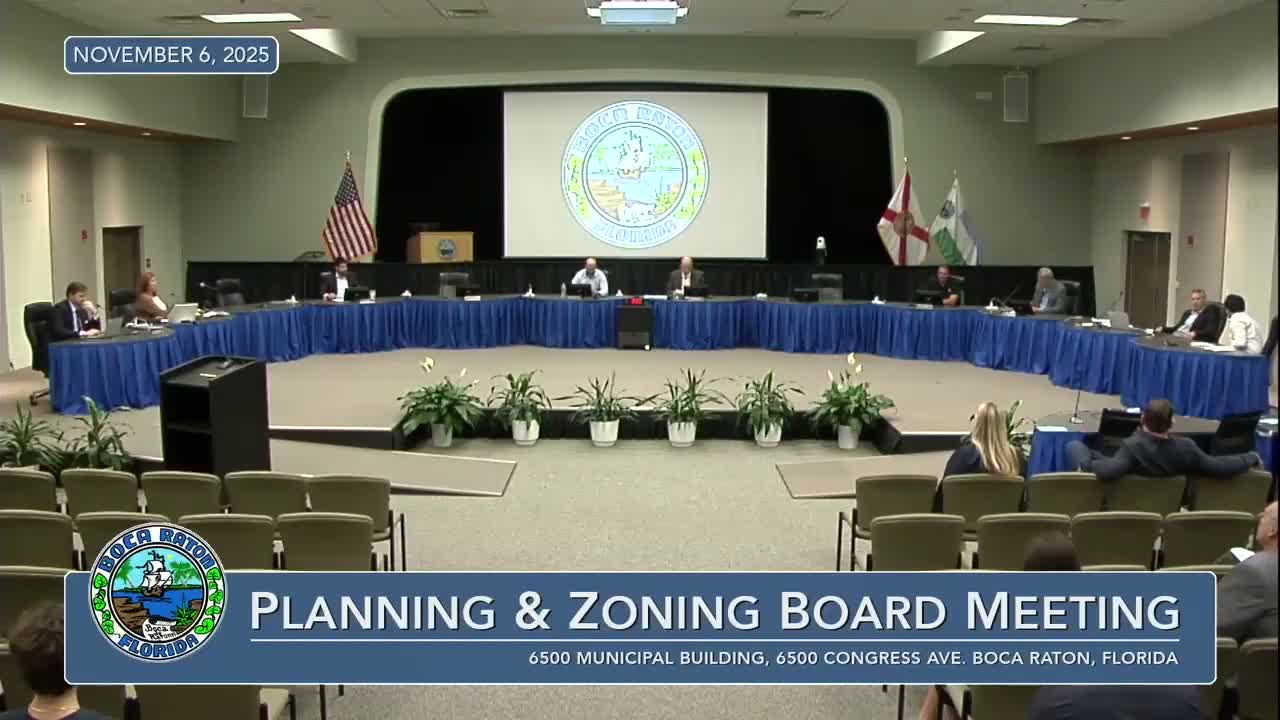
The Boca Raton Planning and Zoning Board recommended on Nov. 6 that the city council adopt text amendments aligning the municipal zoning code with recent revisions to Florida’s Live Local Act. The board voted 5-0 to forward the ordinance after a staff presentation and public comment.
Brandon Shadd, Development Services Director, summarized the state-driven changes and how the city's ordinance would reflect them. Major adjustments explained by Shadd include: limiting local nonresidential square footage required for a mixed-use Live Local project to 10% of building square footage (if 5,000 sq ft is more than 10%); clarifying maximum floor area ratio (FAR) allowances — the state allows up to 150% of the highest FAR in a jurisdiction (the city’s current maximum of 1 would yield a 1.5 FAR cap for Live Local projects); mandated parking reductions (15% reductions in certain transit-proximate situations and full elimination of minimum parking within transit-oriented developments); and treatment of height when adjacent to single-family properties (the ordinance would limit height to the greatest of three specified measures, but no more than 10 stories).
Shadd also explained that the Live Local Act now requires affordable units to be rentals and instructs that projects approved under the act be treated as conforming even after the statute’s expiration (currently 2033). He said enforcement measures will be codified locally through restrictive covenants and administrative processes to ensure affordability commitments are met; legislation calls for projects violating affordability requirements after a reasonable cure period to be treated as nonconforming uses.
Vice Chair Salon asked for clarification about the possibility of owner-occupied market-rate units alongside rental-only affordable units; Shadd said while most buildings are either rental or owner-occupied in practice, the legislation only requires the affordable 40% to be rentals and leaves other units’ tenure to the developer’s choice in rare circumstances. Public commenter Lehi Grama supported staff’s recommendation while stressing that the ordinance changes reflect state law rather than a city-initiated policy shift.
After closing public comment, the board moved and seconded to recommend the ordinance amendment to city council. A roll-call vote recorded five affirmative votes and the motion passed 5-0. Staff recommended approval and will forward the record and recommendation to city council for final action.