Get Full Government Meeting Transcripts, Videos, & Alerts Forever!
Get email alerts on the Downtown Campus Lease topic
No spam. Unsubscribe anytime.
Planning board backs 99‑year lease for downtown Boca Raton campus, 7‑0
Summary
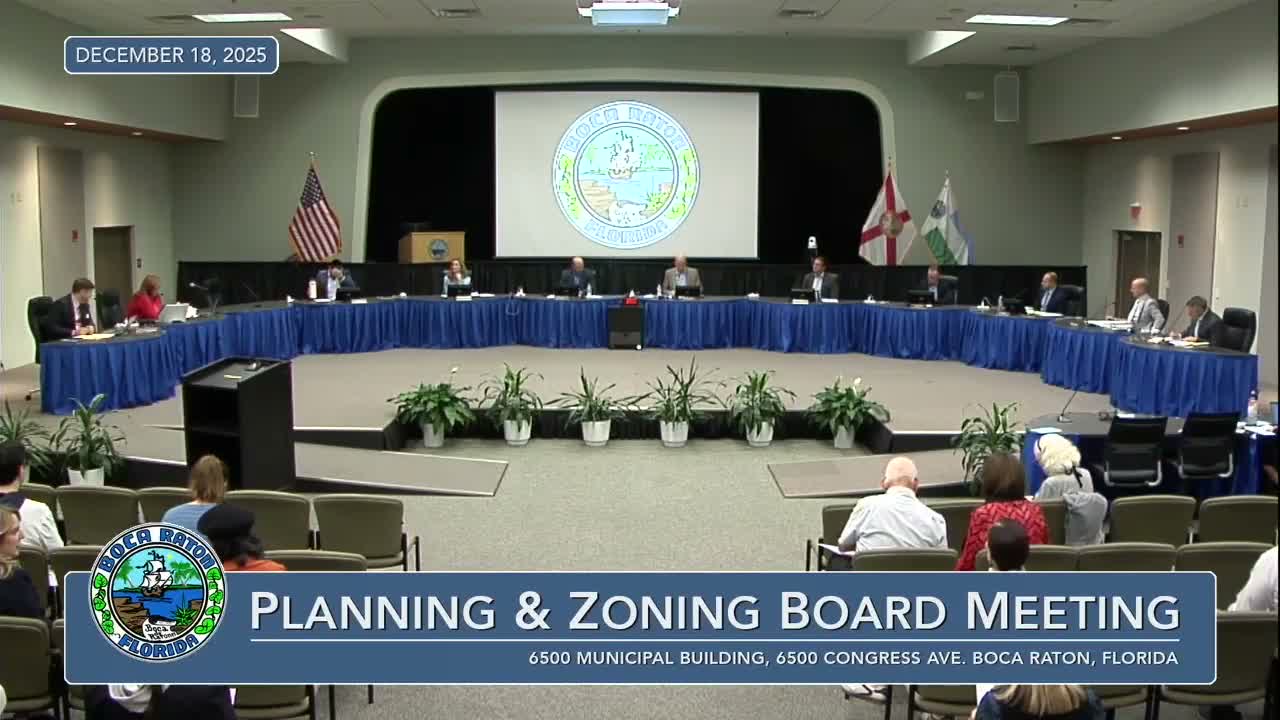
The Boca Raton Planning & Zoning Board voted 7‑0 to recommend that the city convey a 99‑year leasehold on about 7.8 acres east of NW 2nd Avenue to support a mixed‑use, transit‑oriented downtown campus; the decision was advisory and precedes City Council review and a March referendum.
The Boca Raton Planning & Zoning Board voted unanimously Tuesday to recommend that the City Council find it advisable from a planning and land‑use standpoint to convey a 99‑year leasehold interest in roughly 7.8 acres of city‑owned land east of Northwest 2nd Avenue, adjacent to the Brightline station.
Deputy City Manager Andy Lukasick told the board the lease is one of the legal instruments tied to a proposed public‑private partnership and master partnership agreement that would guide a mixed‑use, transit‑oriented government campus and neighborhood. "The request is regarding the conveyance of a leasehold interest in 7.8 acres of city owned property," Lukasick said, describing the parcels and the role of the MPA in controlling planning, entitlements and financing.
Brandon Chad, the city’s development services director, summarized the regulatory steps staff expects: small‑scale comprehensive‑plan amendments to bring the site into the Central Business District, amendments to the Downtown Development of Regional Impact ordinance (listed in the packet as ordinance number 40 35), creation of a new downtown zoning district with subdistricts, and routine site‑plan reviews. Chad recommended the board find that the proposed private improvements are consistent with the comprehensive plan, the amended downtown (CRA) plan and the city’s strategic priorities.
Staff described program elements in the developer’s concept: the project footprint concentrated on the 7.8 leased acres and illustrative proposals for a mix of housing, office, retail and public space. Staff cited a total residential figure on the presentation of roughly 947 units overall, including 182 condominiums on private property and about 708 rental units on city land, roughly 77 identified as workforce housing; the plan also noted approximately 79,100 square feet of retail, a roughly 180‑room hotel and about 30,000 square feet of grocery space, with roughly 2,100 parking spaces (about 1,900 structured). Lukasick emphasized that the board’s role was limited to planning and land‑use advisability, not the economics of any lease or partner selection.
The public hearing drew lengthy testimony on both sides. Supporters — including longtime residents and community volunteers — urged revitalization near the Brightline station and lauded the developer’s public outreach. "They have clearly spent a significant amount of time and money working through this," said Eric Lanchette, who praised the developer’s responsiveness and noted the project footprint had been reduced from about 30 acres to 7.8 acres during revisions.
Opponents pressed financial and stewardship concerns. Several speakers with accounting or auditing backgrounds questioned the discount rate assumptions used in the city’s fiscal projections and argued the city might be shortchanged compared with a recent independent appraisal that some speakers said valued the land at about $116 million (roughly $15 million per acre). "Simply put, this project is currently structured as fiscally irresponsible," said Michelle Grau, a CPA and candidate for city council, during the public comment period. Martin Bell and others raised similar fair‑market‑value concerns and warned that public land could be effectively removed from civic use for generations under a long lease.
Board members repeatedly noted the narrow scope of their review. "We're not considering the economics," Chair Savelle said when clarifying the board’s charge; several members said financial questions raised by speakers were important but outside the board’s advisory responsibility.
After discussion the board voted 7‑0 to find the lease advisable from a planning and land‑use standpoint. The motion was recorded as passing on a roll call: Chair Savelle and board members Dornblazer, McDermott, Matthews, Maraboli, Mitchell and Morgan voted yes.
Next steps: staff said the City Council will consider the master partnership agreement and the leases in January; if the council votes affirmatively, the matter will go to a public referendum in March (the staff presentation noted a March 10 referendum date). Any private development would still require separate formal approvals, including site plan review and any required rezoning or plan amendments.
The Planning & Zoning Board’s recommendation is advisory only; fiscal terms, final lease language and the partner’s ability to finance and implement the project are matters for the council, the public referendum and later regulatory reviews.