Lifetime Citizen Portal Access — AI Briefings, Alerts & Unlimited Follows
Boca Raton CRA approves Camino Square Phase 2 IDA, 5‑0
Loading...
Summary
The Community Redevelopment Agency approved an Individual Development Approval for Camino Square Phase 2, allowing 374 residential units and 23,368 sq ft of retail on the western 4.54‑acre portion of the site, with conditions including a $15,000 proffer for a pedestrian beacon and a 2‑foot easement for future mobility improvements.
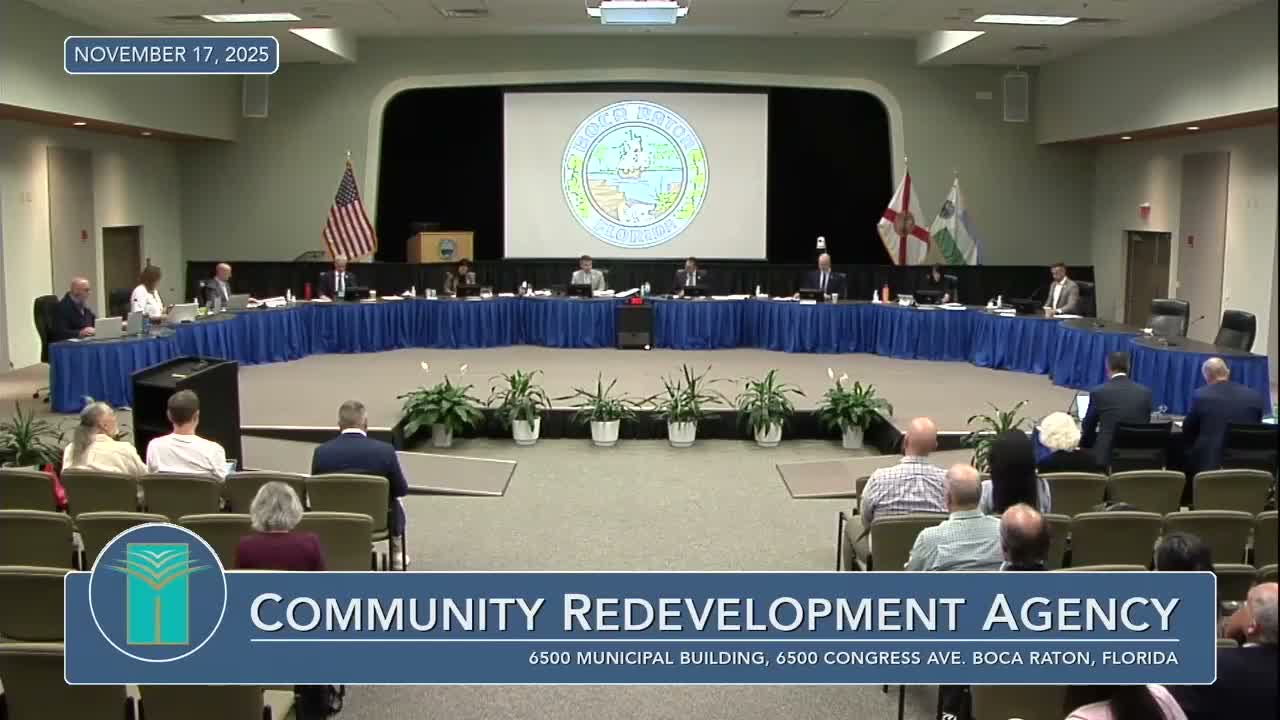
The Boca Raton Community Redevelopment Agency voted 5‑0 on Nov. 17 to adopt an Individual Development Approval (IDA CRP160202 R2) for Camino Square Phase 2, allowing a change of use that converts previously approved retail to 374 residential units and 23,368 square feet of retail across two eight‑story buildings and an integrated seven‑story parking structure.
Senior planner Susan Lester summarized the revised application and staff recommendation, saying the updated site plan (filed Oct. 30) reduced residential units from 394 to 374, increased retail to 23,368 square feet (including 2,000 sq ft fast‑food and 5,805 sq ft of restaurant space), provides 793 structured parking spaces, and seeks a one‑foot technical driveway deviation. Lester also read new conditions of approval that include a required dedication of a two‑foot easement along the Camino Real frontage for future multimodal improvements and a voluntary proffer of $15,000 toward a Rectangular Rapid Flashing Beacon (RRFB) at the existing crosswalk south of the property.
The applicant, Ellie Zacharias, told the board the revisions were made to respond to the council’s prior direction and to make the retail viable. "We did increase the retail — we heard all of you, and have increased the retail by almost what you requested. Now we are at 23,368 square feet," Zacharias said, and described design changes such as a widened Paseo and double‑height retail facing Southwest 3rd Avenue to encourage outdoor dining and pedestrian activity.
Commissioners questioned staff and the applicant on parking methodology, the meaning of "as of right" in the downtown ordinance, and whether bar uses or outdoor bars would trigger additional parking requirements. City staff explained the project uses a shared‑parking analysis under Ordinance 4035 and its implementing rules; the submitted study and staff review show a peak shared‑parking demand of 793 spaces for the mixed uses. Staff and the applicant agreed that a full‑service bar or a long linear bar would likely require additional parking, while short outdoor seating generally falls within permitted allowances.
During the public hearing dozens of residents spoke. Opponents raised traffic and safety concerns near the adjacent Brightline tracks and said the proposed intensity and height are out of scale with nearby blocks. Richard Warner, a resident, described the project as "a total atrocity" and said it would worsen a congested intersection; other commenters urged stronger community outreach, questioned whether the owner had adequately pursued retail tenants, and asked the city to revisit the downtown ordinance.
Several speakers also questioned process matters: whether applicant representatives who meet individually with council members should be registered as lobbyists and whether ex parte contacts had been appropriately disclosed. At the hearing applicant counsel confirmed she is registered with Palm Beach County as a lobbyist for FCI and, as a precaution, for Kimco.
City attorneys and staff clarified the quasi‑judicial role of the board. The city attorney reminded members that while the applicant can characterize a proposal as "as of right," the board retains discretion under Ordinance 4035 to weigh compatibility and consistency when acting as fact‑finder.
After additional commissioner discussion noting the substantial increase in retail space, the mobility proffers, and staff’s findings of ordinance compliance, the board moved to adopt IDA CRP160202 R2. A roll‑call vote recorded five yes, zero no. The board’s approval includes the conditions read into the record: the 2‑foot easement for future mobility improvements, the voluntary $15,000 payment toward an RRFB at the adjacent crosswalk, and restrictions on bar or additional patron seating in restaurant uses unless staff determines required parking is satisfied.
The director’s office said the CRA will include the downtown walkability and related crosswalk work in its capital improvement forecast and will continue coordination with the developer and city departments on implementation. The meeting adjourned at about 3:45 p.m.
What’s next: the approval authorizes the change in use under the CRA/ordinance framework and imposes the conditions noted above; implementation steps such as permitting, tenant selection and any further off‑site improvements will follow standard city review and permit processes.