Get Full Government Meeting Transcripts, Videos, & Alerts Forever!
Get email alerts on the Municipal Finance topic
No spam. Unsubscribe anytime.
City CFO warns proposed Florida property‑tax reforms could cut Boca Raton revenue by tens of millions
Summary
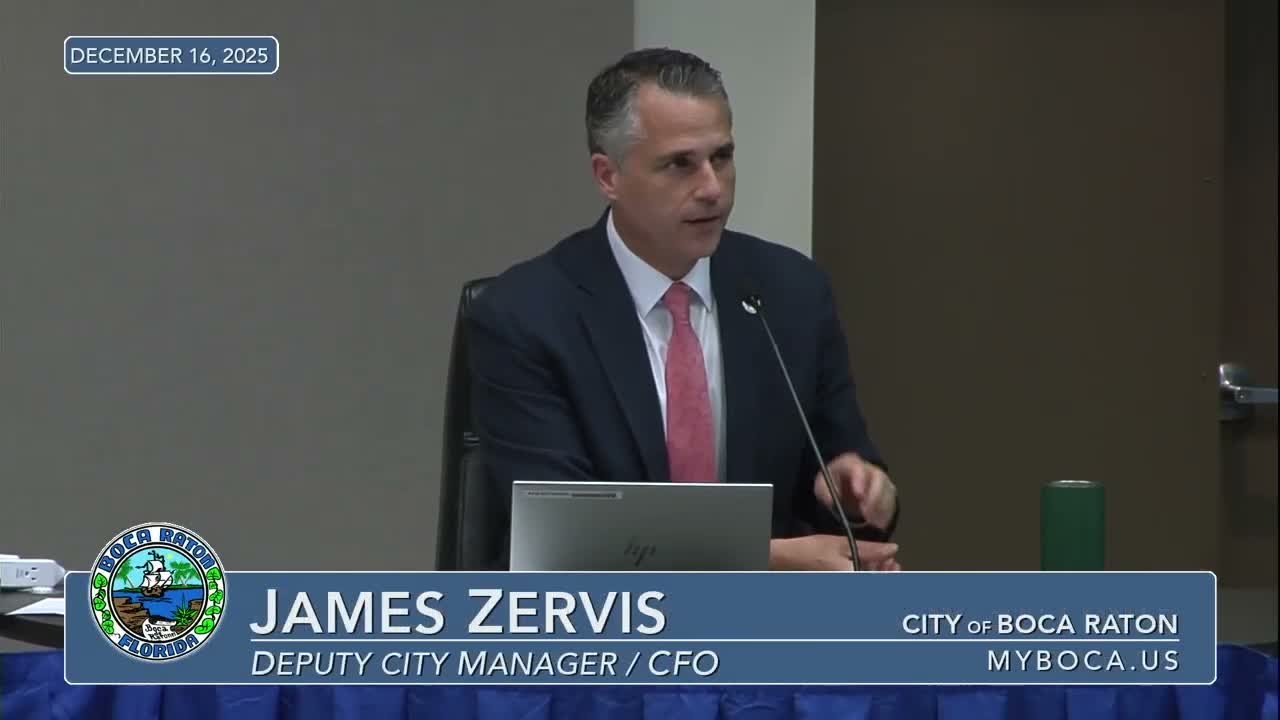
Deputy city manager/CFO Jim Zervos briefed the council on four state proposals that would reduce or eliminate non‑school ad valorem taxes on homesteaded property; the broadest option could reduce city general fund revenue by about $58 million (≈32% of non‑public‑safety budget), Zervos said, and staff outlined mitigation options including fee increases and millage shifts.
Deputy City Manager and CFO Jim Zervos told the Boca Raton City Council Dec. 16 that several pending Florida bills could substantially reduce local ad valorem revenue and materially affect city services and financing.
Zervos reviewed four bills under consideration at the state level. The broadest proposal (HJR 201) would eliminate non‑school ad valorem taxes on homesteaded property; staff estimated an immediate $58 million annual revenue loss for Boca Raton, roughly 22 percent of total general fund revenue and about a 32 percent reduction of the non‑public‑safety portion of the budget after excluding police and fire. A narrower bill (HJR 205) targeting taxpayers aged 65 and older would cost the city an estimated $27.3 million a year. Another proposal (HB 209) would increase homestead exemptions and was estimated to reduce city revenue by about $15 million annually.
Zervos emphasized the bills’ carve‑outs for law enforcement and first responders, but he said those exceptions do not remove significant long‑term fiscal stress. "If we can't touch police and fire budgets, we're looking at roughly a 32 percent reduction across everything else," Zervos said, describing potential layoffs, reduced service levels and constrained capital program options if the state does not replace lost revenue.
Staff suggested mitigation options, including raising the millage on non‑homesteaded properties (subject to statutory caps), increasing non‑ad valorem fees such as the fire assessment, reworking user fees to full‑cost recovery, monetizing city assets and selectively outsourcing services. Zervos noted each option carries tradeoffs: raising fees or the millage would shift greater burden to non‑homesteaded properties and renters, and monetizing assets or user‑fee increases would represent a major shift in Boca Raton’s longstanding revenue model.
Zervos also warned of secondary effects: economists have estimated eliminating property tax can increase home prices (he cited analyst ranges of 7–9 percent), and converting to assessment or fee‑heavy funding can be regressive. He recommended monitoring state negotiations closely; the proposals would take effect Jan. 1, 2027 if adopted and ratified by voters as required.
Council members asked for more analysis on outstanding contractual commitments for capital projects and additional scenario planning; staff agreed to provide follow‑up materials.