Lifetime Citizen Portal Access — AI Briefings, Alerts & Unlimited Follows
Boca Raton City Council reviews proposed downtown P3; public alarms over referendum clause
Loading...
Summary
City staff and consultants outlined a public–private redevelopment plan for the downtown government campus, including unit and revenue projections and a 99‑year lease structure; public commenters and candidates urged the council not to let a contract clause make the deal effective without a voter referendum.
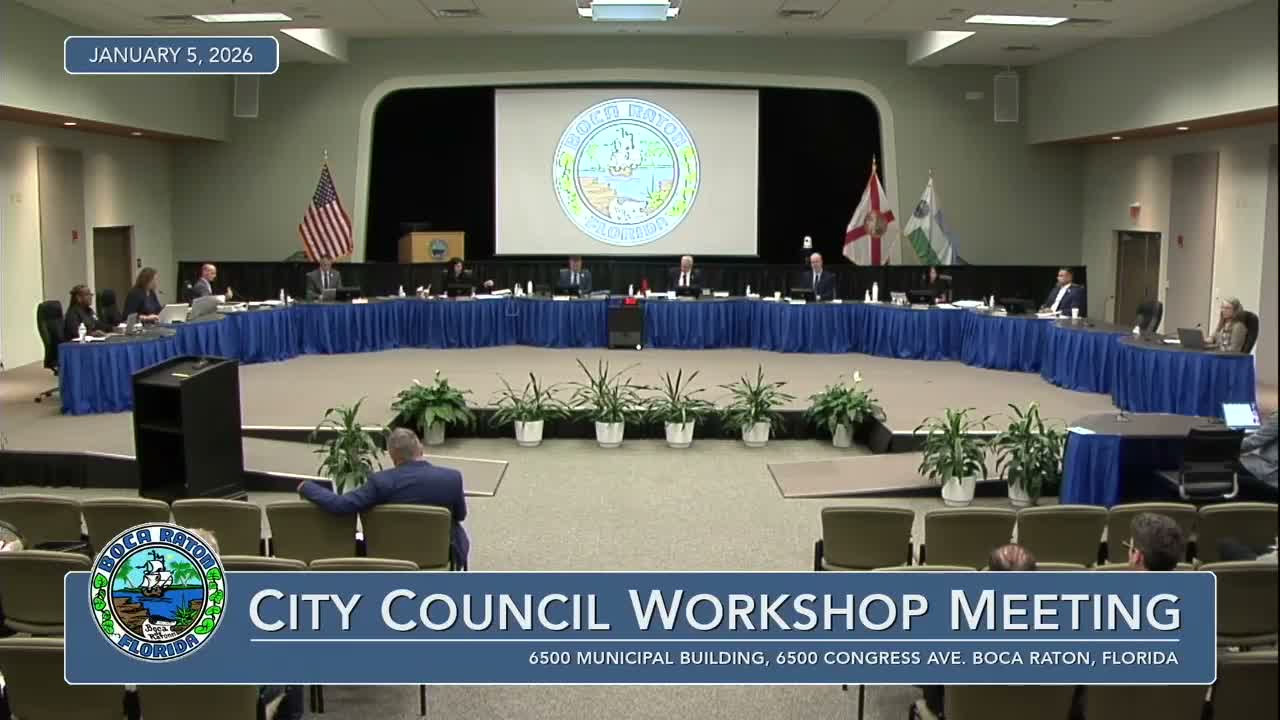
The Boca Raton City Council met in workshop on Jan. 5, 2026, to review the proposed public–private redevelopment of the government campus and related legal agreements, and heard sustained public concern about a contract provision tied to the March 10 referendum.
Deputy City Manager Andy Lukasick led the staff presentation, summarizing the conceptual master plan and the near‑term schedule. He said the project is designed as a transit‑oriented, pedestrian‑scaled district adjacent to the Brightline station with a mix of uses that includes 947 residential units (765 rentals including 77 workforce units, and 182 condominiums), 120,000 square feet of office, about 79,000 square feet of retail and commercial space, a 3,000‑square‑foot grocery, a 180‑key hotel and roughly 2,000 parking spaces, of which about 506 are planned in a public garage. Staff said the developer would make a one‑time mobility contribution of $7,800,000 and that design of West‑Side civic facilities will be guided by a robust community engagement process.
Consultants presented financial projections prepared by CBRE and PFM. CBRE’s non‑discounted revenue projection over a 99‑year term was shown as $4.1 billion; PFM’s corresponding number was $4.3 billion. Present values were reported as roughly $347.2 million (CBRE) and $330 million (PFM), and PFM estimated a net present value after operating costs of $175.8 million. Councilmembers pressed staff for clarification after earlier public figures had shown lower values; PFM representation explained that differences arose from modeling two rent‑option approaches (a percentage‑rent model versus a fair‑market rent model) rather than from a change in underlying assumptions.
City legal counsel outlined the Master Partnership Agreement (MPA), the long‑term ground lease (described in materials as a 99‑year term keyed to milestone and financing conditions), and a development management and construction agreement for civic facilities. Counsel said the agreements include enforcement rights, audit protections and provisions that retain fee‑simple ownership of the land with the city until a lease commences; he emphasized that no construction or lease commencement can occur until financing, permits and regulatory approvals are in place and until the city’s ordinary site‑plan and public‑hearing processes are followed.
Public commenters focused heavily on Section 23.24 of the draft agreement, which staff read as wording that ‘‘the failure of the referendum to occur shall not be deemed a rejection and shall have no effect on the effectiveness of this agreement.’’ Joe Majes told the council that language suggests the contract could remain binding even if the referendum does not take place, and urged the council to make the agreement contingent on a valid referendum. John Prollman accused city counsel of drafting ‘‘slanted’’ ballot language and said survivability clauses in the contract should not remain if voters reject the measure: ‘‘He put to the people, he worked with the developer on the slanted ballot language and suppressed democracy,’’ Prollman said during public comment.
Other speakers pressed for transparency and for searchable contract documents. Mike Liebelson, who identified himself as running for mayor, said he reviewed the 432‑page package and urged the council not to execute any agreement before voters have the chance to decide. Judy Morrow argued the 7.7 acres are public land and suggested alternative civic uses; she asked why a hotel would be sited there. Several speakers, including John Perlman, said they were coordinating mass email campaigns urging the council not to approve or sign the contract prior to the March 10 vote.
Council members and legal counsel responded that the clause was intended to prevent procedural or legal maneuvers (for example, a court order) from cancelling a voter decision and that counsel could propose clarifying language to affirm a city and partner commitment to hold the referendum. Several councilmembers asked that revised language be circulated in writing before the next meeting so members and the public could review it.
Next procedural steps noted by staff: the council will introduce the ordinance relating to the transaction at the meeting on Jan. 6 (no action required at the workshop); the council will consider action on the ordinance on Jan. 20 (regular meeting beginning at 10 a.m.); and, if the council approves the ordinance, the referendum is scheduled for March 10. If the referendum proceeds, rezoning, site‑plan review and further public engagement would follow prior to any lease commencement or construction.
The workshop closed after council reports and brief remarks acknowledging outgoing staff; the mayor adjourned the meeting at 3:15 p.m. tomorrow’s regular meeting and the Jan. 20 session were confirmed.