Get Full Government Meeting Transcripts, Videos, & Alerts Forever!
Get email alerts on the Rhtp topic
No spam. Unsubscribe anytime.
Montana awarded $233.5M in Rural Health Transformation funds; DPHHS outlines procurements and grants
Summary
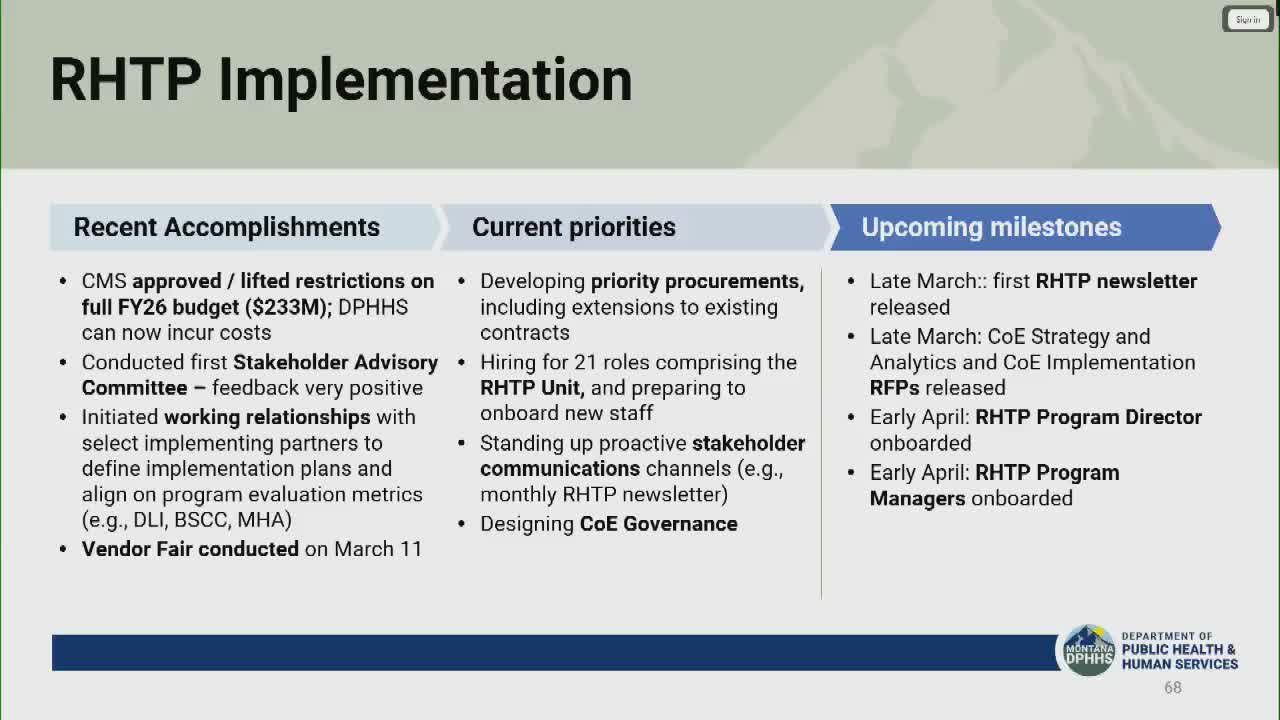
DPHHS described its plan to spend the first year of a $233.5 million Rural Health Transformation Program award, including center‑of‑excellence procurements, grants for ambulances, school‑based primary care expansions, telehealth hubs, workforce attraction and technical assistance to rural providers.
The Department of Public Health and Human Services told the subcommittee that Montana’s application to the federal Rural Health Transformation Program (RHTP) was approved and that the state has access to year‑one funds after CMS lifted initial restrictions. The department outlined a multi‑pronged implementation plan that blends competitive procurements, direct grants and partnerships with other state agencies.
Key planned procurements include a Center of Excellence (COE) strategy and analytics vendor to analyze county‑level utilization trends and propose facility‑level recommendations, and a COE implementation vendor that would provide hands‑on technical assistance and serve as a grant intermediary to distribute incentive and transformation funds to participating rural providers. Other near‑term RFPs will solicit vendors for talent attraction, school‑based primary care expansions, emergency medical services infrastructure, and EHR readiness assistance.
DPHHS articulated grant streams that will be open to hospitals, clinics, providers and community groups for projects such as ambulatory renovations, telehealth hub expansions, community paramedic training and pharmacy point‑of‑care startup costs. The department emphasized that funding and procurement design will prioritize rural and frontier communities and that CMS will visit the state during the year‑one monitoring period.
Committee members asked how the department will avoid a common problem—one‑time federal dollars creating programs that end when the grant expires. DPHHS said it is developing sustainability plans for each initiative and will report on those strategies in coming months. Public commenters and committee members urged transparency, small‑business participation and specific metrics for measuring success and equity of rural reach.