Get Full Government Meeting Transcripts, Videos, & Alerts Forever!
Get email alerts on the Government Campus P3 topic
No spam. Unsubscribe anytime.
Independent review shows revenue but flags funding gap and exclusions in Boca Raton downtown P3
Summary
PFM presented a conservative fiscal and economic analysis of the proposed downtown government campus P3, projecting positive long‑term net fiscal impacts but identifying an approximate $87 million funding gap for public facilities and excluding transfer fees and upside profit sharing from bondable revenues; public commenters and council members raised legal and valuation concerns.
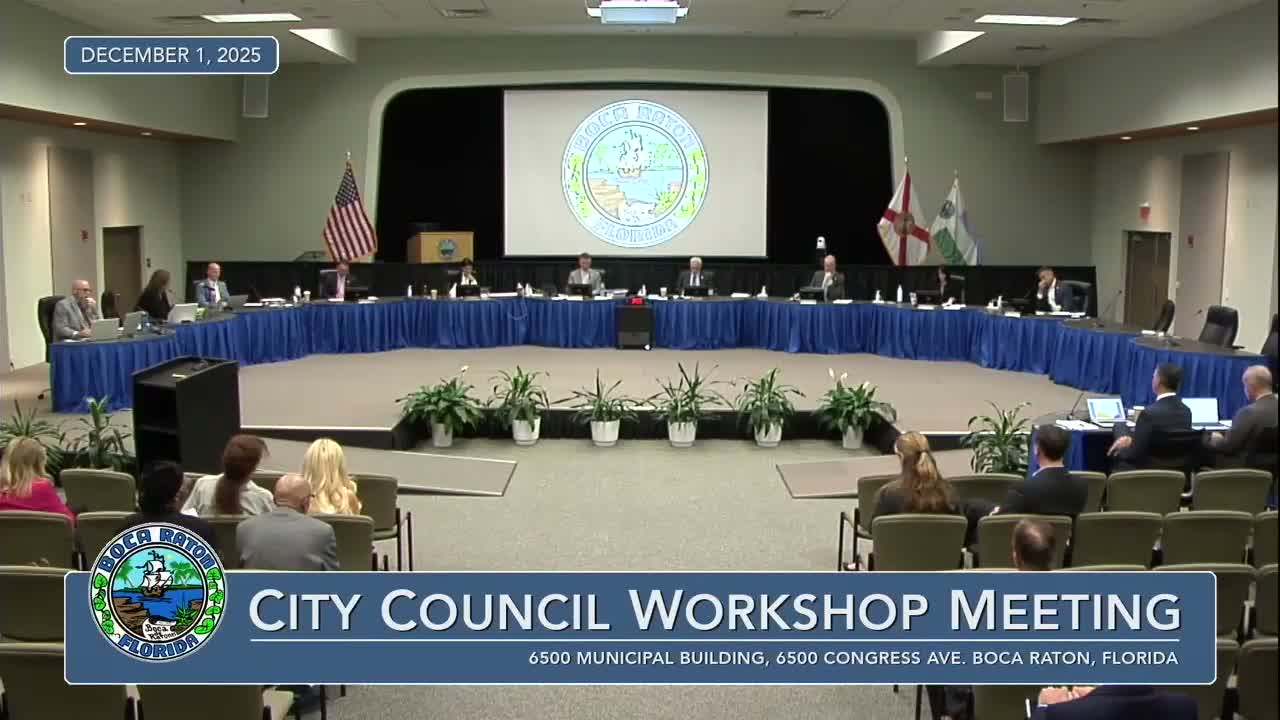
PFM Group, the city’s independent financial consultant, presented its fiscal and economic analysis of the proposed downtown government campus public–private partnership to the Boca Raton City Council on Dec. 1, projecting long‑term net fiscal benefits but identifying a material near‑term funding gap and excluding certain developer‑proposed revenues from bond calculations.
Jim Zervis, Boca Raton’s chief financial officer and deputy city manager, introduced the presentation and said PFM’s scope covered economic impacts, the project’s fiscal impact on city finances and options to fund required public improvements including a rebuilt Memorial Park and city facilities. Kevin Plensler of PFM said the firm focused on “scenario 4,” a reduced‑density plan, and that on a full stabilization basis that scenario shows an annual net fiscal impact of just under $10,000,000 at full build‑out.
PFM told council it followed Florida public‑private partnership statutory guidance and ran conservative assumptions when projecting bond‑able revenues. Mallory Richards of PFM said the firm excluded two developer‑proposed revenue streams—the 1% transfer fee and upside profit‑sharing—from revenue available for bond repayment because those sources are not scheduled or reliably predictable for debt service. Plensler said the firm used a 5% discount rate for net present value calculations, explaining that “we felt very comfortable that a 5% was a reasonable expectation given the riskiness of the cash flow.”
PFM’s capital revenue estimates include a $7.8 million upfront payment, phased over four years, and modeled bond structures that assumed a 30‑year city issuance and a shorter CRA issuance timed to a CRA sunset. The presentation showed total project construction costs just over $200 million and modeled project‑generated bond capacity of about $114 million, producing a modeled funding gap in the range of tens of millions of dollars (PFM and multiple speakers referenced an $87,385,000 figure in public comment as the funding gap). Council and staff identified potential local options to address the gap—CRA bond capacity, proceeds from the sale of the golf course and available CRA cash—but staff cautioned those funds have constraints, including CRA eligibility and timing.
Council members pressed PFM on differences between its analysis and the developer/CBRE projections. PFM and staff said the key differences were (1) PFM’s exclusion of transfer fees and upside profit‑sharing from bondable revenues, (2) inclusion of estimated operational expenditures attributable to new development, and (3) a more conservative discount rate (5% for PFM versus 4.5% used by CBRE), all of which reduced modeled bond capacity.
During the public hearing, residents sharply criticized the proposed deal structure and the city’s approach. John Perlman said “we’re giving this land. We’re entering into this deal, and we’re at a negative in terms of being able to fund what we need to,” and questioned reliance on developer‑supplied appraisal numbers and proprietary pro formas. Michelle Grau, a CPA, told council a 99‑year agreement is risky while state tax rules are under review and urged the city to “Forget about doing this deal. Let’s do it on our own, build our own public facilities ourselves.” Other speakers asked for the Walter Duke appraisal to be released before tomorrow’s council vote and argued the ballot language that would have sent the measure to voters was found unconstitutional by a court.
City Attorney (Mr. Goler) clarified the court’s ruling: the judge found the petition language unconstitutional and the measure was removed from the January ballot; he also said the city did not draft petition language and had limited ability to change it. Jim Zervis emphasized the CRA numbers shown in the presentation represented borrowing capacity, not cash on hand.
Council did not take formal action at the workshop; the council noted appointments to boards and said it would continue the matter and expect another presentation the following evening. The council discussed next steps and possible ordinance language to address public land dispositions.
The council is scheduled to consider appointments and additional presentations related to the downtown campus at its next meeting; no votes on the P3 were recorded at this workshop.