Get Full Government Meeting Transcripts, Videos, & Alerts Forever!
Get email alerts on the Urban Planning topic
No spam. Unsubscribe anytime.
1 Boca presents downsized plan for downtown campus; residents and advocates loudly oppose leasing public land
Summary
Developer Terran Frisbie presented a revised downtown government‑campus plan that keeps Memorial Park public and shrinks leasable area to under 8 acres, while projecting $3.8 billion in gross revenue over 99 years; public comment was extensive and sharply split, ranging from legal challenges to vocal support for jobs and safer fields.
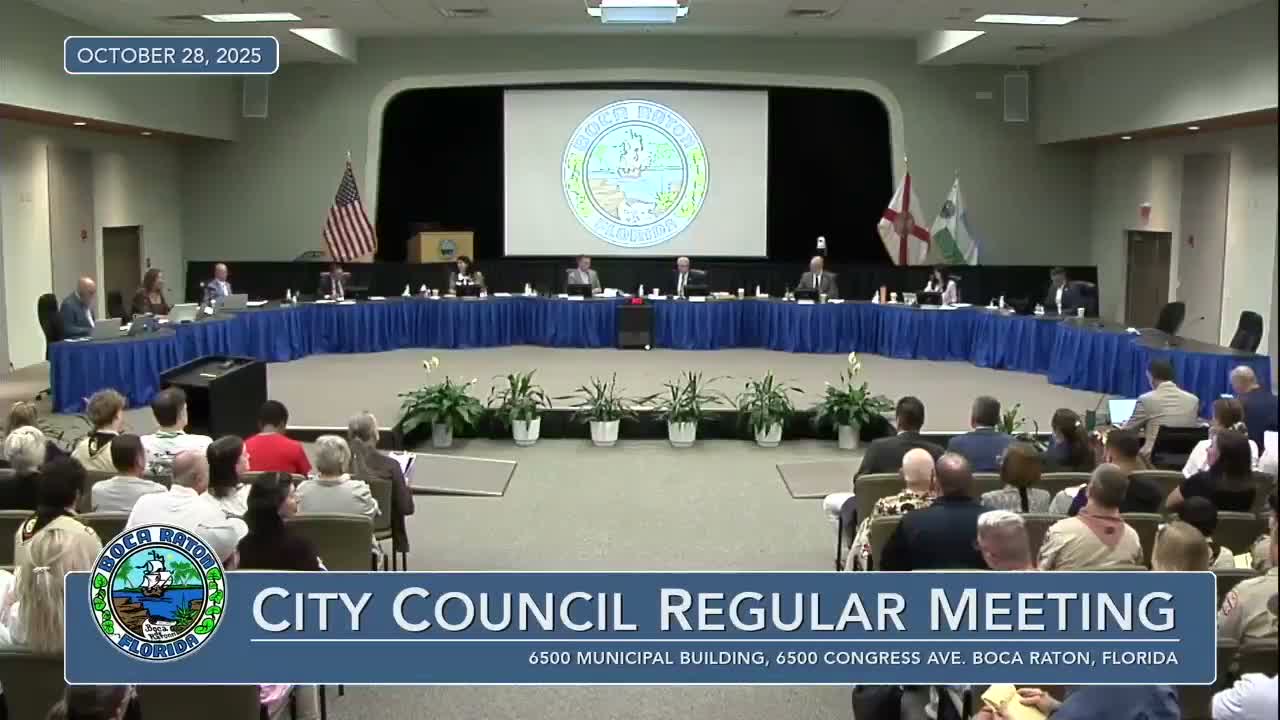
Rob Frisbie, representing the 1 Boca team, presented a revised master plan for the downtown government campus at the Boca Raton City Council meeting on Oct. 28, promising to keep all land west of NW 2nd Avenue in public ownership, double public recreational space and reduce leasable land east of NW 2nd Avenue to under 8 acres.
Frisbie summarized the plan’s core commitments: preserve Memorial Park and its banyan trees on the west side; locate mixed‑use development east of NW 2nd Avenue on largely transit‑adjacent private parcels; and increase public recreational acreage from about 7.6 acres to 15.4 acres. He said the plan would include roughly 769 residential units, 186 condominium units, a 150,000‑square‑foot office building and a 180‑room hotel in a revised footprint with lower overall square footage than prior iterations.
Financials cited by the developer: "We're looking at a total gross revenue of $3,800,000,000 over the 99‑year term. That's a net present value of $370,000,000," Frisbie said during his presentation. He added that, excluding real estate taxes, the NPV of rental payments would be about $217,000,000.
Staff process and review: Deputy City Manager Andy Lukasick briefed the council on staff work evaluating the master plan, including appraisals, revenue projections and high‑level traffic and infrastructure analyses. He said the city engaged PFM as an independent financial consultant to examine the pro forma, statutory P3 criteria and public benefit analyses.
Public reaction: The public comment period ran nearly two hours and featured dozens of speakers. Some residents urged the council to approve the plan, saying it would modernize downtown, create jobs and pay for park improvements. Many more opposed the plan, raising concerns about transparency, P3 financing, environmental impacts (including protected gopher tortoise habitat), the loss or relocation of long‑used recreation facilities and whether the promised financial guarantees and bonds exist.
Legal challenge: Dr. Lorraine Blank told the council she has filed a lawsuit seeking an injunction, arguing the project lacks a required cost‑effectiveness analysis under the P3 statute; she said the first hearing is scheduled for Dec. 12.
What’s next: Council members said staff will provide additional independent financial analysis at a subsequent meeting; in parallel, councilors referred two citizen‑initiated ballot measures restricting large land disposals to the Jan. 13, 2026 special election. The council did not approve a final development agreement on Oct. 28.
Context: The revised plan follows months of workshops, open houses and evolving renderings. Residents and advocacy groups remain divided on whether the city should pursue a long‑term lease model with a private partner or preserve public ownership and deliver public facilities through other funding mechanisms.