
Senator McNerney backs $150 million/year to shore Delta levees, address subsidence risk
Get AI-powered insights, summaries, and transcripts
Sign Up Free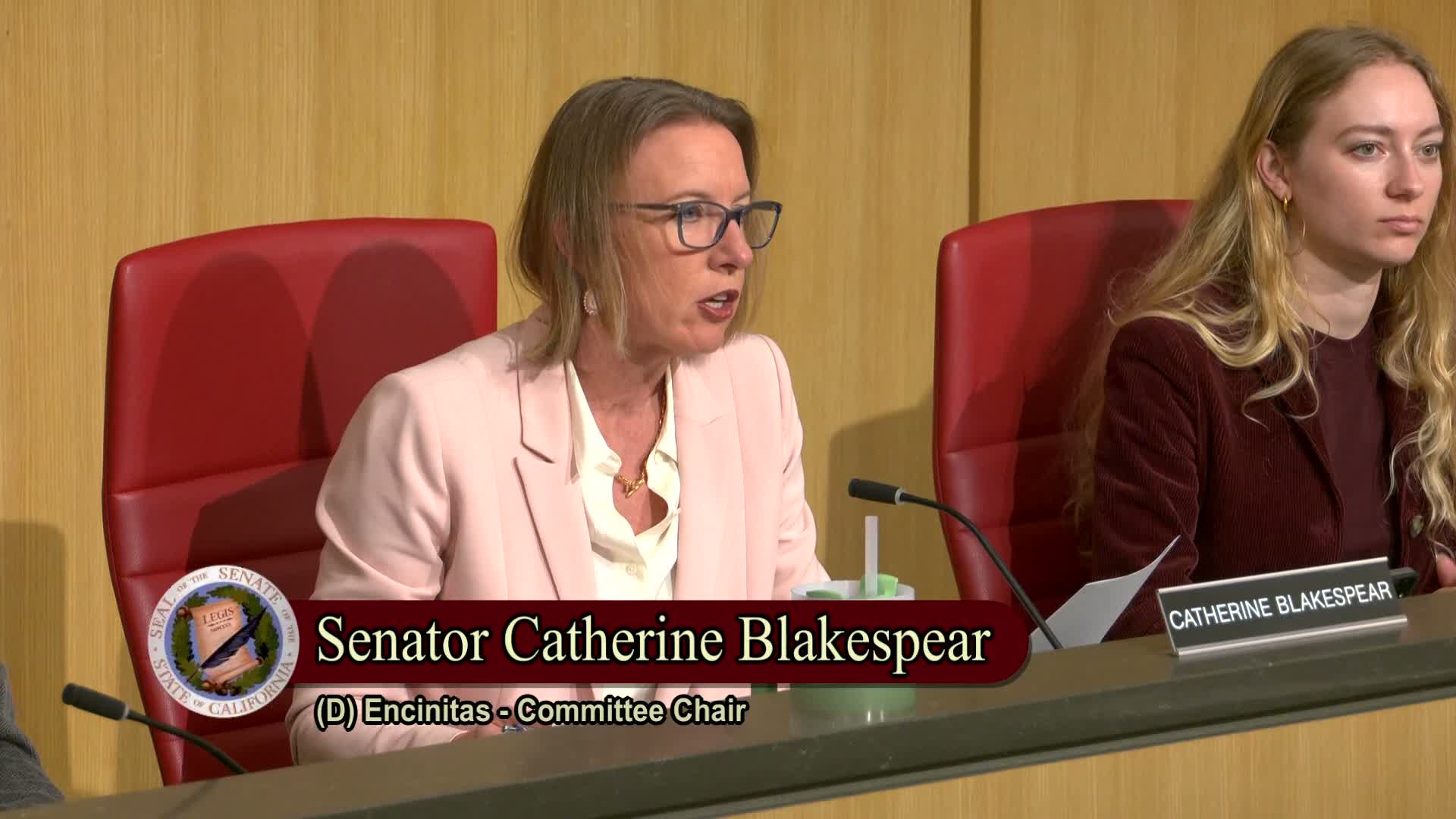
Summary
SB 872 would direct $150 million a year each to fix Central Valley subsidence and Delta levee vulnerabilities that sponsors say threaten water deliveries to 27 million Californians and expose roughly $22 billion in state assets; supporters range from water districts to environmental groups.
Senator McNerney introduced SB 872, saying the measure would direct $150 million a year to address subsidence in Central Valley conveyance canals and another $150 million a year to repair Delta levees.
"If the subsidence continues further, then the aqueducts will be unable to produce, deliver water to Southern California," McNerney said, warning of potential failure timelines cited in testimony. He told the committee the aqueduct system serves about 27 million people.
The bill’s author and lead witnesses told the Senate Committee on Environmental Quality that subsidence from over‑pumping and aging levees built in the late 1800s and early 1900s are creating urgent risks for infrastructure, public safety and the state economy. Morgan Snyder of Restore the Delta said the Delta economy generates nearly $7 billion annually and supports recreation, commercial fishing, tribal resources and agriculture. "Delta levees are foundational in protecting these communities and economies from flood risk," Snyder said.
Jennifer Pierre, general manager of the State Water Contractors, said repairs are essential to maintain the State Water Project’s ability to move and store water for climate resilience. She told members that while the Sustainable Groundwater Management Act reduces future subsidence, historical damage must be repaired or the state could face delivery disruptions by 2045.
Support for the bill included multiple local water agencies and conservation groups that said statewide coordination and funding are needed to prioritize high‑risk levee segments and preserve drinking water supplies. Several witnesses noted a federal commitment of $540 million for federally owned California water infrastructure and urged complementary state investment.
During questions, Senator Valadares asked why state funding is limited to state‑owned conveyance; McNerney replied that responsibilities are typically split between the State Water Project (state) and the Central Valley Project (federal), so SB 872 focuses state funds on the state portion of conveyance.
The committee moved the bill as amended to the Senate Natural Resources and Water Committee. A roll call showed Senators Blakespear, Valadares, Allen, Hurtado and Menjivar voting aye and the motion recorded as 5 to 0.
The bill’s next stop is the Senate Natural Resources and Water Committee.