Get Full Government Meeting Transcripts, Videos, & Alerts Forever!
Get email alerts on the Transportation Infrastructure topic
No spam. Unsubscribe anytime.
Traffic study outlines six roadway and pedestrian changes to support proposed Browns stadium in Brook Park
Summary
NOACA and consultants presented a 2030 traffic simulation and six priority infrastructure changes—ramp widenings, a southbound flyover, Angle Road realignment, a connector and potential pedestrian bridge—to reduce event-day congestion concentrated at Snow Road and Bagley interchanges.
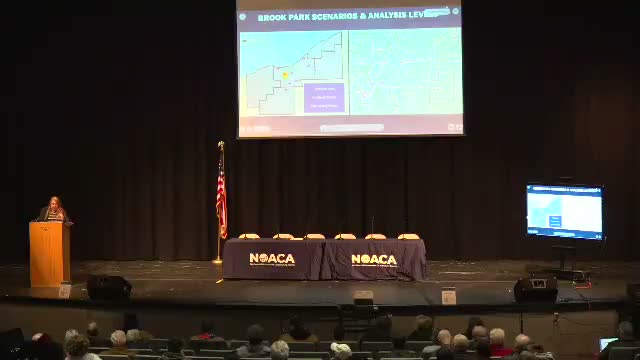
NOACA and engineering consultants presented a traffic analysis for the proposed Cleveland Browns stadium and surrounding development and outlined six priority transportation improvements intended to limit event-day congestion.
The presentation, delivered by Dr. Ali Makarachi, NOACA’s director of special projects, used a 2030 build-year scenario and seasonal-ticket ZIP-code data to estimate origins. “So if it's a 65,000 people coming to the event…there's gonna be something like 22,000 over 22,000 cars,” Makarachi said, emphasizing the analysis focused on the weekday afternoon–evening peak (3–7 p.m.). The model measures travel time and delay, and organizers said they use an 85% capacity threshold (roughly LOS D) to judge whether links need additional investment.
Osborne Engineering’s director of transportation Dennis Albrecht listed the six improvements the technical team is analyzing: widening the I‑71 northbound exit ramp to Snow Road, constructing a new southbound flyover ramp to bypass Angle Road and the CSX rail crossing, Snow Road corridor improvements, realigning and widening Angle Road to align with the site entrance, a connector between Snow Road and Angle Road (formerly called a ‘ring road’), and a potential pedestrian bridge or surface crossing treatments to separate people from traffic.
Albrecht said the flyover would “go over the top of Angle Road and CSX railroad tracks” and that most work would occur on ramp and connector alignments rather than I‑71 mainline lanes. The team showed comparative simulations for three cases—base (no stadium), no-build (stadium without infrastructure), and build (stadium plus the six improvements)—and said the build scenario reduced total delay across the study’s influence area and county compared with no-build conditions.
Panelists acknowledged congestion would concentrate at two interchanges—Snow Road/I‑71 and Bagley Road/I‑71—and that improvements would focus there. Makarachi said impacts on longer-distance trips to Hopkins Airport and Southwest Hospital would be modest in aggregate (generally increases measured in about one to two minutes), though some neighborhoods could see localized effects.
The team described construction staging and traffic maintenance during work: most corridors would remain open with lane reductions and detours; only the Angle Road realignment segment may require a temporary closure for a couple of months. Dennis Albrecht said design work was advancing rapidly so contractors could phase construction to limit simultaneous closures.
Panelists stressed that the freeway network has remaining capacity to absorb additional volume but that arterials and local roads will need targeted changes and active event‑day operations to ensure acceptable service for non-event travelers. NOACA and partners plan further study and phased implementation of additional measures outside Brook Park as needed.
The next procedural steps include additional targeted studies (for example on Bagley Road and Angle Road intersections), design completion, and continued public engagement before final project approvals and construction bidding.