Get Full Government Meeting Transcripts, Videos, & Alerts Forever!
Get email alerts on the Municipal Budget topic
No spam. Unsubscribe anytime.
Brook Park mayor proposes $28.5 million 2026 budget; council presses on revenue assumptions and Browns project planning
Summary
Mayor Orcutt introduced an ordinance to appropriate funds for Brook Park's 2026 fiscal year, proposing roughly $28.5 million in general-fund appropriations, a 3% salary cost-of-living increase and new funds for public-safety cameras and building projects. Council members questioned revenue assumptions and how Browns stadium-related receipts will be reserved.
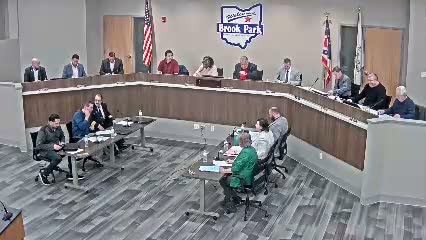
Mayor Floyd Orcutt on Tuesday introduced Brook Park's proposed 2026 appropriations ordinance and asked the city's finance director to walk council through a multi-page packet that lays out revenue projections, transfers and capital spending.
"We're excited to announce the budget," Orcutt said as he handed the presentation to Finance Director Bob McGahn. McGahn told council the city began 2026 with a projected unencumbered fund balance of $11,076,685.23 and a reserve-policy target of $5,964,807. He framed the budget around rising personnel and insurance costs and a conservative revenue outlook.
"Starting with the 2026 key budget points...our fund balance at 01/01/2026 was projected at $11,076,685.23," Finance Director Bob McGahn said, noting salary increases, health-insurance costs and inflation as primary drivers.
McGahn listed a set of revenue and transfer figures shown in the packet, including a projected income-tax transfer schedule and property-tax estimates. The packet as transcribed contains several formatting and numeric irregularities (for example, a general-fund line appears in the record as "27,000,027,610,000", which McGahn identified as a typographical error); McGahn clarified concrete figures he expects to rely on, including an income-tax projection of $24,510,000 for 2026 and projected property-tax revenues near $2,431,677.
Council members pressed McGahn on the nature of the $11 million balance and on investment and collection assumptions. McGahn said the balance is unencumbered and that the city's investment options are limited (the city uses Star Ohio), so staff budgets conservatively for interest income. He also pointed out Cuyahoga County's guidance that collection rates could fall to about 92% (from the more typical 96'98%), a shortfall that would require council and administration to revisit appropriations if it materializes.
Council members and the mayor discussed how revenues tied to the Cleveland Browns construction projects would be handled. Orcutt said those negotiated revenues are not included in the packet yet, and that the administration expects to reserve and assign portions of any future stadium-related receipts to pay for increased public-safety staffing, traffic mitigation, sidewalks and related infrastructure.
"As we put the financial modeling together, we're going to have to take what we generate from that ... to be able to build up our workforce," Orcutt said, adding that some funds will be put aside early to cover police, fire and service needs rather than funneled directly into general operations.
On the expenditure side, McGahn reiterated a planned 3% salary increase tied to negotiated contracts, a police employer-pension assumption budgeted at 20.5% because of pending state-level proposals, and estimated health-insurance increases roughly in the 20% range. The packet shows proposed general-fund appropriations near $28.5 million and identifies transfers to targeted funds (economic development, water-park, bond retirement, retiree-benefit, police and fire pension funds and others).
The mayor also previewed capital items in the packet: a fold-out capital worksheet that includes purchases and leases for police and fire (a $495,000 police line, replacement turnout gear, radio leases and a future ladder truck specification), water-park pump replacement, park improvements and vehicle acquisitions for the service department.
McGahn and Orcutt said the budget creates two new funds: a police camera fund (fund 490) and a safety building construction fund (fund 555), to be seeded with transfers from the insurance fund. The mayor said the camera fund will be used to pay for an on-street traffic-camera system and other public-safety capital needs.
Council members asked procedural questions about timing. The administration and council agreed to move the ordinance to first reading; the clerk assigned it ordinance number 11516-2026 and it will appear on the special meeting agenda for first reading and subsequent consideration.
What happens next: the council moved the appropriations ordinance to first reading (11516-2026) at the special meeting that followed the caucus; council asked finance staff for a brief follow-up on the proposed new funds and any clarifying numbers before further action.