Get Full Government Meeting Transcripts, Videos, & Alerts Forever!
Get email alerts on the Public Safety topic
No spam. Unsubscribe anytime.
Hudson police chief outlines staffing, response numbers and plans for body cameras
Summary
At the March 10 Hudson City Council workshop, Chief Perry Tabak briefed council on department staffing (about 50 employees, 33 full‑time officers), about 26,000 annual calls for service, a 3‑second average 9‑1‑1 answer time and plans to lease an integrated body‑worn and in‑car camera system. He flagged nationwide recruiting pressures and said staff supports peer‑support and equipment strategies to mitigate officer stress.
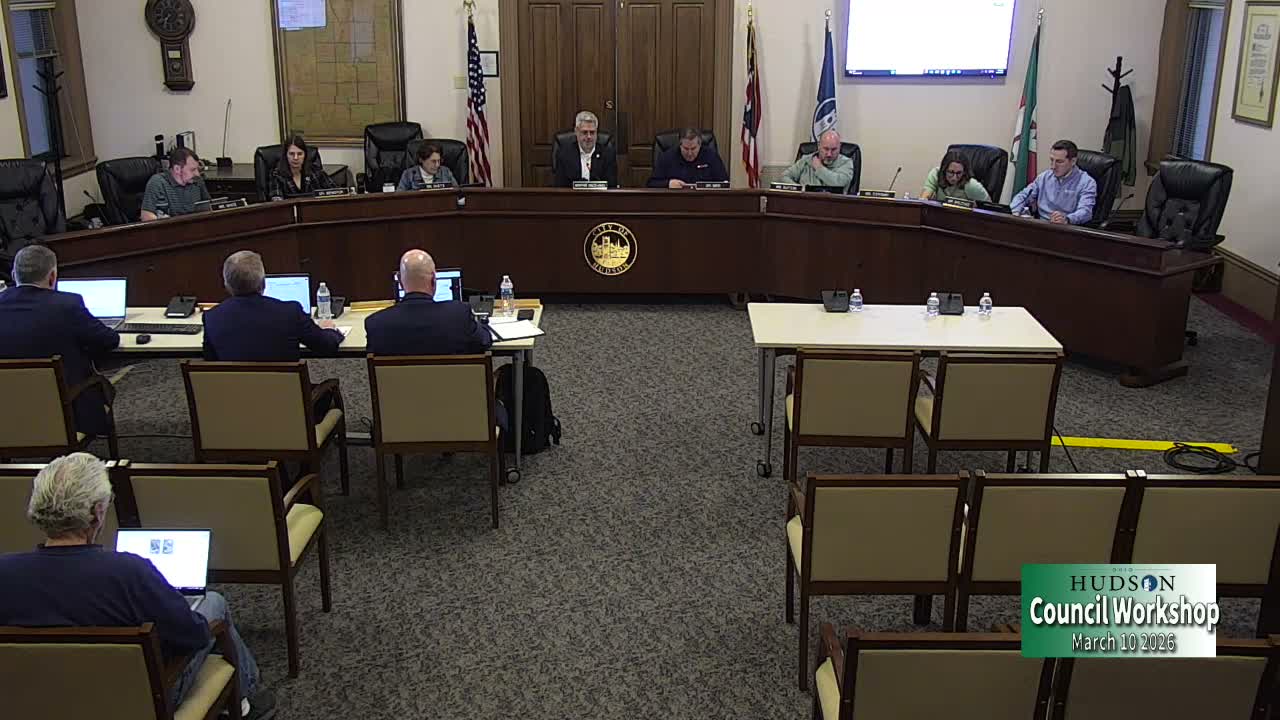
Chief Perry Tabak told the Hudson City Council at a March 10 workshop that the Hudson Police Department employs roughly 50 people — about 33 full‑time officers, 10 dispatchers (seven full time) and several part‑time staff — and handles about 26,000 calls for service a year. "We're a fairly busy police department for a small department," Tabak said, adding that many calls are service‑oriented rather than criminal.
Tabak highlighted dispatch performance and equipment updates. "Ohio requires 99% of 9‑1‑1 calls to be answered within 15 seconds. The Hudson Communications dispatch center averages 3 seconds," he said, noting that the figure represents a multi‑year average. He also described a small e‑bike program (four e‑bikes in service) and said the department plans to expand deployments seasonally as staff permits.
Why it matters: staffing, response times and equipment choices affect how the department delivers public safety services and how council budgets for technology and personnel. Tabak emphasized recruiting and retention as the department's central challenge. "There's a shortage of highly qualified applicants in the police profession," he told council, noting the department currently has one open position and anticipates two additional openings in the near future. He described hiring ahead of known retirements and over‑hiring as strategies to prevent gaps.
Tabak also discussed body‑worn camera procurement. He said the city will not buy the devices outright but will use a multi‑year lease/service model to keep pace with rapid technology changes. "We actually won't own the equipment ... we're leasing a lot of stuff ... at the end of a 5‑year lease, the stuff's obsolete," Tabak said while explaining the department's recommendation to move to a leased integrated system. Council later discussed a staff resolution to contract with Axon for an integrated body‑worn and in‑car camera system; staff said the roughly $328,000 figure is a multi‑year lease and service cost, not a single upfront purchase.
Council members asked about mental‑health calls, officer support and whether the department needs other capital items. Tabak said mental‑health related calls have increased over his career and that Hudson offers peer support, critical‑incident debriefings and Employee Assistance Program resources for staff. He described new internal peer‑support training, opportunities for confidential resets for officers following difficult calls and partnerships with regional responder support organizations.
What happens next: council will consider associated procurement and budget items on upcoming agendas (including the Axon camera agreement referenced during the briefing). The chief said he will provide follow‑up details when requested.