Get Full Government Meeting Transcripts, Videos, & Alerts Forever!
Get email alerts on the Traffic Calming topic
No spam. Unsubscribe anytime.
Lima Council advances neighborhood traffic‑calming plan, sends issue to Council of the Whole
Summary
After a presentation from the city engineer and consultant, council voted to refer the matter to Council of the Whole for further review while directing staff to continue preparatory work and pick two pilot streets for concept design.
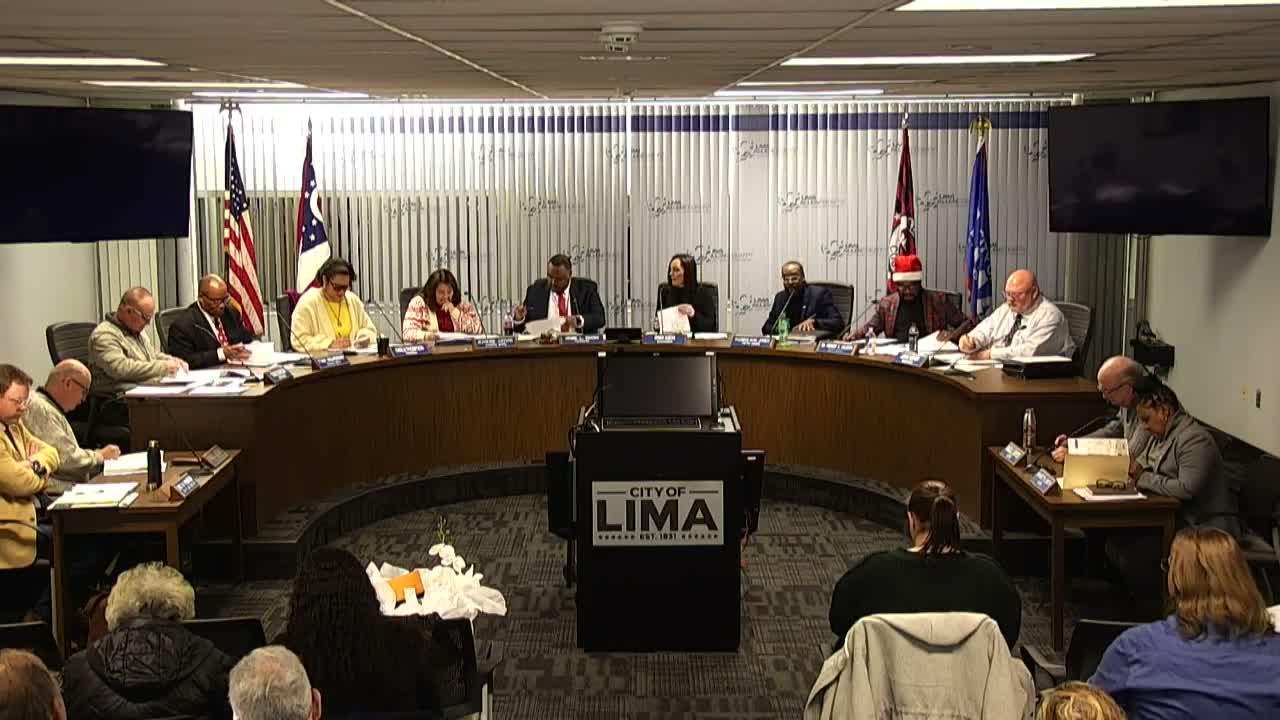
Councilors heard a second workshop on a neighborhood traffic‑calming program on Dec. 23 and voted to move the issue to Council of the Whole for more discussion while allowing staff to continue preparatory work.
City Engineer Ian Colai introduced the item and Drew Parker of Tool Design presented outreach findings, data and a proposed process. Parker said the team collected two public workshops and 164 survey responses and recommended a four‑step program: identify a concern, determine eligibility, develop solutions with the community and evaluate effectiveness after installation.
Parker said the program focuses on local streets and outlined screening criteria: a primary threshold in which an 80th‑percentile speed at or above 30 mph (or more than 1% of vehicles traveling at or above 40 mph) would make a street eligible; a secondary threshold (80th percentile ≥27.5 mph or >1% at 35 mph) could apply near parks, schools or where serious crashes occurred. He also described a reactive petition path that would require signatures from at least 50% of households on a street, followed by a street survey with a 30% response rate and a majority (50%+) support among respondents before implementation is considered.
Councilors pressed staff on decision authority, timelines and whether the plan would sidestep council oversight. One councilor urged faster action after years of local complaints and a serious crash in his ward, saying residents expected concrete measures rather than additional studies. The mayor and others said the program establishes a consistent framework to evaluate requests and noted proposed 2026 budget funding for initial implementation.
Councilor Nipper moved to place the traffic‑calming program into Council of the Whole for further discussion; the motion passed by voice vote. Council clarified that staff may continue behind‑the‑scenes work — drafting petitions, producing standard engineering drawings and selecting two pilot streets for concept design — and aim to have concept plans by April. Staff and consultants said they would consult emergency services before finalizing designs.
Why it matters: the policy sets objective eligibility rules and a resident petition pathway for neighborhood traffic calming while preserving council oversight. The referral to Council of the Whole indicates more detailed policy and priority discussion is forthcoming before construction funds are allocated.
Key quotes: “ We received 164 responses, which is pretty good for that type of survey,” Drew Parker said, summarizing community input and the top strategies residents favored (speed humps/cushions, higher‑visibility enforcement, raised crosswalks and traffic circles).
“ We’ve been on that subject for 8 years … and now we’ve got a gentleman that will be crippled for the rest of his life because we’ve done nothing,” Councilor Nipper told colleagues, pressing for clearer, faster action.
Next steps: staff will work with the consultant and public safety departments to identify two high‑priority streets for concept design and post program materials on the city website; Council of the Whole will review the plan in committee before any construction funding is approved.