Get Full Government Meeting Transcripts, Videos, & Alerts Forever!
Get email alerts on the Economic Incentives topic
No spam. Unsubscribe anytime.
Consultants tell Delaware council the city can be selective with incentives; recommend matrix and transparency
Summary
Bricker Grama consultants told council the city's economic development program is strong but recommended refining the CRA ordinance, adopting a decision matrix for incentives, and publishing public-facing templates and data; they cited 2024 figures of roughly $1.8M in CRA foregone revenue and about $10.4M redirected into TIF funds.
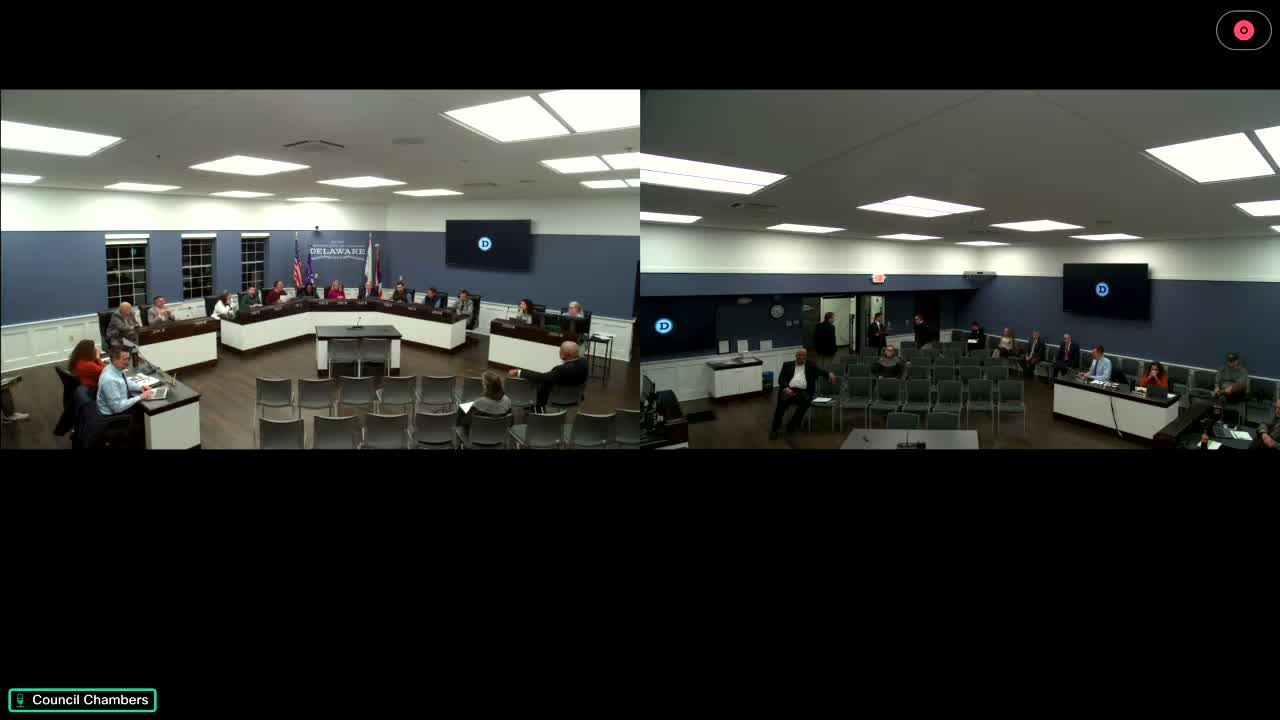
Consultants from Bricker Grama told the Delaware City Council on Nov. 24 that the city lready performs well on economic development but should adopt clearer standards for when to use taxpayer-funded incentives.
"One is the city knows what it's doing," Jeff Harris said in a blunt opening that praised city staff and framed the consultants' work as an assessment rather than a critique. Harris and Mike Jacoby outlined three takeaways: the city has core competencies, the CRA ordinance needs refinement, and the council should publicly state what it will and will not support.
"No is a complete answer," Harris said, urging clear boundaries for incentives so developers can quickly understand whether a project is viable for city support. The consultants recommended a project-evaluation "matrix" that would score proposals on fiscal impact, infrastructure needs and public benefit, rather than relying solely on a strict return-on-investment threshold.
They provided figures to illustrate scale: in tax year 2024 the city recorded about $1.8 million in foregone tax revenue tied to active CRA projects and roughly $10.4 million in redirected property tax revenue into TIF escrow funds. The consultants said those numbers show the city already uses incentives at scale and that better documentation and templates would improve transparency.
Council members asked whether a matrix would include ROI thresholds; the consultants said the matrix should be informed by ROI calculations but also weigh qualitative priorities such as schools, infrastructure, and long-term land strategy. They also suggested exploring options like community improvement corporations or land acquisition strategies to give the city more leverage when shaping development.
Next steps: the consultants said they will return with implementation materials, legal templates and a final report in early 2026; council members welcomed the direction and asked staff for additional fiscal comparisons where available.