Get Full Government Meeting Transcripts, Videos, & Alerts Forever!
Get email alerts on the Campus Master Plan topic
No spam. Unsubscribe anytime.
Boca Raton council presses ahead on downtown campus master plan while debating connectivity and scope
Summary
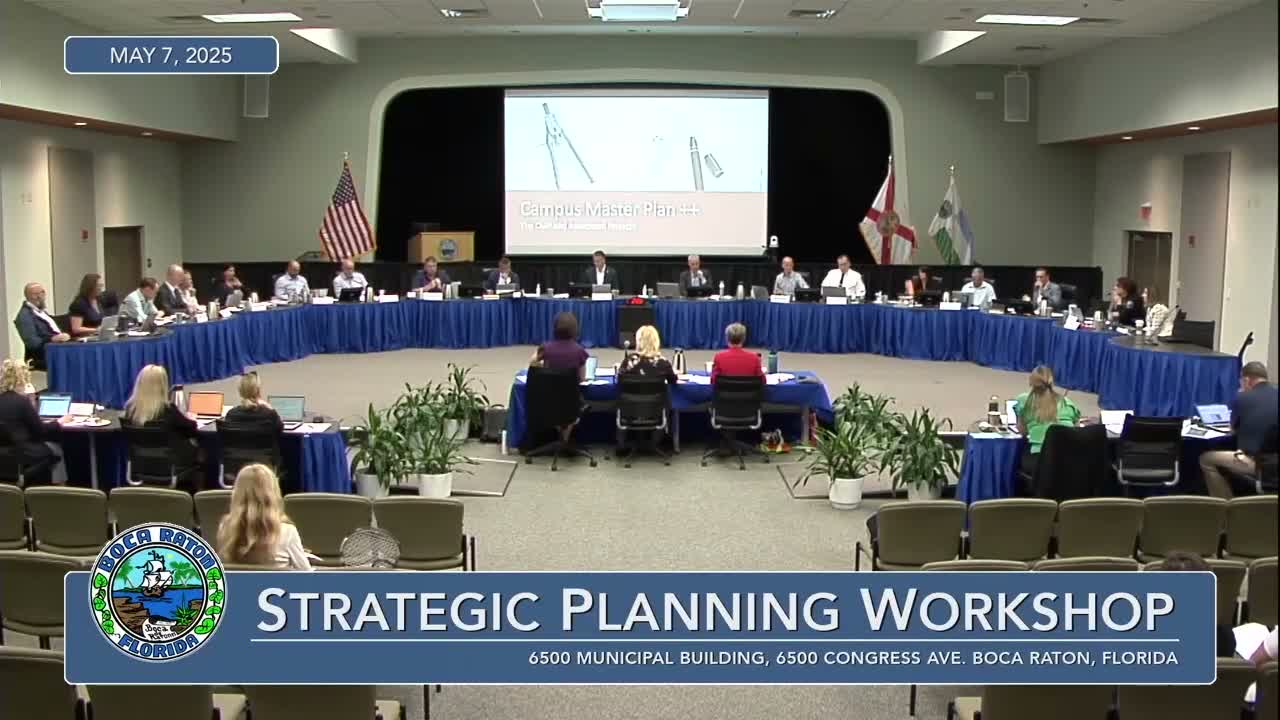
At a May 7 strategic planning workshop, Boca Raton leaders framed the downtown 'campus master plan' as a top generational priority and debated how tightly it should be tied to related projects, transit overlays and street designs; staff said an interim plan is due May 12 and recommended focused follow-up workshops.
Mayor Mary Singer and outside facilitators opened a two‑day strategic planning workshop in Boca Raton on May 7 focused on long‑range outcomes for 2035 and 2050 and the city’s downtown campus master plan. Facilitator Trina Pulliam told the council the session was intended to be “outcome‑oriented” and participatory so staff could leave with clear direction.
Councilmembers broadly endorsed a vision of a mixed‑use, walkable downtown tied to transit, but disagreements emerged over how prescriptive regulations should be and how projects should be sequenced. “I think you’ve outlined them well,” Mayor Singer said, endorsing the general approach while urging pragmatic follow‑through.
The council debated whether the campus master plan’s land‑development rules should be written to later replace the existing downtown development order and whether a separate transit‑oriented overlay was required around the Brightline and Tri‑Rail stations. City planning staff said the preferred strategy is to write targeted regulations for the campus that could then inform broader downtown rules.
Councilmembers and staff also discussed pedestrian connectivity across busy corridors. Some members urged a bolder approach—tightening lane widths, prioritizing pedestrian‑dominant streets, even temporary closures to test activity—while staff cautioned that technical traffic studies and emergency‑access requirements must guide any changes. “If you truly want it to be a vibrant area, sometimes you could close off the street,” a councilmember said in the discussion about Second Avenue and a possible pedestrian emphasis.
Staff reported an aggressive schedule: work groups are active and an interim plan from the campus partner was expected by May 12. Council and staff agreed to at least one dedicated workshop to resolve technical questions (traffic cross‑sections, lane widths, public‑safety access) and to give staff a short list of policy choices with estimated costs and time implications.
Beyond design questions, financial strategy surfaced repeatedly. Several councilmembers cited the impending expiration of downtown tax‑increment financing and the need to replace that revenue as part of long‑range planning. Others emphasized protecting existing neighborhoods and not using the campus parcel as an automatic template for surrounding blocks.
What happens next: staff will return with clearer options and technical analysis, and the council scheduled a follow‑up workshop to dissect the interim master plan and term sheet with negotiators and traffic experts. The city expects to continue public outreach as designs are refined and regulatory language is drafted.