Get Full Government Meeting Transcripts, Videos, & Alerts Forever!
Get email alerts on the Public Health topic
No spam. Unsubscribe anytime.
Board approves freestanding emergency room despite neighborhood demands for more parking data (4–1)
Summary
After heated public comment and technical debate over a requested parking reduction from 120 to 82 spaces, the Planning & Zoning Board approved a 10,860‑sq‑ft freestanding emergency room at 1001 East Telecom Drive, voting 4–1; neighbors and a traffic engineer asked the board to require site‑specific parking studies prior to permit.
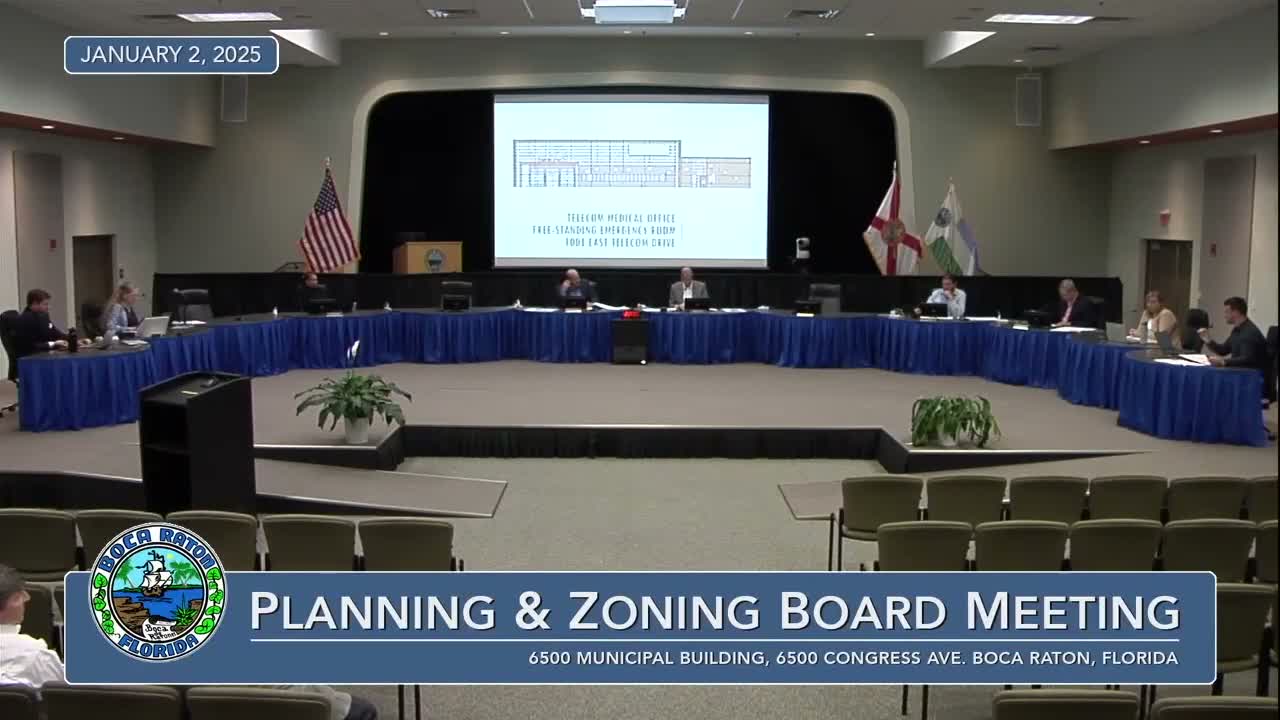
The Boca Raton Planning & Zoning Board approved construction of a freestanding emergency room (FSER) at 1001 East Telecom Drive on Jan. 2, voting 4–1 after an extended public hearing that centered on a requested technical deviation reducing total required parking from 120 spaces to 82.
Staff presentation: Owen Devlin, senior planner, said the applicant requested three technical deviations: a reduction from 120 to 82 parking spaces across the property, designation of nine reserved spaces for the existing office, and a reduced driveway reservoir distance. Devlin told the board staff supported the deviations because the FSER will operate 24/7 and could use the property’s parking outside traditional office hours.
Applicant and operator: Michael Marshall, counsel for the applicant, told the board the property owner will ground‑lease the building footprint to HCA, which will operate the emergency room under a hospital license. Industry representative John Sennett said FSERs nationwide typically record low ambulance volumes and lower parking demand than outpatient surgery centers. Marshall said the applicant used ITE (Institute of Transportation Engineers) rates and local observations to justify the reduction and offered to provide a shared‑parking analysis or site‑specific counts if the board wanted more data.
Public comments and concerns: Bonnie Miskill, representing the neighboring Boca Raton Innovation Campus, and traffic engineer Brian Kelly urged the board to require site‑specific parking counts rather than rely primarily on ITE rates. Kelly argued the ITE data for FSERs is limited (fewer sample sites) and that other local FSERs in Palm Beach County typically provide more parking than the 21‑space equivalent for the emergency component implied by the ITE calculation. Miskill said her client feared off‑site spillover parking and asked for assurances or conditions to prevent adverse impacts.
Board action and rationale: Board members split on the issue. Some said they were persuaded by the applicant’s data and the argument that nighttime and weekend office parking creates available capacity; others said they wanted more enforceable guarantees. The applicant offered to make a shared‑parking analysis or a post‑approval data submission a condition before building permits are issued. After debate the board voted 4–1 to approve the FSER and the requested technical deviations.
Why it matters: the decision approves Boca Raton’s first freestanding emergency room, which proponents said will increase emergency care access and reduce hospital ER load. Opponents warned the reduced parking could create spillover demand and asked for site‑specific evidence that the 82‑space total is sufficient.
Next steps: staff and the applicant said they could make a shared‑parking analysis or an equivalent data submission a permit condition; the board’s approval moves the project forward subject to the final conditions recorded in the resolution.