Get Full Government Meeting Transcripts, Videos, & Alerts Forever!
Get email alerts on the Coastal Variance topic
No spam. Unsubscribe anytime.
Boca Raton environmental advisory board declines to recommend CCCL variance for 2600 North Ocean Boulevard
Summary
After staff recommended approval with strict mitigation measures, the Boca Raton Environmental Advisory Board voted against recommending a coastal construction control line variance for a proposed oceanfront home at 2600 North Ocean Boulevard, citing remaining concerns about dune impacts, lighting and long‑term risk to nesting sea turtles.
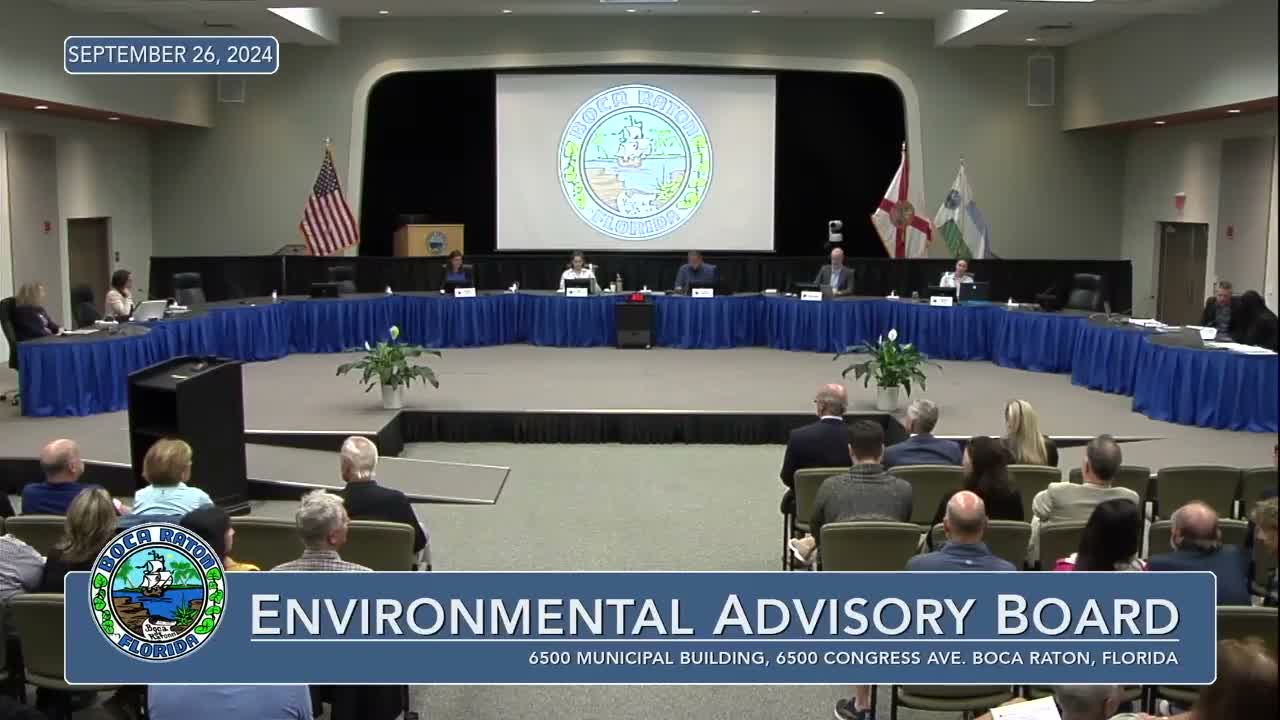
The Boca Raton Environmental Advisory Board on Sept. 26 heard more than three hours of testimony on a request to allow construction seaward of the city’s coastal construction control line at 2600 North Ocean Boulevard and declined to recommend approval to the city council.
Staff presentation and applicant rebuttal
Tamashbin Raman, chief planner with the city’s Development Services Department, told the board staff had reviewed a revised proposal for a single‑family residence seaward of the CCCL and recommended approval subject to detailed conditions, including a glazing limit with visible light transmittance no greater than 31 percent on north, south and east elevations, a required sea‑turtle lighting plan, biennial tree pruning plans, dune restoration and sequencing of construction to avoid nesting season. Raman said the site contains suitable sea‑turtle nesting habitat and the applicant had reduced the scale of a previously denied duplex application.
The applicant’s representative and engineer, William Stoddard, described the design as reduced from the prior application, elevated on piles to retain dune contours and accepting a range of post‑construction mitigation tied to the property in perpetuity. “We’re presenting our single family residence, which is 6,931 square feet, 31 feet tall, and we’ve reduced the glazing transmittance to 31%,” Stoddard said.
Neighbors and preservation advocates urged denial
Opponents — including neighbors and the Yacht and Racquet Club of Boca Raton — urged the board to deny the variance. Attorney Tucker Gibbs, representing the association to the north, read the city’s CCCL prohibition and cited state law on the public interest in preserving beaches and dunes, saying the applicant had not provided competent, substantial evidence to meet the six variance standards in the city code and urging the board to recommend denial. “For all those reasons, we urge you to think about what is being asked for here and deny the variance,” Gibbs said.
Nearby resident and association president George Salinger said placing the structure in the dune would endanger sea turtles and compromise dune vegetation, and other residents supplied photos and first‑hand observations of turtles nesting well into the dune area.
Applicant counsel frames legal and mitigation positions
Applicant counsel Robert Sweetapple argued the property owner has rights to reasonable residential use and stressed the project’s mitigation: darkened glass, rooftop pool, elevation on piles and extensive, continuing conditions tied to the property. “This is the most environmentally sensitive home to be built out of thousands that are built in the state,” Sweetapple told the board, urging a recommendation of approval with the proposed conditions in place.
Board deliberation and vote
During deliberations members debated whether the application met A–F of section 28.127.3 of the city code — special and unique conditions, causation, deprivation of rights commonly enjoyed by similarly zoned properties, minimum variance, non‑detriment to the public welfare, and consistency with the comprehensive plan — and discussed enforceability of ongoing conditions and the project’s long‑term risk from storms and sea‑level rise. Several members questioned whether keeping the dune profile and limiting glazing fully mitigated ecological impacts.
A motion to recommend approval of the CCCL variance was made and seconded; in the roll‑call votes board members Erica Allen, Rachel Bobich, Miss Forte and Chair Newman voted against recommending approval and the motion failed. The board therefore did not forward a positive recommendation to city council.
What comes next
Because the advisory board’s recommendation did not pass, the matter proceeds to the city council with a record of the hearing and the full administrative file. City staff and the applicant have indicated the project would require further state approvals, including from the Florida Department of Environmental Protection, prior to any building permit issuance.
The Environmental Advisory Board adjourned at 7:33 p.m.