Get Full Government Meeting Transcripts, Videos, & Alerts Forever!
Get email alerts on the Zoning Parking topic
No spam. Unsubscribe anytime.
Boca Raton council eases parking rules for most medical offices, keeps urgent‑care/ERs tighter
Summary
The City Council on Aug. 27 amended the zoning code to lower minimum parking requirements for most medical and dental offices to match general office rates, but kept higher minimums for outpatient surgery centers and moved urgent‑care/stand‑alone ERs into that higher‑parking category; the measure passed 5‑0 with staff promised to study clinics further.
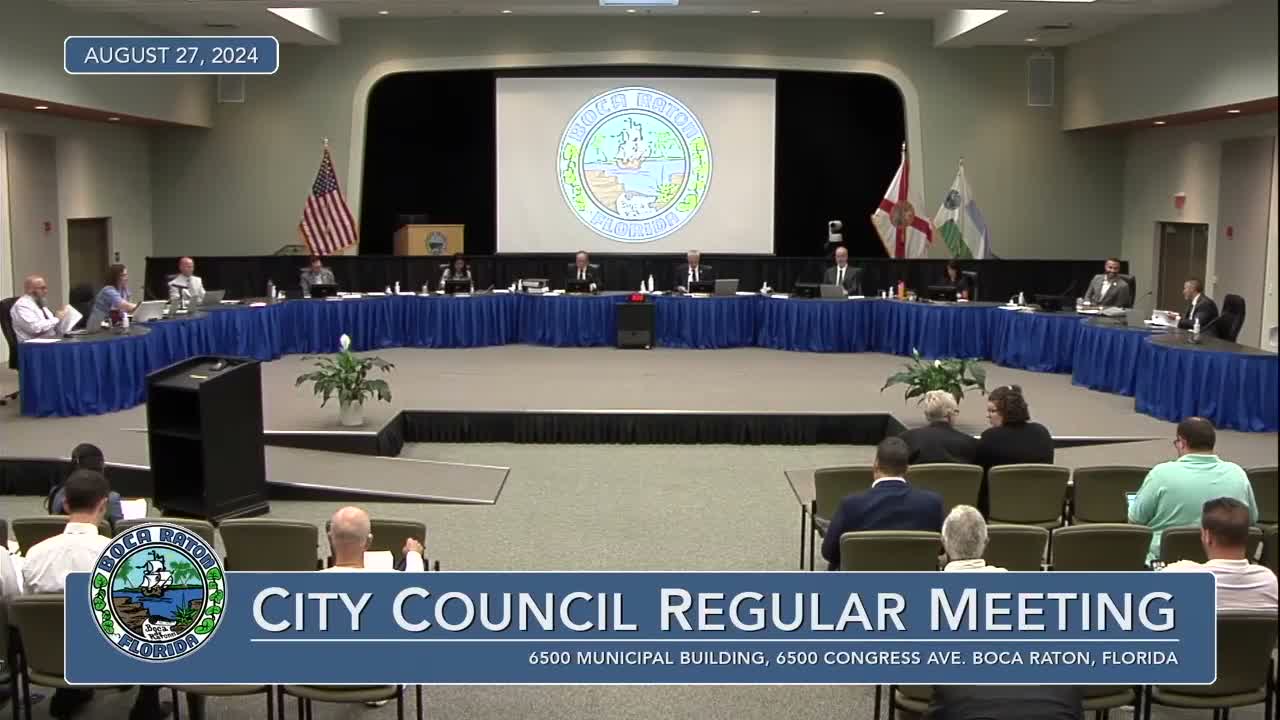
The Boca Raton City Council on Aug. 27 voted 5‑0 to amend the city’s off‑street parking rules so that most medical and dental offices will use the same parking ratio as general office space, while retaining stricter requirements for outpatient surgery centers and for urgent‑care and stand‑alone emergency rooms.
Zoning manager Tori Boone told the council staff recommended lowering the medical office minimum from one space per 175 square feet to one per 200 square feet for the first 4,000 square feet, matching general office rates. She said the change would allow medical tenants to lease space in existing office buildings more easily and advised a separate definition for outpatient surgery centers, which would remain at 1 space per 175 square feet.
Councillors debated whether urgent‑care clinics, medical clinics that perform frequent procedures, or stand‑alone emergency rooms should be treated like outpatient surgery centers. Council member Wigder argued his proposed amendment would exclude routine clinics from the heavier parking requirement while explicitly including urgent care and stand‑alone ERs in the outpatient‑surgery definition. ‘‘I think that’s a good compromise,’’ he said; the motion to adopt that change carried unanimously.
Residents who spoke during the public hearing urged caution on the outpatient surgery definition. Jonathan Unji said the definition could sweep in dermatologists and other practices that perform minor procedures and warned the term might be ‘‘slippery and unenforceable.’’ Staff replied they had included urgent‑care observations in their data review but had not studied stand‑alone emergency rooms because there are none in the city; development services director Brandon Shad said the code does not currently distinguish between a ‘‘medical clinic’’ and ‘‘medical office,’’ and creating a legal distinction would require additional study.
The council instructed staff to continue studying clinic and emergency‑room‑style uses and to return with additional data if needed. The ordinance as amended keeps outpatient surgery centers at the 1:175 ratio and reduces the minimum for other medical/dental offices to 1:200 (1:300 thereafter beyond 4,000 square feet); it also creates a definition for outpatient surgery center. The text amendment took effect as a code change once adopted.
Council members said the change is intended to encourage adaptive reuse of existing office space for medical tenants while preserving additional parking for the city’s most intensive surgical and emergency uses.
The council’s action followed a staff presentation and public comments and was approved 5‑0.