
Committee advances 5¢/gallon incentive for stations that add E15, with reporting requirement
Get AI-powered insights, summaries, and transcripts
Sign Up Free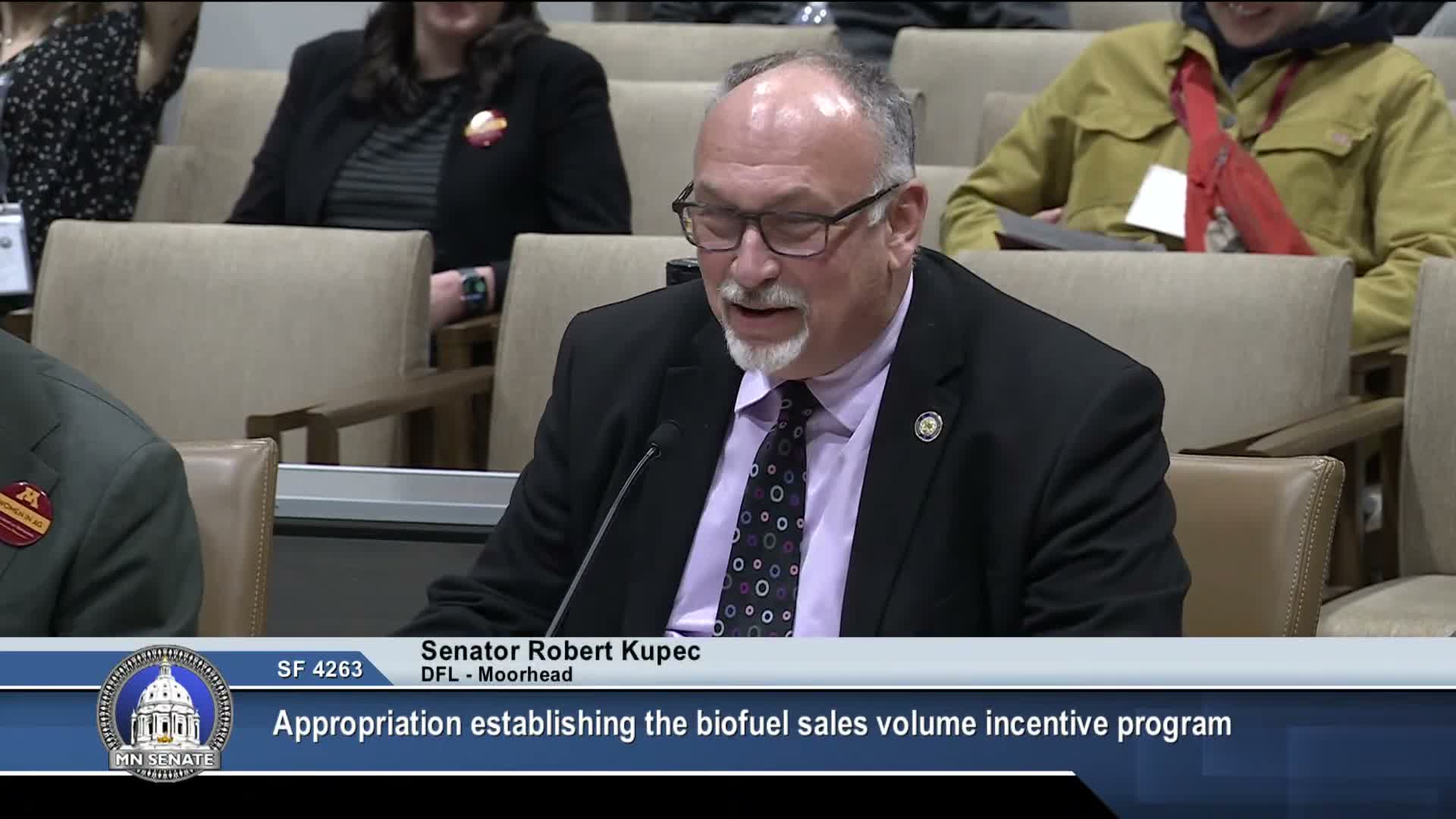
Summary
Senate File 4263 would create a state volumetric incentive to encourage retail availability of E15 (unleaded 88). The committee adopted technical and reporting amendments and laid the bill over for possible inclusion after industry witnesses described consumer savings and domestic supply benefits.
Senate File 4263, presented by Senator Kupak, would establish a Department of Agriculture sales‑volume incentive of 5¢ per gallon for retail stations that begin offering E15 (unleaded 88) after Jan. 1, 2027. The incentive is targeted at stations new to E15 and is capped at $50,000 per station per year; the bill carried a $5,000,000 appropriation placeholder and was described as first‑come, first‑served through 2032.
Industry witnesses testified in favor. Alex Chinnell, public policy manager at the Minnesota Corn Growers Association, framed higher ethanol blends as delivering lower carbon intensity and consumer savings. Brian Werner, executive director of the Minnesota Biofuels Association, and Patrick Hynes (representing POET) outlined state production capacity and noted the program’s precedent in other Midwestern states. Witnesses said E15 has consistently cost less than E10 and cited statewide station counts and sales volume to argue for growth potential.
Committee debate covered program scope, the A1 technical amendment (adopted) and an A2 amendment requiring basic reporting from participating stations to the commissioner and legislative leadership (adopted). The deputy commissioner said MDA needs flexibility to administer the program and would attempt to spread dollars to reach many stations; senators asked for guardrails to avoid "double dipping" with other infrastructure grants. Senator Kupak characterized the reporting change as friendly and helpful for data collection.
The bill as amended was laid over for possible inclusion; supporters said reporting will provide evidence of consumer savings and program uptake.
Next steps: Bill laid over; sponsors expect data returned through reporting and intend to work with MDA on administrative guidance.