Get Full Government Meeting Transcripts, Videos, & Alerts Forever!
Get email alerts on the Native Plants Restoration topic
No spam. Unsubscribe anytime.
Residents press Oro Valley planners to add restoration, ecological‑cycle protections for native plants
Summary
Participants asked staff to strengthen draft goals to include active restoration, protect full ecological cycles and prioritize removal of invasive species; staff said town lists for invasive/approved species exist and will be better publicized.
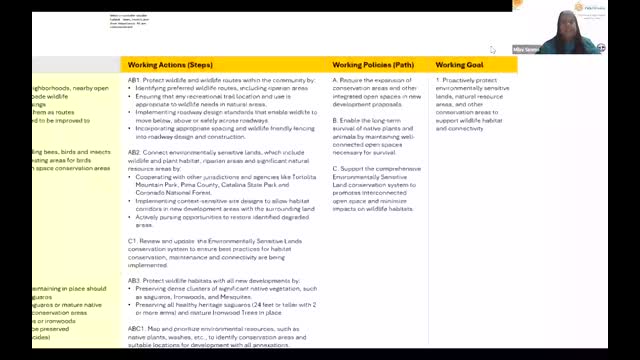
Residents at the working session urged the Town of Oro Valley to make restoration an explicit goal of the 10‑year plan and to protect native plants and whole ecological cycles rather than only preserving patches of vegetation.
"I think we need to add a verb in the working goals — proactively protect and restore," said one participant, urging the group to add wording to capture active restoration and long‑term removal of degraded areas. Multiple participants recommended naming protective examples (saguaro, ironwood, velvet mesquite) and ensuring policy language references ecological cycles so insects, soil and hydrology are considered alongside larger wildlife.
Concerns about invasive species and control methods arose repeatedly. A resident asked whether the word "preserve" implies avoiding pesticides in common areas; staff said pesticide limits for private property require additional research but that the town can model changes on town‑owned land. Staff also noted the town maintains lists of invasive species and approved native plants for developers and acknowledged that public promotion of those resources could be improved.
Participants suggested adding restoration planning actions (multi‑year work) to achieve permanent removal of invasives and recommended partnering with local conservation organizations and volunteer groups to implement habitat connectivity improvements. Staff agreed to incorporate stronger restoration language across duplicated draft sections and to include more explicit references to ecological impacts in subsequent revisions.