Get Full Government Meeting Transcripts, Videos, & Alerts Forever!
Get email alerts on the Housing Plan Review topic
No spam. Unsubscribe anytime.
Oro Valley residents review first-draft housing plan; group asks staff to rework manufactured-housing language
Summary
At a virtual Oro Valley resident working group meeting, staff presented first-draft goals, policies and actions for the town's 10-year plan. Participants broadly accepted the drafts but urged removing or heavily revising manufactured-homes language, clarifying apartment siting rules, and tightening design and implementation details.
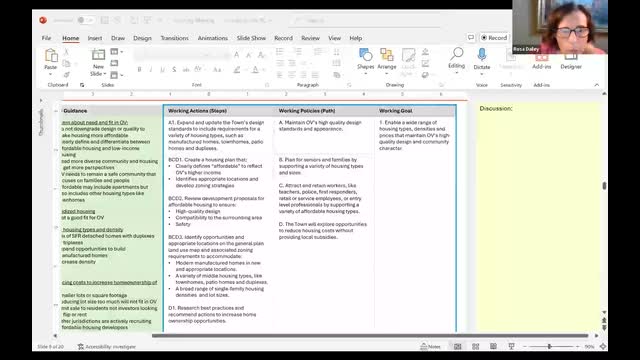
Malini Sims, a principal planner for the town of Oro Valley, opened a virtual resident working group session to review first-draft goals, policies and actions for the town's 10-year housing plan. Sims said the drafts are a first effort that will be refined and circulated for further review.
The meeting centered on whether to include manufactured homes in the town's action list. "Manufactured homes did come up at the very end of our conversation," Sims said, explaining staff was asking the group whether Oro Valley should explore them as a housing type. Multiple participants pushed back, saying manufactured homes risk poor fit with local design expectations and could undermine public approval of the plan.
"I think the manufactured homes probably isn't one we should look at," said participant Sue Allen, citing limited land and community preferences for single-family housing. Bayar Vela, the town's planning and zoning manager, explained the code currently restricts traditional manufactured homes to a single zoning district and that modern factory-built homes cover a broad spectrum: "there's this whole spectrum, really, really broad spectrum," he said, noting some factory-built homes can be as expensive as site-built houses.
Participants suggested two paths: remove manufactured homes from the actions for now, and ask staff to return with a refined proposal that defines the term, limits locations, and includes high-quality design standards if manufactured homes are later considered. Sims reported a clear leaning from the group toward removing the item in the present drafts and reworking it for future consideration.
The meeting also covered other elements of the housing strategy. Staff and residents discussed survey results and legal requirements; Sims said the town must address housing in its 10-year plan once its population reaches 50,000, a threshold Oro Valley is nearing. Sims also cited survey findings: roughly 60% of respondents indicated concern about housing costs, and about 8% identified a high need for manufactured homes — which staff noted translates to approximately 4,500 people in town.
Younger residents and a Chamber of Commerce representative described workforce housing needs, saying many local employees and small-business workers cannot afford current Oro Valley rents. "I currently am living with my parents in Oro Valley because I'm one of the folks that cannot currently afford to rent in Oro Valley," said a participant who identified herself as working with the Oro Valley Chamber of Commerce, urging more non-luxury apartment options and condos.
On the topic of apartments, staff recommended limiting 2'3 story apartment complexes to areas with access to shops, services and employment and keeping them away from existing single-family neighborhoods. The group debated language around separation: some participants wanted the draft to say "significant distance" to signal a strong buffer from single-family homes, while staff cautioned against too-specific numeric buffers in a 10-year guiding document. Hal, a participant, suggested "significant separation" as language that could include topographic buffers as well as distance.
Participants also discussed housing quality and appearance, noting that HOAs enforce standards variably and that the town has property-maintenance codes it can use. Staff outlined potential programs — such as code updates, targeted cleanup events, and volunteer-supported assistance — but said those actions have budget implications.
Sims closed by confirming staff will refine the drafts (including revised manufactured-homes language and clearer wording for apartment siting), circulate materials in advance of the next meeting (which will focus on transportation), and use a whiteboard workspace to improve legibility for participants.
The working group did not take formal votes on any ordinance or plan text; staff committed to return with revised language and additional data for further discussion.