Get Full Government Meeting Transcripts, Videos, & Alerts Forever!
Get email alerts on the Housing topic
No spam. Unsubscribe anytime.
Residents, planners debate "affordable" housing language as Oro Valley updates 10-year plan
Summary
At an Oro Valley community working meeting, planners and residents debated whether to keep the term “affordable housing” in the draft housing element and recommended reframing toward “attainable” and “adequate” housing options tied to housing choice and workforce needs.
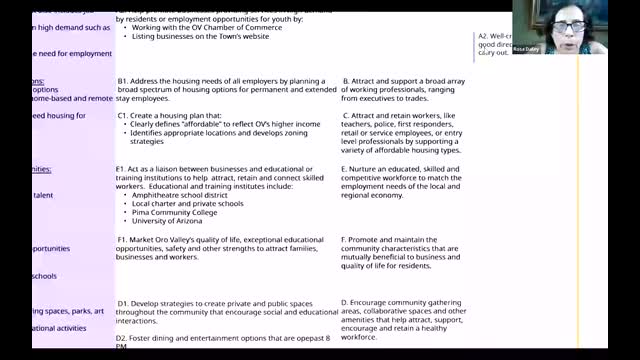
Malini Sims, the Town of Oro Valley’s principal planner, opened the online working-group session and asked participants to review draft goals, policies and actions for workforce attraction and the housing element.
The group spent substantial time on how the general plan should treat “affordable housing.” Resident Kristen said, “Affordable housing does not mean Section 8 housing. It does not mean subsidized housing, especially in Oro Valley,” and urged the group to treat affordability as relative to local incomes and housing types. Rosa urged the plan to reference the Oro Valley residential housing plan and its map, saying that document shows “about 3,000 units going in, approved, you know, and zoned,” so readers understand what housing is already in the pipeline.
Several participants cautioned that the town cannot mandate subsidized housing and that the plan should emphasize housing choice rather than a single affordability target. Hal, who participates in the housing group, said the draft should promote a broader diversity of housing types — including owner-occupied and middle-market units — because “when you create an environment that encourages more housing…the price comes down” through supply and demand. Bill and others asked for clarity on what “affordable” means in practice and warned that residents often equate the term with subsidized programs.
Sims told the group that state requirements require a housing element and related policies, which is one reason the topic appears in the 10‑year plan. She said detailed definitions and thresholds would be developed through specific actions (for example, action c1) and that the revised drafts would be circulated for additional wordsmithing. Participants agreed to consider alternative wording — including “attainable” and “adequate” — to reduce confusion.
The group also suggested practical complements to policy language, such as an education program for first-time buyers (to cover credit, down payments and settlement costs), and zoning strategies to identify locations appropriate for additional housing. Sims said those details would be developed further and shared across working groups.
The working group accepted the drafts as a starting point with the discussed edits and will reconvene; Sims said revised draft goals, policies and actions will be sent before the next session, scheduled online for April 9 from 05:30–07:30.
The working-group discussion was framed as a first draft review; no formal votes were taken and no mandates were adopted during the meeting.