Get Full Government Meeting Transcripts, Videos, & Alerts Forever!
Get email alerts on the Transportation Plan topic
No spam. Unsubscribe anytime.
Oro Valley workshop weighs memorial rules, e‑bike limits and transit options in draft 10‑year plan
Summary
At a March community workshop, Oro Valley staff and residents debated possible design standards for roadside memorials, whether to regulate e‑bikes on multiuse paths, and how to ‘optimize’ public transit options while balancing ridership and funding. Staff will revise draft language and pursue follow‑up work.
Malini Sims, principal planner for the Town of Oro Valley, convened a community workshop on March 24 to review draft goals, policies and actions for a 10‑year transportation plan and to get residents’ direction on next steps.
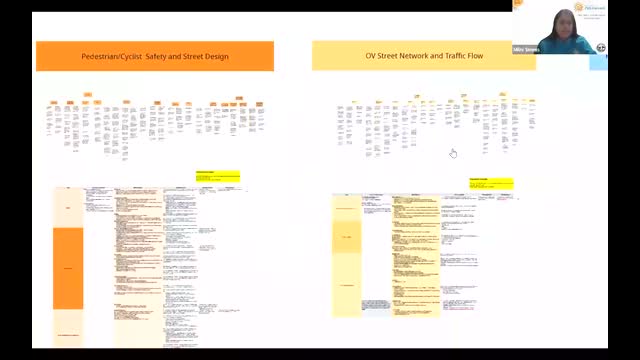
The session focused on pedestrian and cyclist safety, connectivity of multiuse paths (the “loop”), road and intersection timing and public transportation. Sims said the drafts reflect resident input collected over the last year and asked the advisory group whether the materials were “headed in the right direction.”
A central debate concerned roadside memorials. “I want them to be able to memorialize things...but I think there needs to be some kind of rules attached to memorials,” a resident said, urging size limits and design standards to prevent debris and driver distraction. Bayer Vela, planning manager, told the group that staff has not identified a “demonstrable safety issue” tied to past memorials but agreed to add design‑and‑positioning language to the draft so staff will “work on that as a project.” Town engineer Paul Keesler said the town makes safety‑based decisions when memorial elements create sight‑line hazards and described staff’s practice of consulting with families when roadway changes require moving memorials.
Participants raised safety concerns about electric bicycles. Committee members described a range of e‑bike types and weights and asked whether the town should restrict heavier, higher‑speed models on multiuse trails. Keesler noted an existing moratorium on electric vehicles on the path and encouraged the advisory group to coordinate with the trails master plan and neighboring jurisdictions so users do not face inconsistent rules when crossing borders.
On signage and facilities, residents recommended adding shade structures, benches and drinking fountains along high‑use paths to account for local heat and to improve the rider and walker experience. The group also favored consistent wayfinding and mile‑marker signage so loop users can locate parks and businesses.
Engineered guidance drew technical discussion: Keesler explained that the Manual on Uniform Traffic Control Devices (MUTCD) defines “bike lanes” as exclusive to bicyclists and recommended keeping “multiuse paved shoulders” where flexibility is needed for runners, pedestrians and other users rather than converting all shoulders to exclusive bike lanes.
Traffic‑flow conversations covered intersection timing and Oracle Road coordination. Keesler described level‑of‑service metrics and cautioned that optimizing throughput can conflict with safety; he recommended ongoing timing studies and coordination with county and state agencies for intersections that cross jurisdictions.
On transit, Sims noted the survey finding that 48 percent of respondents prioritized increasing public transportation options. Several members urged caution, saying fixed‑route service requires sustained ridership and funding; staff said Dial‑A‑Ride ridership is tracked and that SunTran will operate fixed routes if the town chooses to fund them or demand increases. Participants suggested the guiding principle be revised to “explore” or “optimize” transit options, with explicit language about evaluation and cost‑benefit analysis.
Sims closed saying the draft transportation goals, policies and actions are generally “headed in the right direction” and outlined next meetings: an online session April 3 and two in‑person land‑use map workshops April 14 and 17 (Town Hall), followed by an online wrap‑up on April 29. Staff will update wording to reflect tonight’s comments and return with refined language and follow‑up analyses.