Get Full Government Meeting Transcripts, Videos, & Alerts Forever!
Get email alerts on the Property Tax Assessment topic
No spam. Unsubscribe anytime.
Portland board denies homeowner's appeal of 1353 Westbrook Street assessment, 3-0
Summary
The Portland Board of Assessment Review voted 3-0 on March 10, 2026 to deny an appeal by the owners of 1353 Westbrook Street, finding the city's April 1, 2025 assessment of $569,200 supported by the assessor's methodology and comparable-sales analysis.
PORTLAND — The Portland Board of Assessment Review denied an appeal of the 2025 property assessment for 1353 Westbrook Street on March 10, voting 3-0 to uphold the city's valuation.
The property owners, identified in the record as Adam Pietropallo and his wife Michela Anderson, asked the board to reduce the assessed value. Pietropallo told the board he bought the home on Jan. 13, 2023, for $465,000 and anchored his case to that verified sale price. "I just can't imagine in the short ... time frame, it jumping 22% and actually being worth $569,200," he said during his closing remarks.
Board Chair Eric Larson and the two other members concluded the appellant had not met the legally required burden to show the assessment was "manifestly wrong." Larson moved to deny the appeal, a motion seconded and approved unanimously. The board directed its attorney to draft a written notice of decision for the chair to sign.
Why the board upheld the assessment
City Assessor Alisa Maher, a certified Maine assessor who described her qualifications in the hearing, explained that Portland's valuation used a cost approach supported by a sales-comparison component and neighborhood-level adjustments. She told the board that the assessment reflects values as of April 1, 2025 and that many of the sales the owner submitted were not sufficiently similar in style, grade, condition or neighborhood code to be reliable comparables for the Westbrook property.
"The market's been crazy," Maher said when describing market movement between 2023 and 2025, and she emphasized the assessment model applies factors such as style, square footage, grade and a CDU measure (condition, desirability and utility). She disputed several of the appellant's comparables as different in significant ways — for example, differing house styles, missing basements or sales tied to estates — and said those differences reduce their weight as evidence.
Evidence offered and the board's weighing of it
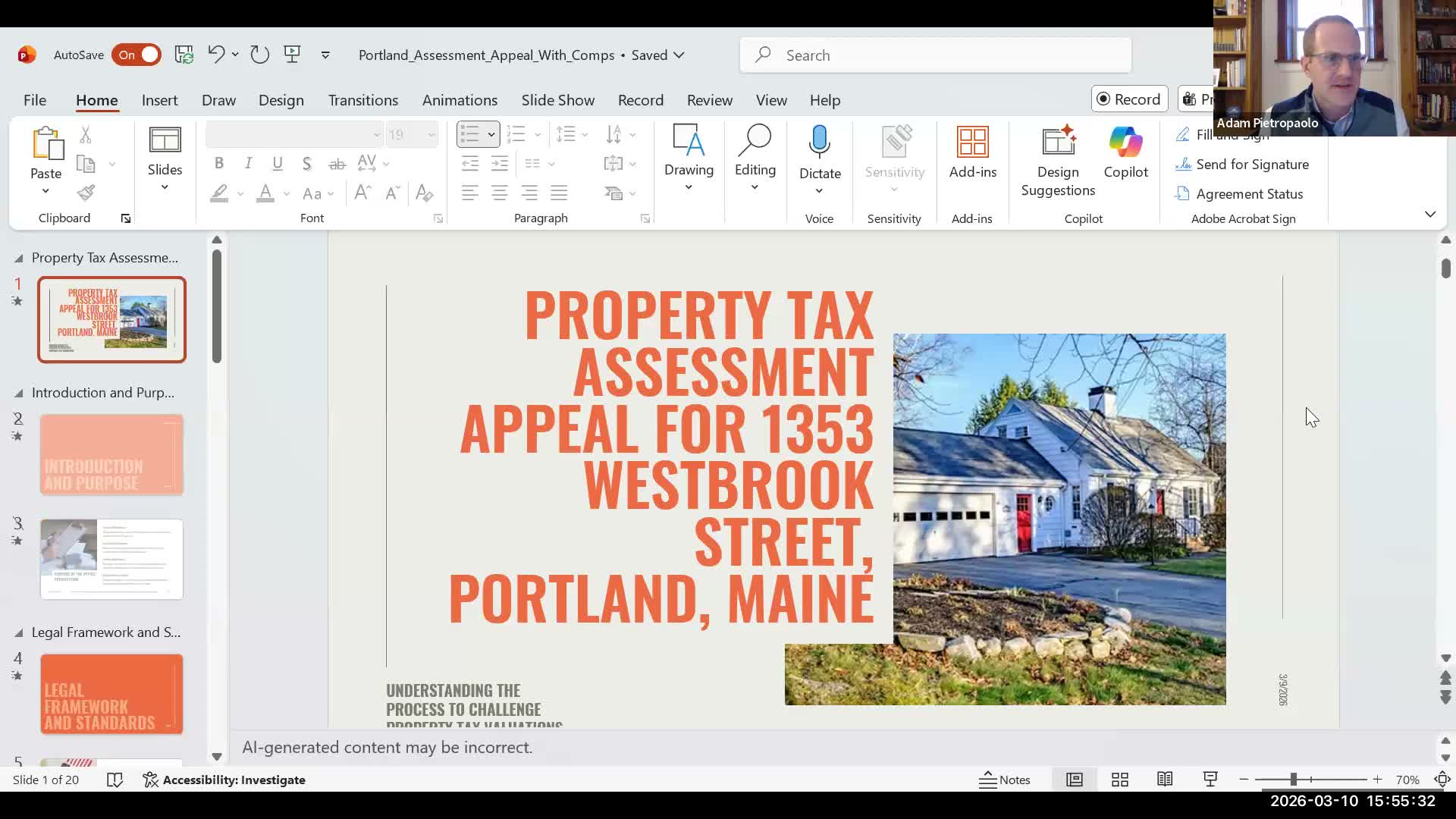
Pietropallo presented a PowerPoint that he said included comparable listings and calculations of percent differences between the sale price and the assessment. He said the comparable sales he found within the assessment window ranged roughly from $392,000 to $500,000 and asked the board to reduce the assessed value toward the sale price or to a compromise figure (his filings earlier listed $493,000 and a $500,000 figure as alternative proposed adjustments).
The board allowed Pietropallo to present the PowerPoint after debating whether it contained "new" information not previously filed. Chair Larson moved to admit the presentation while expressly allowing the city to request additional time to respond if needed; that procedural motion was seconded and approved before evidence proceeded.
Assessor Maher responded to the appellant's examples and explained how the assessing software and neighborhood coding produced the city's estimate. She also noted that the assessor's office did not routinely inspect backyards and would not have recorded some interior or nonvisible defects unless they were reported or observed during field work; she offered to review the property again if the owner would arrange access.
On specifics, the appellant pointed to condition issues (an aging roof, a prior basement flood, some electrical work) and to his insurer's replacement-cost figure of $483,600. The assessor acknowledged condition can affect grade and value but said the automated model and the comparable-sales analysis, applied with neighborhood adjustments, supported the $569,200 assessment as of April 1, 2025.
Board standard and final finding
Board counsel and members reviewed the controlling standard for an abatement appeal: the assessor's valuation is presumed correct, and the taxpayer bears the burden of proving the assessment is substantially overvalued such that an injustice results. After deliberation the board concluded the appellant's submissions did not rise to that standard. Member Lee Lowry announced his support for the assessor's valuation and the denial; Dale Knapp likewise said the appellant had not provided evidence sufficient to meet the manifestly wrong threshold.
The vote and next steps
The board voted 3-0 to deny the appeal. It also voted to authorize the board attorney to draft a written notice of decision consistent with the board's findings and to present that draft to the chair to sign. The board informed the appellant of his right to appeal the board's decision under the statutory process.
The meeting adjourned at about 5:43 p.m.