Get Full Government Meeting Transcripts, Videos, & Alerts Forever!
Get email alerts on the Utilities Tenant Protections topic
No spam. Unsubscribe anytime.
D.C. Council requires expanded tenant notices, reporting after DC Water shutoff concerns
Summary
After hearing that DC Water faces roughly $35.5 million in unpaid bills and that tenants in master-metered buildings have experienced unexpected shutoffs, the Council unanimously approved emergency legislation requiring improved notice to individual units (when practical), monthly reporting, and clarification of DC Water’s late-fee authority.
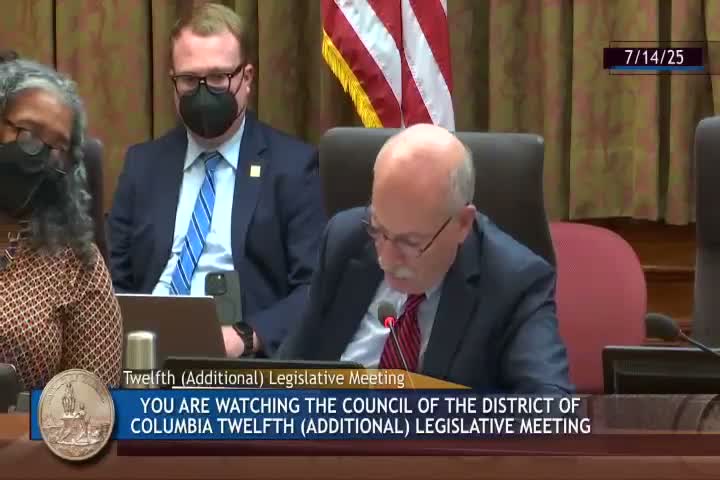
The D.C. Council unanimously approved emergency legislation on July 14 that requires DC Water to provide clearer notice to tenants in master-metered multifamily buildings and to report shutoff activity, responding to councilmembers’ concerns that some residents lose water service through no fault of their own.
Councilmember Charles Allen, who introduced the measure, said DC Water reported about $35,500,000 in unpaid water bills and that the authority’s recent collection efforts revealed tenants in master-metered buildings often do not know the building is in arrears until a notice or disconnection occurs. "DC Water has also shared that they are faced with $35,500,000 in unpaid water bills owed to it by rate payers," Allen said during debate.
Councilmember White framed the measure as a tenant-protection step: "Water is a basic human right. No one should be punished for bills that they don't control," she told colleagues while urging transparency and accountability from DC Water. The emergency act requires DC Water to post clear, multilingual notices, report monthly to the Council on shutoffs and impacts, and caps or clarifies late-fee authority that had been implemented administratively.
Councilmembers pressed several limits: multiple speakers noted that the Council’s ability to categorically prevent shutoffs is constrained by DC Water’s independent status and its bond documents. Allen said the emergency focuses on notice and transparency because the Council lacked a statutory mechanism to prohibit disconnections outright. An amendment accepted on the floor clarifies that DC Water must post 30 working days' notice at each unit in a multifamily building only if that unit is publicly accessible and individual posting is practical.
What happens next: The emergency act takes immediate temporary effect while committees pursue permanent statutory changes. Councilmembers said they will continue working with DC Water, tenant advocates and legal aid groups to develop longer-term solutions to reduce the risk of shutoffs for paying tenants.