Get Full Government Meeting Transcripts, Videos, & Alerts Forever!
Get email alerts on the Housing Policy Options topic
No spam. Unsubscribe anytime.
Oro Valley residents and planners weigh land trusts, annexation and zoning changes to expand housing options
Summary
At a town working-group meeting on Oro Valley's 10-year housing plan, participants proposed land trusts, annexation of state trust land, incentives for 'middle housing,' manufactured-home models and shared-ownership as potential ways to increase housing variety while maintaining local character.
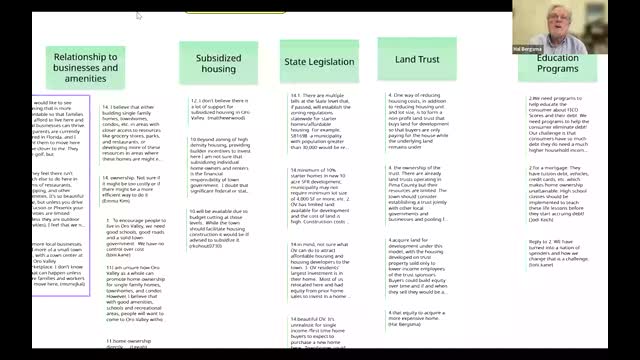
Participants and staff discussed a range of policy tools to expand housing variety without necessarily relying on traditional subsidized rental programs. Hal described one option in detail: "A land trust basically is an organization, a nonprofit that acquires land, and then builds on it and sells homes on that land only for the cost of the home, not for the cost of the land," which can reduce the purchase price by removing land cost from the sale price.
Several speakers raised annexation of nearby state trust land (north and west of the town) as a possible source of developable acreage if Oro Valley decided to grow its footprint. Don and others noted that land and construction costs — plus the limited remaining buildable acreage inside town limits — remain major constraints.
Staff (Planning Manager Bayar Bella) explained the sequence of decisions: annexation and rezoning happen before design and development review, and some sites already carry Pima County zoning that the town would inherit on annexation. Bella said the design conversation is where neighbors and the town can influence the look and placement of development even when land use was established previously.
Alternatives discussed included manufactured housing and "resident-owned community" models, where residents collectively own the land to limit space rent increases; Hal and Stephanie described models from other states and California where co-op approaches reduced monthly site costs. Participants also suggested incentives or percentage-based metrics to encourage developers to include townhomes, paired homes or three-bedroom townhomes suitable for families.
Several participants stressed design standards and careful siting to preserve Oro Valley's appearance: taller multifamily would be limited to certain corridors (participants suggested the west side of Oracle Road and near commercial centers), while many said 2–3 story garden or walk-up apartments are more compatible with local zoning than high-rise models common in larger cities.
Staff said tonight's input will be folded into draft goals and policy language for the March 20 meeting; no funding decisions or formal actions were taken.