Lifetime Citizen Portal Access — AI Briefings, Alerts & Unlimited Follows
D.C. Council approves extending home-purchase assistance to some transit workers after debate
Loading...
Summary
On Jan. 6, 2026, the Council passed Bill 20-698 to expand the Employee Home Assistance Program to include certain transit workers, amid debate over limited housing dollars and program capacity; proponents said the fund has unused capacity and would help recruit operators.
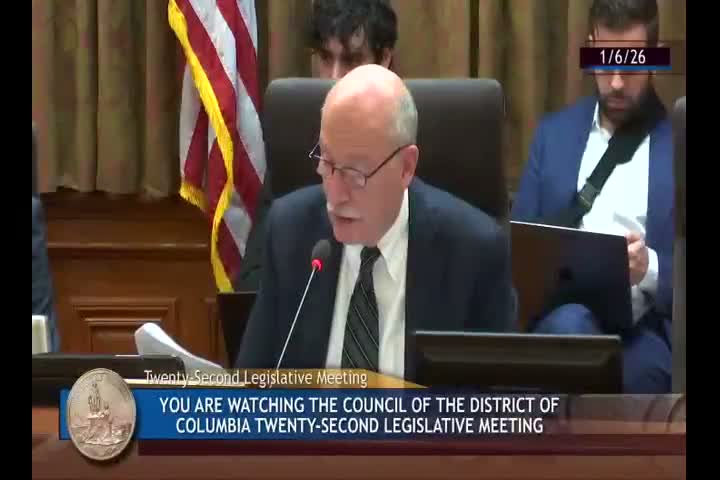
The Council of the District of Columbia voted Jan. 6, 2026, to approve the Home Purchase Assistance for Transit Workers Amendment Act of 2025 (Bill 20-698), extending the city's Employee Home Assistance Program (EHAP) to some transit employees. Supporters said the change will help recruit and retain bus and rail operators, while opponents warned it could divert scarce housing dollars.
Councilmember Robert White, who moved the bill, said EHAP currently has roughly $5 million allocated and that about half of that funding goes unused. "There are between 30,040 DC government employees. The amount we fund in EHAP is about $5,000,000. So roughly half of that goes unused," he said, arguing the program could absorb a limited number of WMATA employees without displacing other housing programs.
A council member opposing the measure cited competing demands for housing funds, saying expanding an incentive that primarily serves government employees to non-DC government workers would compete with programs such as emergency rental assistance and the Housing Production Trust Fund. The member noted an estimated $2,000,000 in unspent EHAP funds and argued those dollars could be redirected to other priorities.
Supporters pressed that WMATA and other transit agencies are vital to the city's functioning and that operator shortages have left service gaps. "There's a persistent ... shortage of bus and rail operators," one supporter said, citing recent reporting and on-the-ground service disruptions. Proponents framed the bill as a straightforward, targeted step to make living in the District more affordable for transit workers and to strengthen the local workforce.
Councilmembers asked for and received assurances from the bill's proponents that adding transit workers would not require diverting funds from other programs; proponents said the program has capacity and that any larger adjustments to housing funding should be made through the budget process.
The Council called the vote after more than an hour of discussion. The chair announced that "the ayes have it," and the bill was recorded as approved. During the vote sequence a member asked to be recorded as voting no.
The Council did not provide a detailed roll-call tally in the hearing transcript beyond noting that at least one member asked to be recorded as "no." The next procedural steps are the usual transmittal to the Mayor for signature and any implementation work by the relevant agencies to expand EHAP eligibility.
Why it matters: Council members framed the vote as a balance between two policy goals: maximizing scarce housing dollars for long-standing affordability programs and using targeted incentives to stabilize and recruit essential transit workers whose labor underpins daily city life.