Lifetime Citizen Portal Access — AI Briefings, Alerts & Unlimited Follows
D.C. Council approves emergency measures to make body‑worn camera footage and arrest documentation public when federal officers are involved
Loading...
Summary
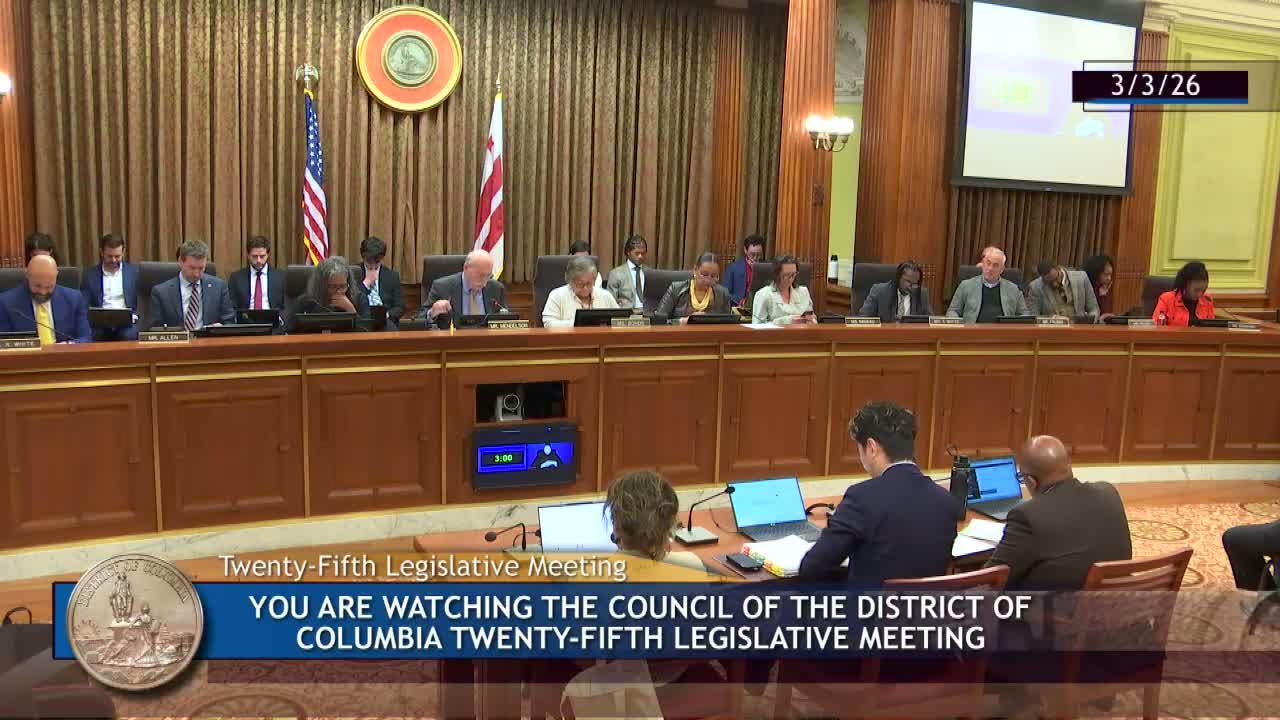
The Council of the District of Columbia unanimously approved emergency and temporary measures March 3 to require release of MPD body‑worn camera footage and to require MPD officers to document all law enforcement present at arrests, including federal officers; sponsors said the steps respond to community concern about federal operations in the city.
The Council of the District of Columbia on Tuesday unanimously approved emergency measures to increase transparency when Metropolitan Police Department officers are present during arrests or serious use‑of‑force incidents that also involve federal law enforcement.
Councilmember Pinto, chair of the Committee on the Judiciary and Public Safety, introduced an emergency body‑worn camera transparency bill that requires MPD to publicly release BWC recordings of officer‑involved deaths or serious uses of force when MPD officers are present alongside other law enforcement, and to list the names of directly involved officers when available. "DC residents deserve transparency about what is happening with federal agents in our communities," Pinto said, citing community testimony and two recent incidents in which HSI officers shot at residents.
The council accepted a technical amendment clarifying that the emergency measure applies retroactively to footage available since August 1, 2025, while ensuring that MPD officers will not be deemed out of compliance for conduct consistent with prior review practices. "We want to make sure that the other laws surrounding that review are not accidentally implicated," Pinto said during debate.
Separately, Councilmember Robert White moved the Full Accountability and Arrest Reporting emergency measure, which requires MPD to document the name, badge number, and agency of every officer present at an arrest and to include that information in arrest reports and probable cause affidavits. White said the reforms pair video transparency with stronger contemporaneous documentation so that accountability is not dependent solely on later releases of footage. "Accountability works best as a system, not in fragments," White said.
Several councilmembers described the bills as steps toward restoring trust after incidents in which federal officers used force and local reports did not reflect those uses. Councilmember Parker raised concerns that technical language should not be interpreted to shield misconduct, and Pinto and White said amendments were intended to prevent retroactive culpability while preserving transparency. "I just want to state my concern, that ... I don't want this amendment to be interpreted as a get‑out‑of‑jail‑free card," Parker said; Pinto and White said that was not the intent.
Both emergency declarations and the underlying temporary measures were approved unanimously. Councilmembers said they plan to pursue permanent hearings and legislation so the transparency and reporting requirements can be codified beyond the temporary and emergency measures adopted Tuesday.
The measures passed as emergency declarations and will be conformed into corresponding temporary amendments; sponsors said they will continue to work on permanent versions that expand data collection and clarify enforcement and reporting protocols.