
Committee hears bill to fund energy-code technical assistance; author lays bill over
Get AI-powered insights, summaries, and transcripts
Sign Up Free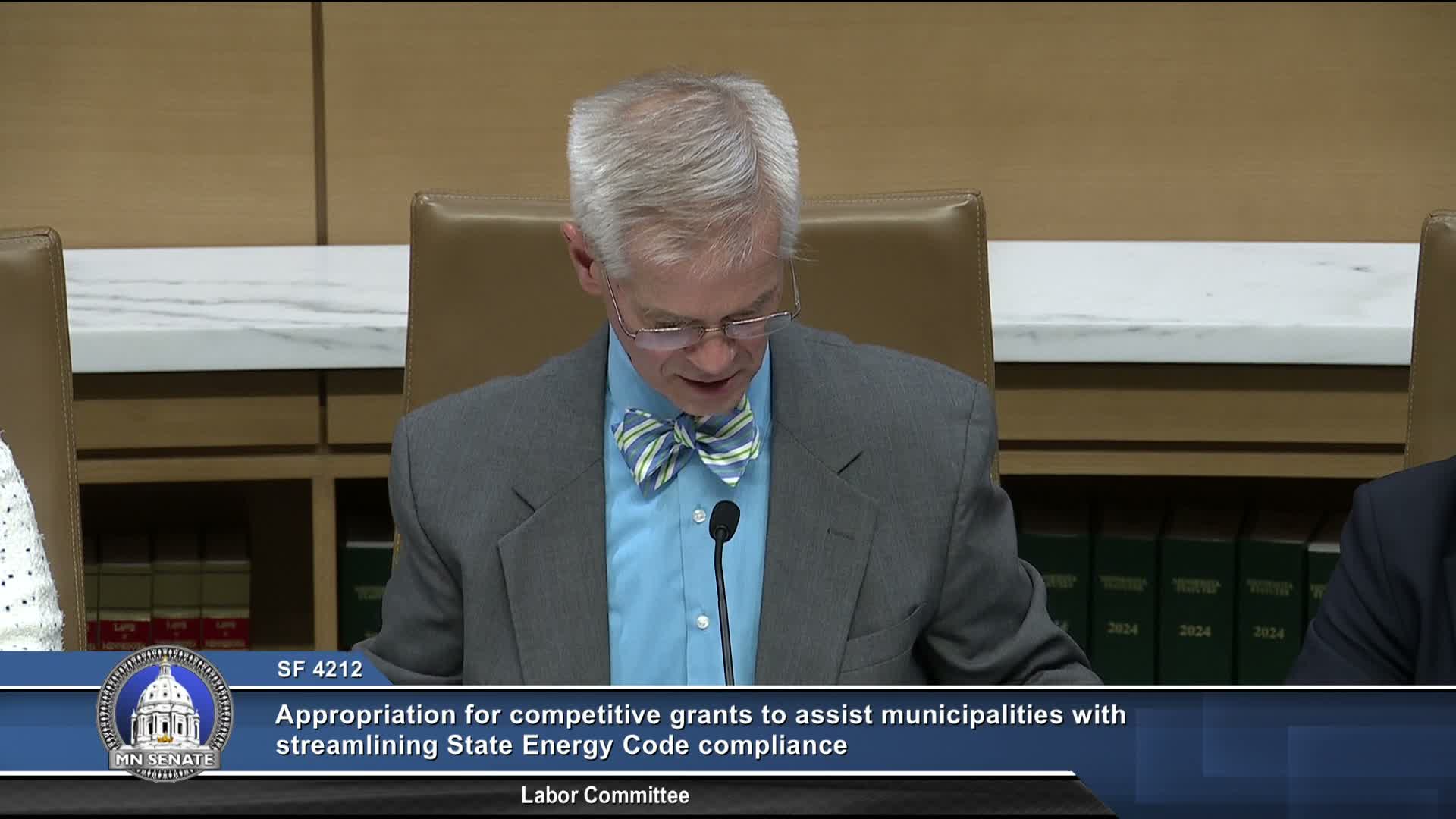
Summary
Senate File 4212 would create a competitive grant program (administered by the Department of Labor and Industry) to fund third-party technical assistance for local energy-code enforcement; the committee accepted an amendment clarifying eligibility and laid the bill over for further work.
Senate File 4212, which would create grants to help local jurisdictions and code officials meet evolving commercial building energy-code requirements, was presented to the Minnesota Senate Labor Committee and laid over for further consideration after committee members adopted an amendment clarifying grant eligibility.
Senator McKeown, the bill sponsor, said the grant program would make technical experts available to municipalities to review performance-based energy models, conduct inspections and provide training. "Our solution is...to make technical assistance more readily available," the sponsor said, noting that performance-based pathways require specialized building-science skills.
Megan Hoye, director of climate equity action for the City of Minneapolis, told the committee that municipalities need support to implement newer energy code approaches and listed letters of support from several cities. "This bill and the proposed grants will help to close these gaps," Hoye said, noting that past federally funded services are no longer available to provide the same level of support.
Will Nissen, director of policy at the Center for Energy and Environment, said the bill would provide municipalities the expertise necessary to determine compliance for new construction and major renovations using performance-based standards.
Senator Kupak offered an A1 amendment to clarify that eligible entities include jurisdictions that have adopted the state building code; Senator McKeown accepted that amendment as friendly and the committee adopted it by voice vote.
Members questioned grant size and distribution—committee remarks noted a one-time appropriation of $1,000,000 in committee discussion—and whether grants would pay third-party providers that serve multiple jurisdictions. Josiah Moore, legislative director at the Department of Labor and Industry, said DLI would administer a competitive grant program and that there is precedent for using third-party vendors to spread services across regions.
Committee members also discussed whether municipal adoption or local enforcement of the state code affects eligibility. DLI staff clarified that the state sets the code and municipalities adopt enforcement ordinances; some jurisdictions enforce locally while others rely on state inspectors.
Senator McKeown asked to lay the bill over for further discussion and technical cleanup; the committee agreed. Sponsors and agency staff flagged the need to clarify applicant eligibility and implementation details before the bill returns to committee.
Notes: The bill centers on implementation support rather than a change to code standards; the committee did not vote to advance the bill to the floor at this hearing.