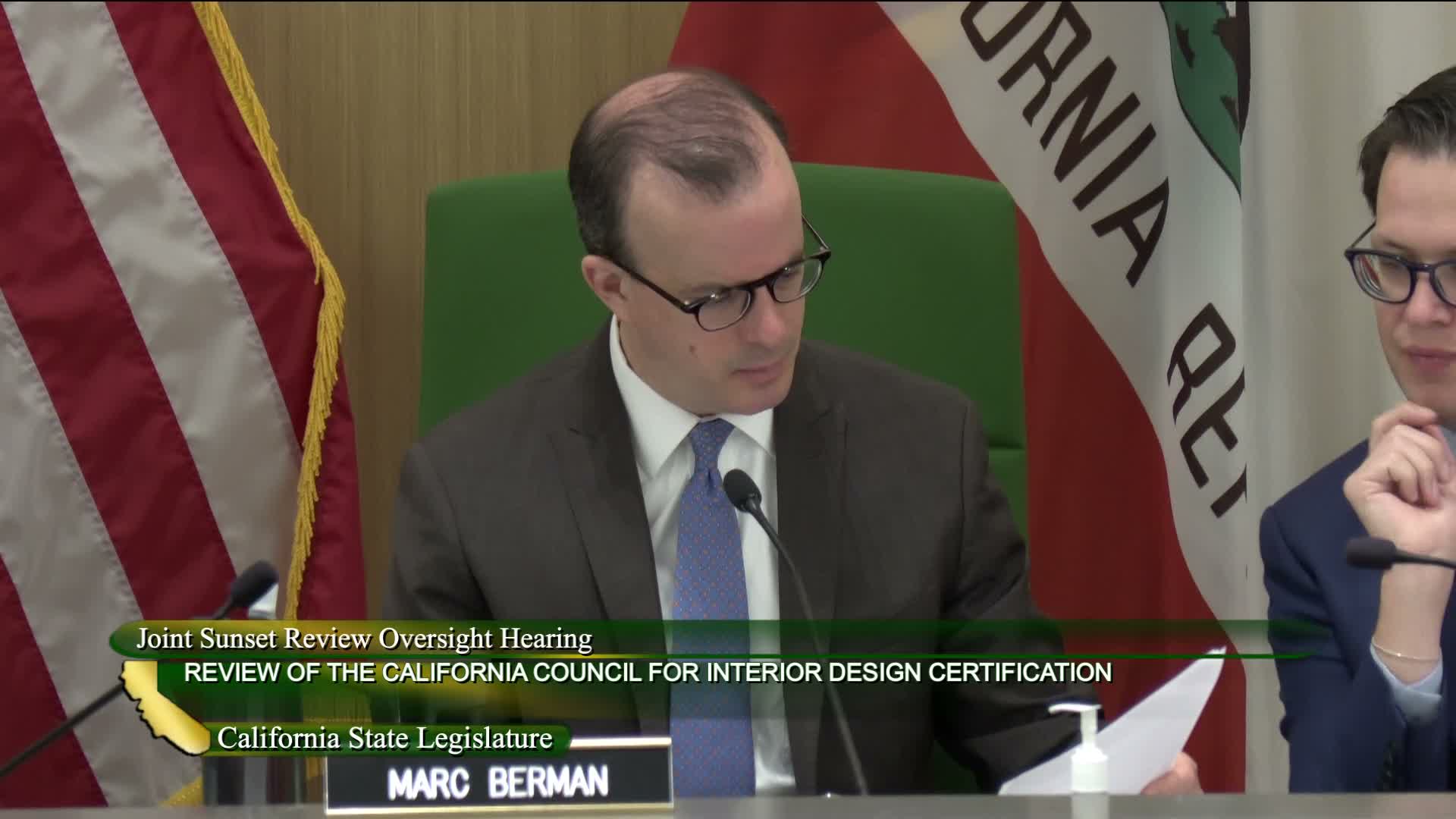
Interior Design Council Argues Voluntary Certification Works as Lawmakers Question Transparency and Stamp Acceptance
Loading...
Summary
The California Council for Interior Design Certification told legislators that voluntary certification protects public safety and that licensure would create workforce barriers; lawmakers and practitioners pressed the council on plan‑check denials, Bagley‑Keene compliance and the council's private nonprofit structure.
George Brazil, chair of the California Council for Interior Design Certification (CCIDC), told joint committees that California has chosen a voluntary certification model for interior designers that emphasizes demonstrated competency, California‑specific code knowledge and a certification exam.
"From my perspective, this system is working," Brazil said, arguing that licensure would create immediate disruption and barriers for experienced practitioners who do not meet a proposed licensure threshold.
Executive director Rose Wiebe added that CCIDC has operated for decades under a title‑act model, tracks complaints and enforces a code of ethics for certified designers. She said reported complaints are minimal and that the organization operates with public meetings and a certification framework intended to protect health, safety and welfare.
Committee members questioned whether a voluntary system can reliably produce consistent enforcement and plan acceptance. CCIDC told the committee it tracks plan‑check denials and that training or misinterpretation by local building departments often explains denials — citing 16 plan‑check denials in the last four years, 14 of which were resolved favorably or remain in process.
Members also raised transparency concerns. Vice Chair Johnson asked whether CCIDC’s 100% virtual meeting practice during and after the COVID pandemic complies with the Bagley‑Keene Open Meeting Act; CCIDC said it would review and make adjustments as needed but noted that virtual meetings substantially increased public participation.
Practitioners offered competing views in public comment: some, including Janice Plasus and Linda Panattoni, supported continuing the voluntary model as proportionate and effective; others, including designer Bonnie Perry and early‑career practitioners, described instances where CID stamps were not accepted at plan check, leading to project delays and increased costs for small businesses.
Why it matters: The debate touches on professional mobility, small‑business costs, local building department practice and what standard (certification vs. licensure) best ensures public safety without unduly limiting practitioners.
Next steps: Legislators indicated an interest in additional data about plan‑check outcomes, the commercial designation, compliance with Bagley‑Keene, and continued consultation with CCIDC and local jurisdictions; no legislative action was taken at the hearing.