Get Full Government Meeting Transcripts, Videos, & Alerts Forever!
Get email alerts on the Technology Synergy topic
No spam. Unsubscribe anytime.
Trustees press district technology leaders and Synergy vendor after scheduling outage
Summary
At the Aug. 8 Pleasanton Unified board meeting trustees pressed district technology staff and the Synergy vendor over a scheduling outage and reports of double student schedules, lost teacher seating charts and other user problems after a July 23 SIS go‑live; staff promised training, help‑desk tracking and a vendor review.
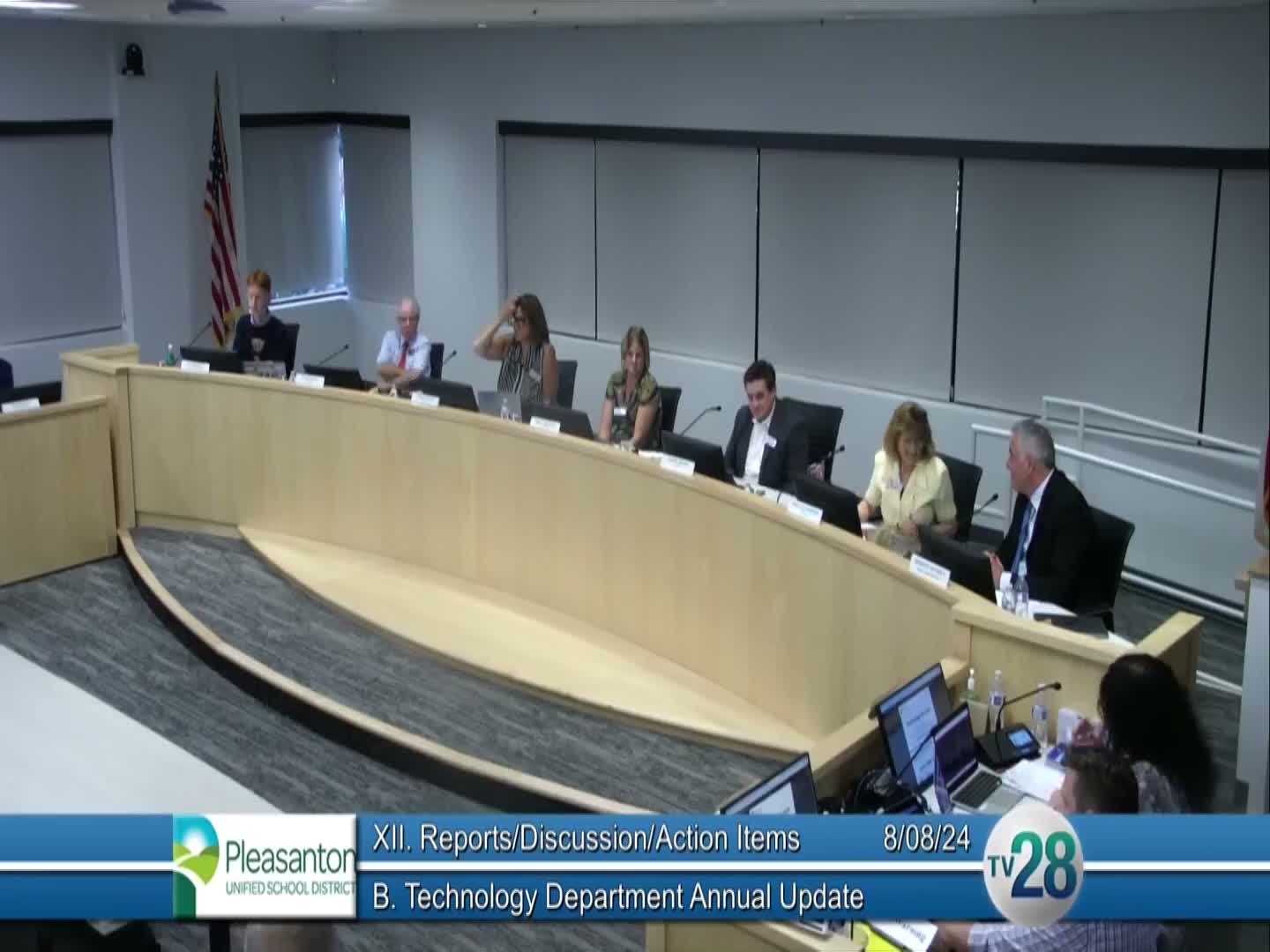
Pleasanton — Trustees spent much of the Aug. 8 board meeting pressing district technology staff and the Synergy vendor after a scheduling outage and parent reports that some students were shown double schedules.
"At what point do we say we made a mistake with Synergy?" Board President Mary Jo Carrion asked during an extended exchange that also included Trustee Justin Brown and Chief Technology Officer Robert Torres. The board raised multiple examples of operational disruption, including teachers who reported losing seating charts and parents who saw conflicting schedules in ParentVUE.
The district’s CTO, Robert Torres, said the vendor-hosted system experienced a server CPU lockup the night schedules were released; an automatic scaling mechanism that should have increased capacity did not activate. Torres told trustees that the district logged 11,000 successful parent and student sign-ins in the first hour and that the vendor has been asked to increase cloud resources and provide a more resilient configuration. "We did put some practices in place," Torres said, describing conversations with the vendor and short-term mitigations.
Trustees pressed for accountability and for steps to ease the rollout. Several trustees described teachers spending hours re-creating seating charts or manually correcting schedules; Trustee Justin Brown and others urged the district to gather user feedback and ticket data and to demand technical fixes from the vendor’s leadership. Superintendent Maurice Geisels called the outage unacceptable and said the district is pursuing remedies with the vendor. "That thing that happened Tuesday night should not have happened," Geisels said.
Torres outlined the district’s immediate steps: add help‑desk capacity and office hours, conduct targeted training for registrars, counselors and teachers, adjust capacity with the vendor to avoid repeat outages at high-demand moments, and continue a phased plan to improve application proficiency over the next two years. He said the district budgeted $160,000 annually for the basic Synergy SIS package and an optional 504 module at roughly $12,000 a year.
Board members and staff also flagged longer-term work: a structured root-cause review with Synergy, a request for a vendor deep dive on auto‑scaling and failover behavior, and a formal evaluation timeline tied to the district’s five‑year contract. Several trustees urged the district to collect and present median time‑to‑resolution for help‑desk tickets and other customer-satisfaction metrics at future meetings.
What’s next: staff said they will return with consolidated help‑desk data, examples of systemic failures versus training gaps, and a plan for vendor engagement and remediation. Trustees said the district should be prepared to reassess the vendor relationship when they reach the contract review point in year three.