Get Full Government Meeting Transcripts, Videos, & Alerts Forever!
Get email alerts on the Noise Control topic
No spam. Unsubscribe anytime.
Council narrowly adopts Residential Tranquility Act after debate over dispersal orders and protests
Summary
The D.C. Council approved the Residential Tranquility Amendment Act to limit amplified overnight noise directed at residences, rejecting an amendment that would have explicitly required dispersal orders before arrests and drawing extended debate about enforcement and free‑speech boundaries.
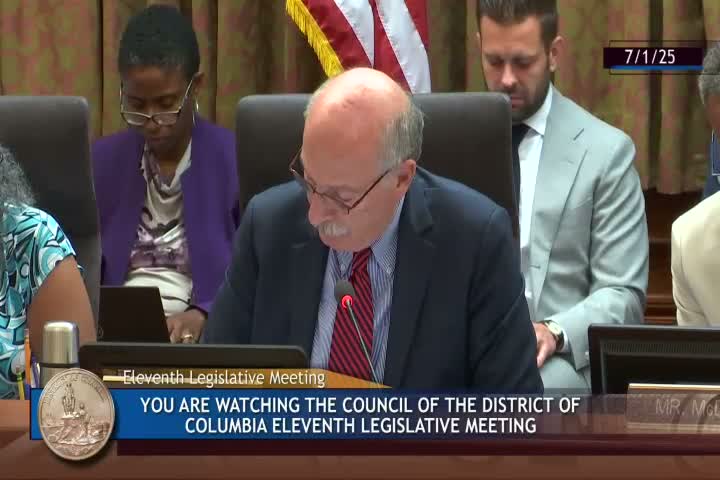
The Council on July 1 adopted the Residential Tranquility Amendment Act, a narrowly drawn measure targeting the use of amplification devices to target individual residences overnight. Sponsor Councilmember Brooke Pinto and other supporters framed the bill as a response to sustained, targeted amplified protests in residential neighborhoods.
Chair Phil Mendelson described visiting a demonstration in Kalorama and said a decibel reading on his phone measured "128 decibels at the source," arguing the level was far above thresholds that harm hearing and that the measure was aimed at preventing amplified audio targeted at households. "This bill is about residential tranquility," Mendelson said on the dais.
Councilmember Nadeau proposed an amendment to require that police follow dispersal‑order procedures and provide warnings before arrests; supporters of the amendment argued it would ensure the First Amendment dispersal rules are followed in these enforcement situations. Sponsors and other members countered that dispersal procedures already exist in Title 5 and that adding a new standard could be duplicative or confusing. Nadeau's amendment failed on a voice vote after a disputed request for a roll call.
After extensive debate about civil‑liberties safeguards and enforcement practices, the council approved the permanent and emergency versions of the measure. The emergency declaration and the underlying emergency bill passed with Councilmembers Nadeau and Parker recorded as voting no on one recorded voice vote, according to the secretary's notes; other floor votes were completed by voice vote.
Supporters emphasized the bill's limited scope — targeting amplified noise aimed at residences during specified hours — and stressed it was not intended to shut down legitimate demonstrations. Opponents said the measure risks chilling lawful protest and urged the council to rely on existing police enforcement powers.
The council adopted the measure and moved the emergency declaration to preserve the law’s immediate effect while the permanent text is finalized.