Get Full Government Meeting Transcripts, Videos, & Alerts Forever!
Get email alerts on the Public Health Budget topic
No spam. Unsubscribe anytime.
Health department seeks to restore immunization fund and requests ARPA projects as HIV prevention questions rise
Summary
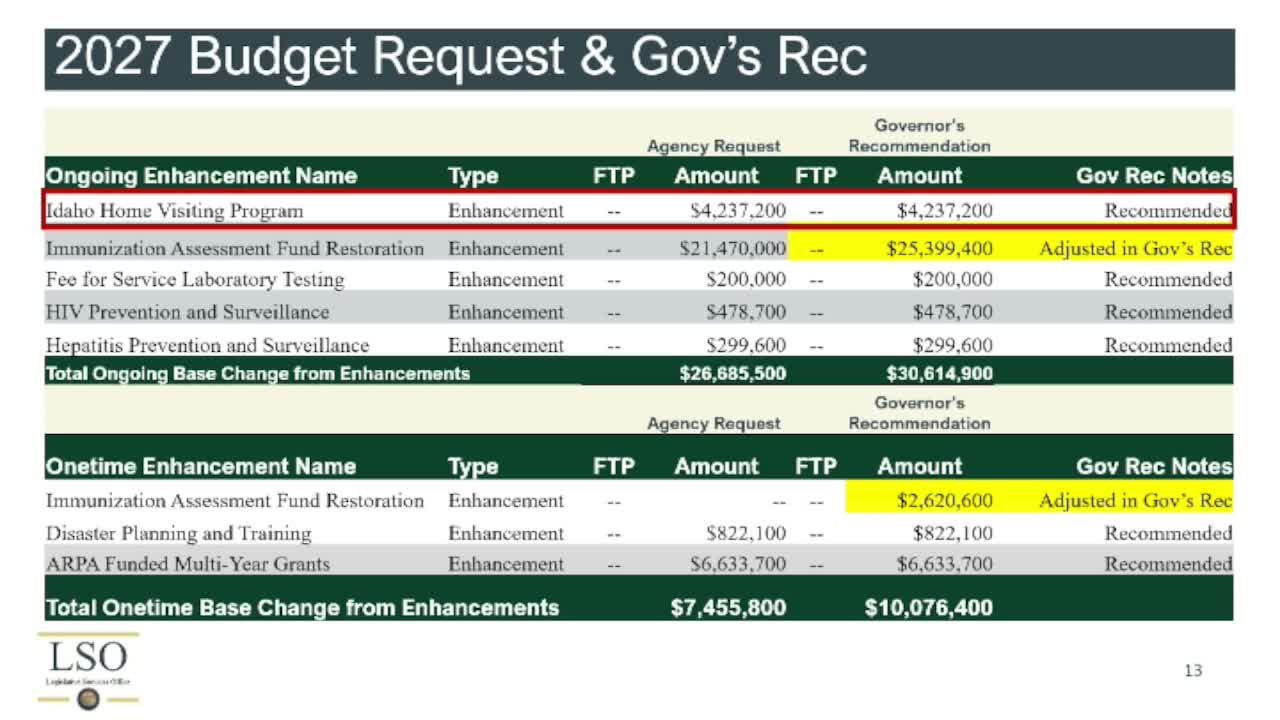
The Department of Health & Welfare requested restoring the immunization assessment fund to about $25.4M, continued federal support for HIV and hepatitis prevention, and one‑time ARPA funding for data modernization; lawmakers asked for clearer outcome metrics after reports of an HIV uptick.
The Department of Health and Welfare asked the Joint Finance‑Appropriations Committee to restore and increase the immunization assessment fund and to authorize a set of federal and one‑time ARPA projects aimed at public‑health infrastructure and prevention programs.
Morgan Paloney, a Legislative Services Office analyst, said the governor’s recommendation increases ongoing immunization assessment funding to $25,399,400 based on the Idaho Immunization Assessment Board’s determinations, and recommended one‑time dedicated spending authority to cover existing provider expenses.
The department also proposed ongoing federal funds—about $478,700 for HIV prevention and surveillance and $299,600 for hepatitis C prevention—to expand screening, prevention outreach and linkage to care. Director Juliette Sharon told the committee that the state is observing a growth trend in reported HIV cases and noted Idaho’s per‑capita incidence is higher than the national average.
Representative Harris and other lawmakers pressed the department for performance metrics, asking whether prevention spending is producing measurable reductions in new infections. Sharon acknowledged an uptick in cases and said the funds support prevention, education and screening rather than treatment; she added the department is revamping how it tracks and reports outcome measures and offered to supply additional data to the committee.
Paloney and Sharon also described one‑time ARPA projects (about $822,100 and larger ARPA multi‑year grants totaling $6,633,700) for disaster planning, data modernization (including an updated vital‑statistics registry and online enrollment for the WIC program), and other time‑limited initiatives. Sharon said most ARPA funds will be exhausted in calendar year 2027, and that the projects were designed so that core improvements would be transitioned to the agency’s base funding where possible.
Senators asked about privacy protections for public‑health surveillance; Sharon cited federal HIPAA protections and offered program‑level security protocol follow‑up. The department said many public‑health functions rely heavily on federal grants and that loss of federal spending authority would eliminate numerous services.
Committee members requested follow‑up on HIV outcome metrics, a breakdown of ARPA projects and timelines for transitioning one‑time projects to ongoing support.