Get Full Government Meeting Transcripts, Videos, & Alerts Forever!
Get email alerts on the Public Health Corrections topic
No spam. Unsubscribe anytime.
Hepatitis C fund near depletion; DOC to bill medical appropriation if dedicated funds run out
Summary
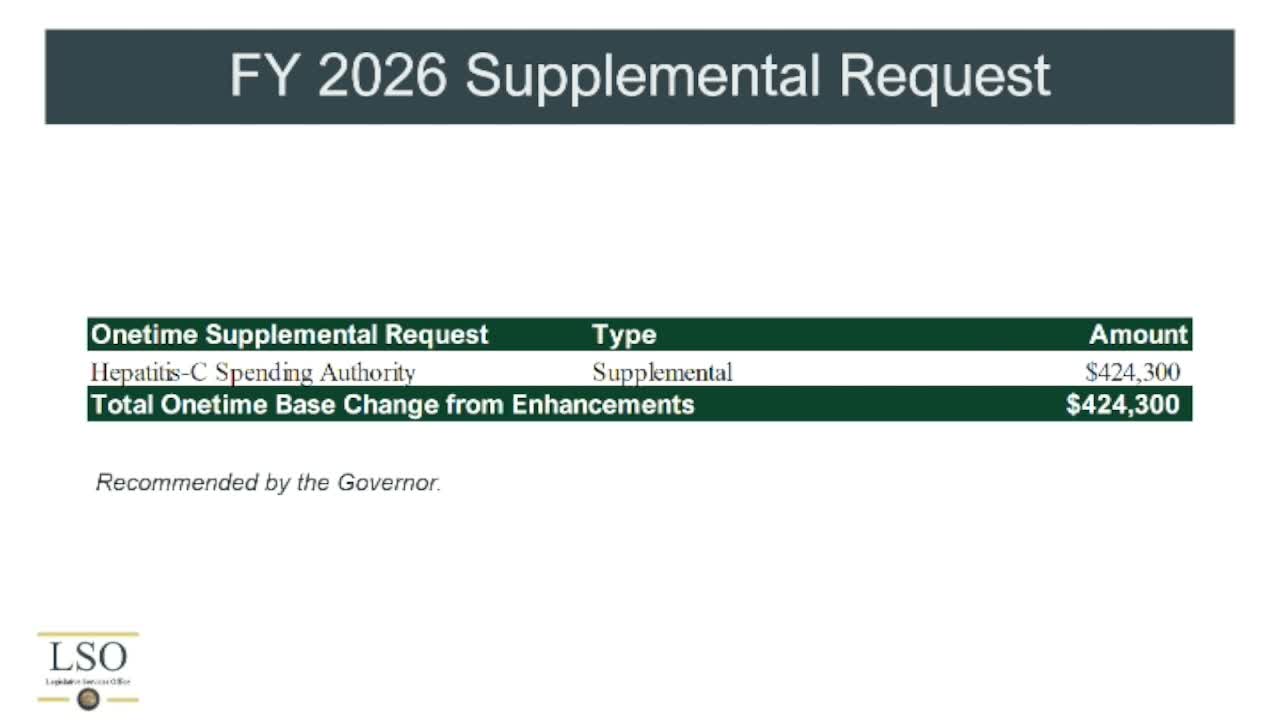
LSO and DOC told lawmakers the Hepatitis C Fund (seeded by 2022 legislation) had an FY25 cash balance of about $393,000 and a projected expendable amount of $424,000; any treatment costs beyond that would shift to the department's medical services appropriation.
Noah Peterson told the committee that the Hepatitis C Fund originated with Senate Bill 1420 (2022) and received a $12 million transfer into a dedicated fund that can be used only for Hepatitis C treatment in accordance with the Attorney v. Atencio settlement. Peterson said the FY25 ending cash balance for the fund was $393,000 and, after projected interest, the fund could expect about $424,000 to expend.
Peterson said reappropriation authority for FY26 was not requested last year because of analyst oversight and agency fiscal turnover; the department is requesting a FY26 supplemental and reappropriation authority for FY27 to spend any unspent balance. "It was an oversight," Peterson said, describing the missed reappropriation request.
Director Bree Derek clarified that once the Hepatitis C Fund is exhausted, Hep C treatment costs would be charged to the medical services division appropriation (general fund) and, separately, that the department has implemented awareness campaigns and free testing in facilities to reduce spread, which Derek said is primarily driven by illicit tattooing and needle sharing.
Why it matters: the fund was created to ensure treatment tied to a court settlement; depletion or lapses in reappropriation authority change how those treatment costs are financed and could affect the medical services contract and general‑fund outlays.